Smaller, faster, safer: running Kimi and GLM at scale
blog.cloudflare.com
August 3, 2026
7 min read
🔥🔥🔥🔥🔥
61/100
Summary
Workers AI runs inference for Moonshot's Kimi K-series and Z.ai's GLM models on GPUs in Cloudflare data centers. These models are large, long-context, and mixture-of-experts types, presenting challenges in efficient serving due to memory constraints.
Key Takeaways
- Cloudflare uses quantization techniques to optimize the KV cache for long-context models, increasing memory capacity from 686,000 tokens to 1.37 million tokens without affecting model accuracy.
- The KV cache is stored in 8-bit floating point (FP8) instead of 16-bit (BF16), allowing for higher concurrent request handling and reducing costs by approximately 30% per token.
- Model weights for GLM 5.2 are compressed from 8-bit floating point to 4-bit integers, reducing the model size by about 40% and decreasing per-GPU memory usage significantly.
- Cloudflare benchmarks indicate that performance between FP8 and BF16 KV caches is indistinguishable in terms of model accuracy across various evaluation suites.
Community Sentiment
Positives
- Nice to see a provider being transparent about KV cache quantisation — transparency is key in a field where subtle changes can make or break performance.
- The claim that FP8 KV quantisation can deliver meaningful latency and capacity gains with negligible accuracy loss is a promising development in model efficiency.
Concerns
- The benchmarks used to assert that FP8 KV quantisation is indistinguishable are lacking, especially since they omit critical coding benchmarks that could reveal serious issues.
- Serving quantized models without clearly stating it feels deceptive, especially when the impact on coding agents could be significantly negative.
Related Articles
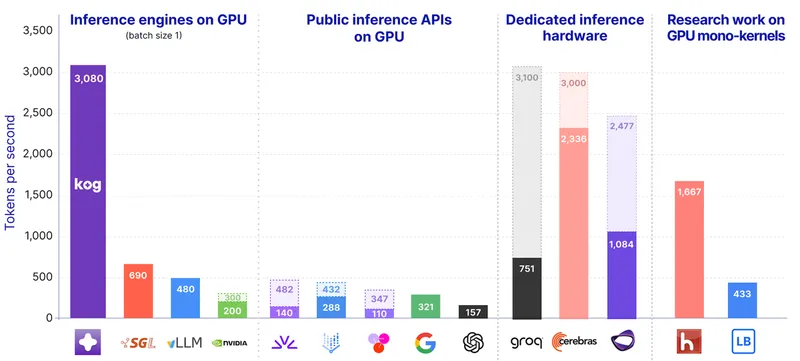
Real-time LLM Inference on Standard GPUs: 3k tokens/s per request
May 29, 2026

A 10 year old Xeon is all you need
Jun 1, 2026
Running a One Trillion-Parameter LLM Locally on AMD Ryzen AI Max+ Cluster
Mar 1, 2026

Performance per dollar is getting faster and cheaper
Jul 3, 2026
Local Qwen isn't a worse Opus, it's a different tool
Jun 18, 2026