Report · dreamgroup.com
Chained PHP2Shell Exploit Roots 25 Servers, Including US Government Servers

dreamgroup.com
Source published October 29, 2026
Summary: 2 min read
63/100
Summary
Dream researchers said they uncovered a campaign that used a custom PHP2Shell exploit chain and the Fragnesia Linux kernel privilege-escalation flaw to root 25 Palo Alto Networks PAN-OS firewall and management servers. The campaign targeted internet-exposed PAN-OS management interfaces, including the GlobalProtect portal, and affected systems in the United States, Japan, Taiwan and South Korea. Palo Alto Networks’ Unit 42 independently verified the tooling and results and is releasing fixed PAN-OS versions for affected branches. The attackers reportedly scanned about 19,000 exposed devices, identified 5,000 responsive systems, narrowed the list to 240 targets matching tested PAN-OS versions, and rooted 24 firewalls. The exploit chain combined unauthenticated remote code execution in PHP2Shell, identified as CVE-2026-109618 and CVE-2026-109619, with Fragnesia, CVE-2026-46300, to obtain persistent root access in under 15 minutes. Dream said the attackers planted webshells and later used a compromised firewall at a US government-affiliated organization to establish a reverse SSH tunnel, compromise an internal firewall management server, decrypt LDAP credentials, and enumerate Active Directory users and groups. Dream found Claude Code, the aiscan offensive-security platform configured with DeepSeek and Kimi, and FOFA API keys in the attack infrastructure. It found no direct evidence that AI wrote the exploit or scripts, though it said the consistency of roughly 40 custom scripts suggested AI-assisted development. Unit 42 tracks the activity as CL-UNK-1280 and attributes it to a Chinese-speaking attacker in the UTC+8 time zone.
Key Takeaways
- Dream said a chained PHP2Shell and Fragnesia exploit compromised 25 PAN-OS firewall and management servers, including systems associated with a US government-affiliated environment.
- The chain used unauthenticated PHP remote code execution and a Linux kernel privilege-escalation flaw to gain persistent root access on vulnerable internet-facing PAN-OS systems.
- Attackers reportedly scanned about 19,000 exposed PAN-OS devices, filtered them to 240 targets in four countries, and rooted 24 firewalls before compromising an internal management server.
- Recovered artifacts confirmed LDAP credential decryption and Active Directory user and group enumeration, but did not establish whether password spraying, backdoor-account creation, or SAML-key extraction succeeded.
- Palo Alto Networks’ Unit 42 verified the attacker tooling and results, tracks the activity as CL-UNK-1280, and is releasing fixed PAN-OS versions across affected branches.
What the discussion said
The thread was overwhelmingly about a PHP parsing flaw and exposed firewall-management interfaces, not AI. Its AI-relevant corner was narrower and more unsettling: commenters treated code-generation systems as capable of lowering the skill required to assemble an exploit proof of concept. One self-described amateur said DeepSeek could produce a PHP2Shell exploit, then could not meaningfully compress the payload after an upload limit was added. Another reader reported the opposite result, saying their DeepSeek session did find the more compact approach described in the write-up. That exchange did not establish a stable benchmark for the model; it did show that capability can vary sharply with prompting, session behavior, or user technique. Commenters also noted that the compromised environment had Claude Code installed, but the discussion offered no evidence that it enabled the intrusion or that attackers depended on it. The only reaction was confusion over why an attacker would choose that particular coding harness when alternatives exist. No one argued that AI caused the vulnerability: the root problem remained unpatched, internet-reachable software whose parser could be exploited before application-level authorization. Still, the DeepSeek anecdote sharpened the practical worry that generative coding tools can turn exploit adaptation into an accessible iterative task, even when they do not reliably discover the best technique on their own.
Where opinion split
The sharpest AI-specific dispute was whether DeepSeek could optimize an exploit payload beyond a crude initial implementation. One side presented its failure to find more than a modest reduction as evidence of clumsy limitations; the other said the same model did discover the compact technique, suggesting the limitation was prompt- or session-dependent rather than fundamental.
Coverage & discussions
Hacker News · dreamgroup.com
Community discussions
Community Sentiment
Positives
- DeepSeek reportedly let a nonexpert assemble a working PHP exploit concept, illustrating how code models can rapidly translate technical ideas into executable experiments.
- One commenter found that DeepSeek could identify the payload-compaction technique another session missed, hinting that capable prompting can surface non-obvious exploit refinements.
Concerns
- Generative coding assistance appears to lower the barrier from amateur curiosity to exploit construction, making vulnerable internet-facing systems easier to probe and abuse.
- The model's inconsistent payload optimization makes its security impact hard to gauge: it may fail on one attempt yet produce a more dangerous variant under different interaction conditions.
- Claude Code's presence on compromised systems raised unease about AI coding tools in attacker workflows, although the thread supplied no evidence that it was actually used.
Related Articles
Anatomy of a Frontier Lab Agent Intrusion: A Technical Timeline of the Incident
Jul 28, 2026

We May Be Living Through the Most Consequential Hundred Days in Cyber History
Apr 13, 2026

Exploit brokers pay $500k for WordPress RCEs. I found one with GPT5.6 and $25
Jul 20, 2026
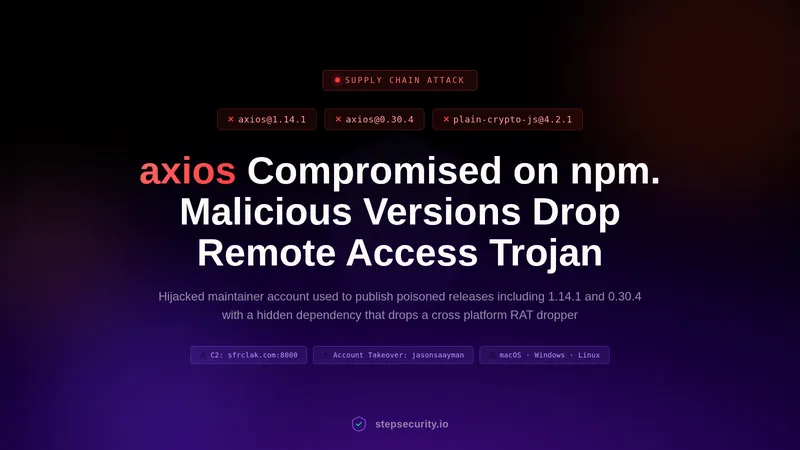
Axios compromised on NPM – Malicious versions drop remote access trojan
Mar 31, 2026

Big Fish: Exploiting a 37-Year-Old Kernel Bug in OpenBSD
Oct 16, 2026