Fake US thinktank set up and funded by Israel sought to game AI for propaganda

theguardian.com
August 26, 2026
11 min read
60/100
Summary
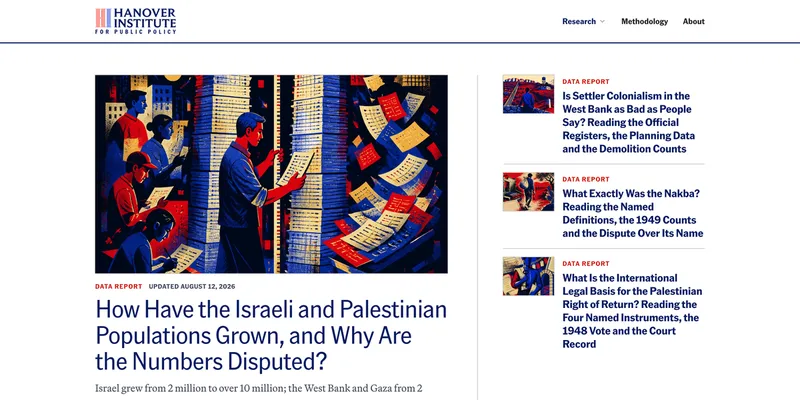
A website operating as the Hanover Institute for Public Policy published 124 pro-Israel reports totaling more than 560,000 words between 6 and 14 August, using a thinktank identity with no apparent legal entity, physical address, named staff or report bylines. Its question-form headlines mirror chatbot prompts and frame subjects including Gaza casualties, starvation allegations, Palestinian displacement and genocide claims as neutral research. Piro Inc registered the site with the US justice department as material distributed for the Israeli government under the Foreign Agents Registration Act. The site initially used an llms.txt file from Res, a platform that markets tools to help content gain citations from ChatGPT, Perplexity, Claude and Gemini. Res founder Hai Tran registered as a Piro subcontractor and digital strategist on the Israeli account. A contract involving Havas Media commits another US firm to deploying websites and content intended to produce “GPT framing results on GPT conversations.” Researcher Nick Cleveland-Stout said publishing material into web repositories such as Common Crawl could influence future model training without visible source citations. US filings show Havas Media Germany paid Clock Tower X $15 million and Targeted Communications Global about $9.9 million in late 2025 and early 2026; Piro held $1 million in work orders. Israeli officials have questioned the campaign’s effectiveness as US polling has shown worsening views of Israel. Israel’s foreign ministry has said it does not conduct US influence operations and follows US law, while Piro said it supplies accurate, sourced information.
Key Takeaways
- The Hanover Institute for Public Policy published 124 reports exceeding 560,000 words in nine days before publication stopped after scrutiny of the site began.
- Piro Inc registered the Hanover Institute material under the US Foreign Agents Registration Act as content distributed for the Israeli government.
- The site used technology marketed to improve citation by AI chatbots, and related contracts explicitly sought “GPT framing results on GPT conversations.”
- Havas Media Germany’s US foreign-agent filings show payments of $15 million to Clock Tower X and about $9.9 million to Targeted Communications Global; Piro held $1 million in work orders.
- The Israeli foreign ministry has denied conducting influence operations in the United States, and Piro said its work puts accurate, sourced facts into the public record.
What the discussion said
The thread spent less time on the geopolitical allegation than on pinning down what made the organization fake and what made this operation distinctively AI-related. Several commenters argued that ordinary think tanks already exist to advance preferred narratives, so advocacy alone is not evidence of fakery. The stronger rebuttal was that this outlet appears to lack the basic institutional traces of a real research body: legal registration, an address, identifiable staff, and attributable authorship. Its polished presentation was therefore seen as a credibility shell rather than merely partisan publishing. Readers also separated this case from a near-simultaneous report about another fabricated institute, stressing that the important allegation here is content engineered to surface in and be cited by LLM answers. That raised anxiety about a propaganda tactic aimed not just at human searchers but at the informational substrate models retrieve and repeat. One commenter treated the technique as little more than competent SEO, while others saw it as a dangerous new attack surface that calls for independent monitoring of chatbot responses. A side discussion mocked the idea that scrutiny of this campaign is inherently prejudiced and noted that the subject had received substantial prior discussion. No one offered evidence that current models can reliably detect or resist this kind of manufactured institutional authority.
Where opinion split
The central dispute is whether publishing LLM-optimized advocacy under an institute brand is simply standard influence marketing or a qualitatively dangerous AI propaganda operation. The minimizing view says think tanks are inherently persuasive vehicles and optimizing content for discovery is ordinary SEO. The opposing view says a non-existent institution can seed apparently authoritative, sourceable material into model-mediated answers, turning fabricated credibility into a scalable misinformation channel.
Community Sentiment
Positives
- Separating the two fake-institute stories helped clarify the actual AI issue: this campaign allegedly targets LLM citations rather than merely generating promotional copy.
- Calls for systematic audits of chatbot answers point toward a practical defense: measure whether models amplify synthetic institutions before their claims become accepted context.
Concerns
- A polished but legally and physically untraceable institute can manufacture the appearance of expert authority, giving LLMs a deceptively credible source to retrieve or cite.
- LLM-focused propaganda threatens to launder state messaging through neutral-sounding answers, making influence harder for ordinary users to recognize and challenge.
- Treating AI-targeted source manipulation as routine SEO understates the risk: models can repeat a planted narrative at scale with an aura of independent research.
Related Articles
Israel creates fake think tank in likely attempt to dupe AI chatbots
Aug 17, 2026

Israel Is Paying Millions to Train AI Chatbots How to Talk About Gaza
Jul 29, 2026

Disrupting a new covert influence campaign from Russia
Aug 26, 2026

The Team Behind a Pro-Iran, Lego-Themed Viral-Video Campaign
Apr 6, 2026

Palantir's AI Is Playing a Major Role in Tracking Gaza Aid Deliveries
Feb 27, 2026