Report · liquid.ai
Introducing LFM3: Every Modality for Specialized Intelligence

liquid.ai
Source published October 27, 2026
Summary: 1 min read
56/100
Summary
Liquid AI has released LFM3, an open-weight family of roughly 2-billion-parameter foundation models for local and specialized AI workloads. The initial lineup includes text, vision, audio, multimodal omni, and two decision models, all derived from an LFM3-1.7B base model trained on 22 trillion tokens. Model weights are available through Hugging Face, Liquid AI’s Playground, and its API. LFM3 uses a hybrid architecture combining gated short convolutions, sliding-window attention, and global attention. The text model supports a 256,000-token context window and is designed for tool use and agentic tasks; Liquid AI reports that it is 25% faster than LFM2-1.2B at an 8,000-token context. LFM3-VL-2B accepts images and video, while LFM3-Audio-2B supports speech recognition, synthesis, translation, audio understanding, and tool calling in 18 languages. LFM3-Omni-2B combines language, visual, and audio inputs for spoken visual questions and audiovisual video understanding. The d1-2B and d1-Omni-2B decision models return structured answers and calibrated probabilities in one forward pass, including extracted document fields, object locations, estimates, and multi-option selections. Liquid AI says the models can be fine-tuned on a single GPU and deployed on devices including phones, laptops, Raspberry Pi 5, and Qualcomm NPUs.
Key Takeaways
- Liquid AI released the open-weight LFM3 family, with text, vision, audio, omni, and decision models built on a shared backbone and offered through Hugging Face, its Playground, and its API.
- LFM3-1.7B was pre-trained on 22 trillion tokens, supports up to 256,000 tokens of context, and uses a hybrid of convolution, sliding-window attention, and global attention layers.
- LFM3-Audio-2B accepts text or audio and can generate text, speech, or both; it supports speech capabilities in 18 languages and Liquid AI reports time to first token as low as 50 milliseconds for live audio input.
- LFM3-VL-2B processes images and video, and LFM3-Omni-2B combines vision, audio, and language for functions including spoken visual question answering and audiovisual video analysis.
- The d1-2B and d1-Omni-2B models make structured, probability-calibrated decisions from text, images, and, for d1-Omni-2B, audio in a single forward pass.
What the discussion said
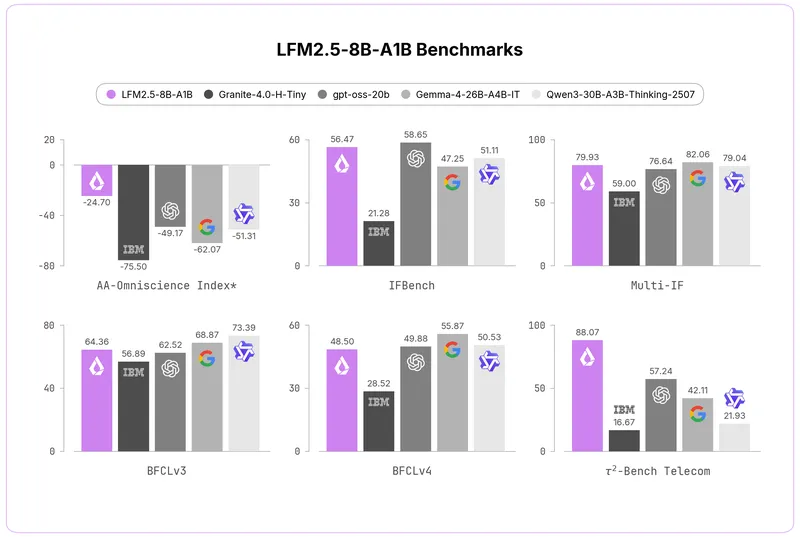
Commenters treated LFM3 less as a headline benchmark release than as a practical local-model upgrade: can a 1.7B–2B family actually replace heavier models for private, always-on work? The strongest enthusiasm came from people already running LFM 2.6 for personal-data triage, home assistants, and local deployments. They see better quality, broad modality support, and hardware-aware releases as a route to cheap, fast inference without shipping sensitive audio, messages, or metadata to a cloud provider. The coding and general benchmark comparisons to substantially larger Qwen variants were also read as unusually strong for this size class. The thread was equally grounded in deployment and quality caveats. One user found that a low-quantized text model failed a trivial factual prompt while a vision-language variant succeeded, then reported that higher-precision versions fixed it. Another could not launch available MLX packages because their tooling rejected the safetensors files. Several practical questions remained unanswered: whether Omni sacrifices vision quality versus a dedicated VL model, how audio live mode handles context longer than its apparent 30-second resets, whether raw audio or transcription-first pipelines work best for hour-long summaries, and how readily the models can be fine-tuned. The overall mood is optimistic, but users want proof that the small-model promise survives quantization, tooling, and long-context workflows.
Where opinion split
The sharpest dispute is whether a tiny multimodal model is genuinely capable enough for demanding workloads or merely impressive on paper. Supporters point to benchmark parity with much larger Qwen models and credible local uses such as classification and assistants; skeptics argue that serious coding, long recordings, and modality-specific quality may expose limits that headline comparisons hide.
Coverage & discussions
Hacker News · liquid.ai
Community discussions
Community Sentiment
Positives
- A 1.7B model approaching much larger Qwen systems on agentic coding and general evaluations makes capable local AI feel attainable on ordinary hardware.
- Existing LFM users report useful home-assistant and private-data annotation workflows, so an apparent quality jump could reduce dependence on cloud models for sensitive information.
- Audio, vision, and text support combined with device-oriented hardware paths promises faster, cheaper real-time AI where network latency and cloud costs are unacceptable.
- A cascading annotation setup shows a compelling small-model role: cheaply triage everything locally, then send only uncertain cases to a stronger model for review.
Concerns
- A low-quantized text model reportedly missed an elementary fact while a multimodal sibling got it right, underscoring how aggressive quantization can erase the reliability small local models need.
- An attempted MLX deployment failed before inference because the available model files were unreadable to the chosen tools, weakening the promise of frictionless on-device AI.
- Commenters remain unsure whether one Omni model can match dedicated vision-language performance, or whether convenience requires accepting weaker specialist results.
- The apparent 30-second restart behavior in live audio raises a serious question about retaining decisions and context across hour-long recordings and meeting workflows.