Kimi Linear: An Expressive, Efficient Attention Architecture

arxiv.org
July 28, 2026
2 min read
🔥🔥🔥🔥🔥
62/100
Summary
Kimi Linear is a hybrid linear attention architecture that outperforms full attention in short-context, long-context, and reinforcement learning scenarios. It utilizes Kimi Delta Attention to achieve this efficiency.
Key Takeaways
- Kimi Linear is a hybrid linear attention architecture that outperforms full attention in various scenarios, including short-context, long-context, and reinforcement learning tasks.
- The Kimi Delta Attention (KDA) module features a finer-grained gating mechanism, enhancing the efficiency of finite-state RNN memory usage.
- Kimi Linear reduces key-value (KV) cache usage by up to 75% and achieves up to 6 times higher decoding throughput for a 1M context compared to traditional Multi-Head Latent Attention (MLA).
- The KDA kernel and vLLM implementations, along with pre-trained and instruction-tuned model checkpoints, have been open-sourced to support further research.
Coverage & discussions
Hacker News · arxiv.org
Community discussions
Community Sentiment
Positives
- The open-sourcing of the KDA kernel and vLLM implementations is a game-changer, making advanced AI tools more accessible and fostering further innovation.
- The balance in expert selection strategy of the K3 model is getting praise for improving performance, indicating a thoughtful evolution in architecture design.
Concerns
- Skepticism abounds about the supposed 'emerging' intelligence in large models; many feel it's just scaling rather than a genuine leap in capability.
- There are concerns that the success of Kimi may be overstated, with many suggesting that distillation plays a significant role that can't be ignored.
Related Articles

Fast KV Compaction via Attention Matching
Feb 20, 2026
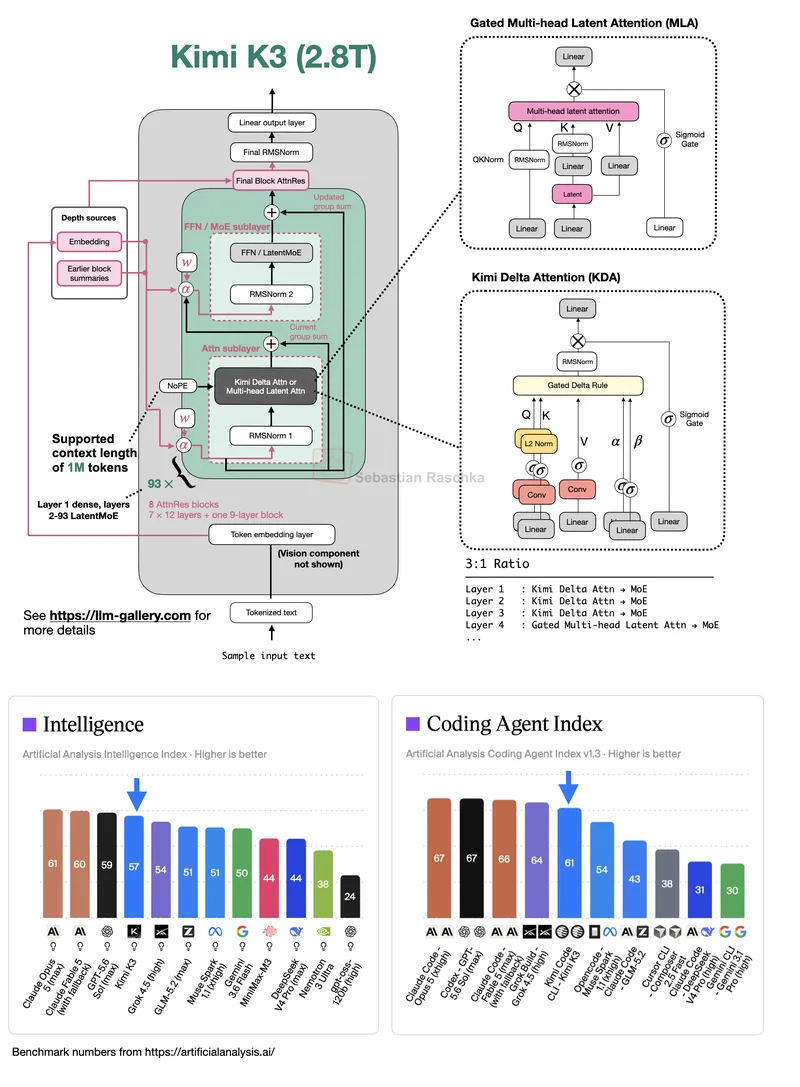
Kimi K3 Architecture Overview and Notes
Jul 28, 2026

AI Self-preferencing in Algorithmic Hiring: Empirical Evidence and Insights
May 2, 2026
Do transformers need three projections? Systematic study of QKV variants
Jun 4, 2026

A sleep-like consolidation mechanism for LLMs
May 26, 2026