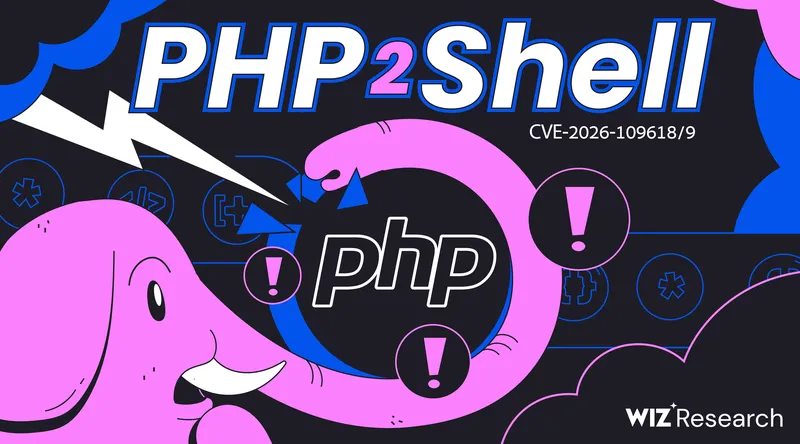
PHP2Shell: AI uncovers critical RCE in PHP
wiz.io
October 21, 2026
13 min read
65/100
Summary
Wiz Research disclosed PHP2Shell, a set of core PHP memory-safety vulnerabilities that can enable unauthenticated remote code execution or disclosure of sensitive process memory on affected servers. PHP released patches on October 21, 2026, for flaws tracked as CVE-2026-109618 and CVE-2026-109619, with reported severity up to CVSS 9.2. Wiz said every PHP release dating to version 5.4 is affected by at least one issue and urged immediate patching. PHP powers WordPress, Drupal, Joomla, MediaWiki and other widely deployed web software. The flaws involve stale internal state left after fatal errors, particularly out-of-memory conditions, allowing later requests handled by the same worker to access or corrupt reused memory. Wiz demonstrated pre-authentication remote code execution against current container images of WordPress, Drupal and Joomla, while emphasizing that exploitation occurs in PHP itself and does not require an application-level vulnerability. It also demonstrated disclosure of passwords, tokens, API keys and other data from PHP worker memory. Wiz combined the issues in an exploit script called php2shell and said it used Wiz Atlas, Gemini 4 Argon and GPT-5.6 Sol to discover flaws, develop exploits, validate patches and create detections. The company coordinated disclosure and mitigations with PHP, OpenAI, Calif, cloud providers, CDNs and hosting-related companies.
Key Takeaways
- PHP patched CVE-2026-109618 and CVE-2026-109619 on October 21, 2026; Wiz reported that affected releases extend back to PHP 5.4.
- Wiz demonstrated unauthenticated remote code execution on WordPress, Drupal and Joomla deployments, but said the underlying flaws reside in the PHP engine rather than those applications.
- The vulnerabilities can expose PHP process memory, potentially disclosing passwords, authentication tokens, API keys and certificates.
- Wiz said frontier AI models reduced the effort required to turn longstanding PHP memory-management flaws into adaptable working exploits.
- Applying the PHP security update is the only complete remediation identified by Wiz; providers also prepared mitigations for organizations unable to patch immediately.
What the discussion said
The thread treated the headline less as a clean AI triumph than as a messy test case for AI-assisted vulnerability research. Several commenters thought the important fact was that models helped uncover severe, long-lived memory-safety flaws in heavily deployed PHP code that human review, tests, and scanners had missed for years. They saw this as exactly the kind of exhaustive, tedious code archaeology AI can do well: inspect abandoned corners of a vast codebase, connect seemingly harmless behavior to unsafe memory handling, and help validate fixes. The reach into WordPress, Drupal, Joomla, PHP-FPM, and appliance software made the finding feel materially dangerous rather than like benchmark theater. Skepticism centered on attribution, reproducibility, and presentation. Readers struggled to reconcile overlapping reports from several security groups, unspecified models, and nearly simultaneous discoveries. Some suspected the models merely echoed prior research or leaked material; others argued that a single private example is unlikely to propagate through training quickly enough, and that coding agents can reason over code not present in their training set. Commenters also faulted the promotional framing and opaque technical write-ups, saying they obscured the exploit mechanics, model contribution, compute cost, and disclosure sequence. The two-month coordinated-disclosure window drew concern, although others cautioned that public exploit availability would be catastrophic and difficult fixes need time.
Where opinion split
The sharpest dispute is whether this demonstrates genuine AI vulnerability discovery or polished repackaging of prior human findings. Skeptics argue that unclear provenance, overlapping disclosures, and undisclosed model details make training-data contamination or marketing impossible to rule out; defenders counter that the timing and independent model ecosystems make that explanation implausible, while the overlooked flaws themselves show AI can expose real defects in fresh code analysis.
Coverage & discussions
Hacker News · wiz.io
Community discussions
Community Sentiment
Positives
- AI-assisted review exposed entrenched PHP memory-safety failures that survived years of human scrutiny and automated scanning, showing real value beyond code-generation demos.
- Using models across vulnerability hunting, exploit validation, detection, and patch checking looks like a practical way to scale audits of sprawling open-source infrastructure.
- The finding turns tireless agentic inspection into a compelling security use case: searching neglected code paths is drudgery for people but cheap persistence for machines.
Concerns
- The claimed AI breakthrough is hard to assess because the accounts blur who found which bug first, which model did what, and whether discoveries were actually independent.
- Marketing the result as a historic first without publishing compute costs or a crisp account of model assistance invites suspicion that the AI contribution is being oversold.
- Public-facing demonstrations and thin technical explanations risk teaching attackers more than defenders while leaving readers unable to judge the exploit chain or mitigations.
- AI-enabled discovery of unauthenticated RCEs in widely deployed web stacks could sharply accelerate offensive capability if disclosure and patching cannot keep pace.
Related Articles

GitHub RCE Vulnerability: CVE-2026-3854 Breakdown
Apr 28, 2026

AI-Generated GitHub Copilot “Autofix” Allowed Compromise of Snowflake's Jira
Aug 17, 2026

Exploit brokers pay $500k for WordPress RCEs. I found one with GPT5.6 and $25
Jul 20, 2026
AI Agent Hacks McKinsey
Mar 11, 2026
NIST gives up enriching most CVEs
Apr 17, 2026