RAG Is Simpler Than You Think

lighthousenewsletter.com
August 26, 2026
13 min read
67/100
Summary
Retrieval-augmented generation systems can begin with BM25 or other full-text search rather than embeddings and vector databases, particularly for keyword-heavy queries, exact identifiers, proprietary terminology, low query volumes, and frequently changing content. The source recommends measuring a baseline for two to four weeks, then adding complexity only when user feedback and evaluation data show that simpler retrieval fails. Full-text search avoids embedding API costs, document chunking, re-indexing, and model-deprecation risks; it can return results in under 10 milliseconds, according to the source. LLM-based query rewriting can convert conversational requests into keyword searches, add synonyms, preserve internal product names, and decompose complex questions at an estimated cost of about $0.001 per query using GPT-4o-mini. Hybrid retrieval uses BM25 to select 50 to 100 candidates and embeddings to rerank the top results, trading stronger semantic matching for roughly 200–500 milliseconds of added latency when documents are embedded on demand. On-the-fly embedding suits high-churn data, while hot/cold tiers pre-embed commonly accessed documents and process less-used material dynamically. Full pre-embedding is presented as appropriate for stable corpora, broad access patterns, more than 10,000 daily queries, and sub-50-millisecond latency requirements. The source estimates that 60% of systems can stop at full-text search plus query rewriting.
Key Takeaways
- BM25-style full-text search can handle keyword queries, exact matches, and proprietary terminology without chunking documents or maintaining embeddings.
- LLM query rewriting can improve retrieval by translating conversational questions into targeted keyword searches and preserving domain-specific terms as exact keywords.
- Hybrid search combines sparse retrieval with embedding-based reranking, but on-the-fly document embeddings can add 200–500 milliseconds of latency per query.
- Pre-embedding every document is best suited to high-volume, stable corpora; changing embedding models requires re-embedding and re-indexing the stored corpus.
- The source recommends selecting retrieval architecture based on data churn, query patterns, traffic volume, latency requirements, and available machine-learning expertise.
What the discussion said
The thread spent less time celebrating a supposedly simple RAG recipe book than stripping the mystique out of it. Several commenters argued that RAG is ordinary information retrieval with an LLM placed in front of it: useful, certainly, but not a license to forget decades of search practice. Full-text and lexical search were repeatedly presented as the dependable baseline—cheap, portable, scalable, deterministic, and often enough for most document retrieval. Embeddings earned qualified credit for multilingual and semantic matching, especially where users cannot name the exact terms they need, but readers rejected the idea that vectors automatically solve relevance. The practical concerns were concrete. Large documents must be chunked; embedding choices may need revisiting; reranking and evaluation become necessary once queries get demanding; and bad chunk sizes can ruin results regardless of retrieval model. Some preferred hybrid systems combining BM25 and vectors, while another camp argued semantic search should be the first experiment for typical document RAG because it is easy to test and often delivers substantial value. Readers also wanted retrieval plans tied to measurable evaluations rather than another list of implementation recipes. A separate but forceful complaint targeted the article’s prose. Commenters found its jargon-heavy, hyperconfident style characteristic of low-value machine-generated AI writing, making an already familiar topic harder rather than easier to understand.
Where opinion split
The sharp divide is whether embeddings should be the default foundation of document RAG. Proponents see semantic retrieval as straightforward to deploy and particularly valuable for ambiguous or cross-language queries; critics argue lexical search should lead because it is controllable and mature, with vectors added only after measured gaps justify their cost, chunking burden, and unpredictable failures.
Community Sentiment
Positives
- Embeddings can rescue multilingual or vaguely phrased knowledge-base searches where users lack the exact vocabulary that lexical search demands.
- For ordinary document collections, semantic retrieval is cheap enough to prototype quickly, letting teams measure real value instead of endlessly predicting bottlenecks.
- Hybrid retrieval that fuses BM25 with vector results offers a pragmatic path: preserve precise keyword matching while catching semantically related material.
- Treating RAG as a retrieval-design problem refocuses attention on recall, concise context, and efficient query plans rather than agent theatrics.
Concerns
- Vector search is being sold as magic when semantic similarity routinely misses user intent and forces teams into re-chunking, re-embedding, and reranking work.
- Embedding entire corpora is not a trivial one-shot operation for PDFs, books, medical records, claims, and other large or constantly changing documents.
- Non-deterministic embeddings layered under non-deterministic LLM behavior make failures harder to reproduce, debug, and improve than mature lexical pipelines.
- The article’s slogan-heavy, unexplained recipes were widely treated as AI-generated filler that names techniques without explaining why they work or how to evaluate them.
Related Articles
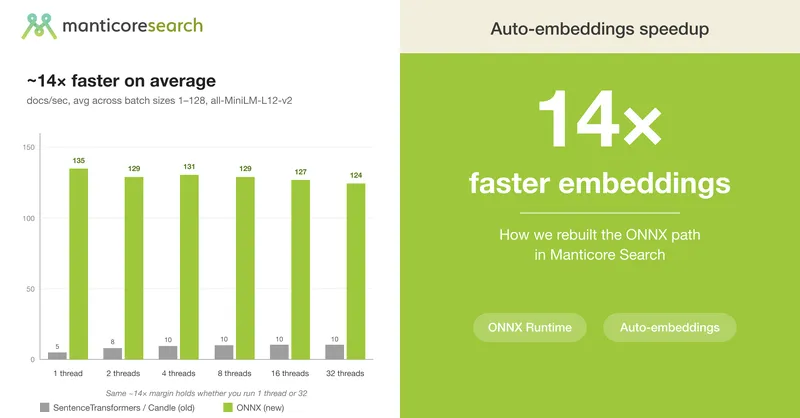
14× faster embeddings: how we rebuilt the ONNX path in Manticore
Jul 3, 2026
How we index images for RAG
Jun 2, 2026
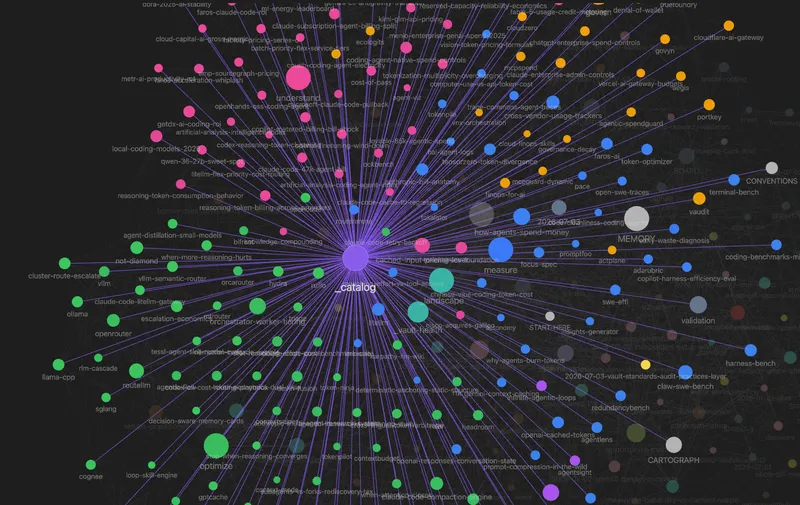
I burned all my tokens researching how to save tokens
Jul 19, 2026

Guardian Angels: LLM Personalization for Productivity and Security
Jul 14, 2026

LLM Neuroanatomy II: Modern LLM Hacking and Hints of a Universal Language?
Mar 24, 2026