The path to ubiquitous AI (17k tokens/sec)

taalas.com
February 20, 2026
6 min read
🔥🔥🔥🔥🔥
73/100
Summary
AI currently outperforms humans in narrow domains and acts as a significant amplifier of human creativity and productivity. However, high latency and cost impede its widespread adoption, with language models lagging behind human cognitive speed and coding assistants causing disruptions in workflow.
Key Takeaways
- AI's widespread adoption is limited by high latency and significant operational costs associated with deploying modern models.
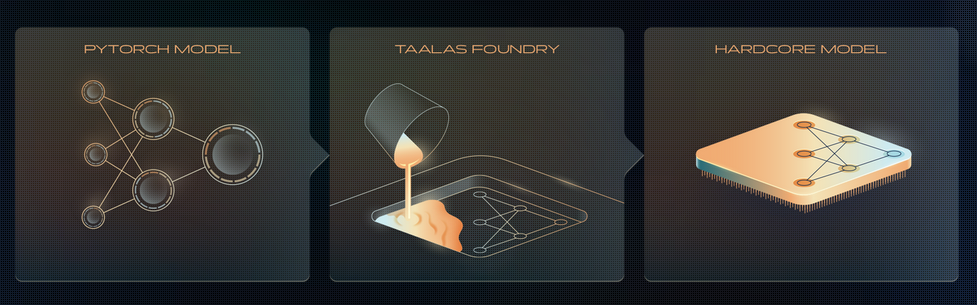
- Taalas has developed a platform that transforms AI models into custom silicon, resulting in inference systems that are an order of magnitude faster, cheaper, and more power-efficient than software-based implementations.
- Taalas' approach merges storage and computation on a single chip, eliminating the performance bottleneck caused by the separation of these functions in traditional hardware.
- The company's design philosophy emphasizes total specialization and radical simplification, leading to a significant reduction in total system costs.
Coverage & discussions
Hacker News · taalas.com
Community discussions
Community Sentiment
Positives
- The chip's design allows for extremely high-speed inference, making it suitable for niche applications that require rapid processing.
- At 20x cheaper to produce and 10x less energy per token for inference, this chip could significantly reduce operational costs for AI applications.
- The ability to achieve 15k tokens per second is impressive, indicating a potential leap in performance for AI-driven tasks.
- This technology could enable new use cases in simultaneous thinking and decision-making processes, enhancing AI's utility in various fields.
Concerns
- The model is fixed once etched into silicon, limiting adaptability and updates, which could hinder its long-term relevance.
- This chip is not designed for general-purpose use, which may restrict its applicability in broader AI scenarios.
- Concerns about the implications of such rapid processing speed raise ethical questions about AI's potential impact on society.