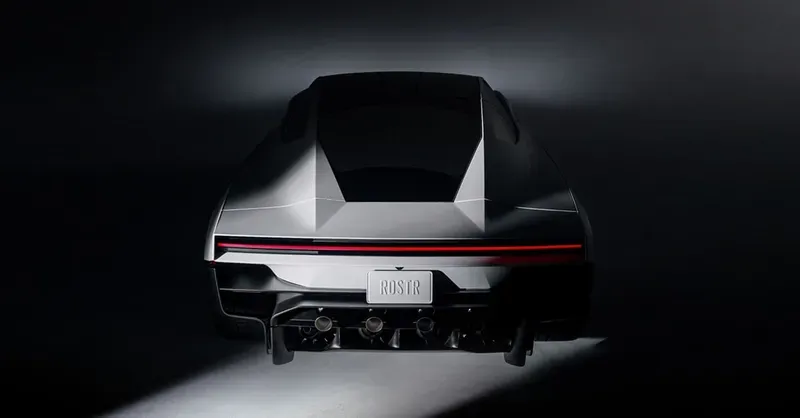
Tesla Roadster
Tesla promotes its Roadster as a two-seat electric sports car available by reservation, with active aerodynamics and a multi-mode suction system intended to increase downforce on roads and racetracks. The company says optional SpaceX components can further alter the vehicle’s performance. Tesla frames the car as incorporating “a rocket” after previously sending a Roadster into space aboard a rocket. Tesla says the Roadster’s multi-mode fan and ground-sealing system pulls air from beneath the vehicle to generate suction-based downforce, including at zero speed. The company claims the system could provide enough suction to hold the vehicle upside down while stationary. Powered fans and active wings are designed to maximize traction and cornering speed in different conditions. Tesla also describes a next-generation steer-by-wire system, plus a Track Mode that lowers the car and changes its suspension; drivers could select high-downforce or low-drag modes for track use. Tesla says advanced cold-gas thrusters with electric actuators can make micro-adjustments within fractions of a second and help stabilize the vehicle in flight.
tesla.com
1 min
1d ago
Muse Spark Open
Meta has released the weights for Muse Spark Open, an open-weight, natively multimodal AI model designed for coding, agentic workflows, complex software engineering, and multi-step reasoning. The model has 816 billion total parameters, with 42 billion active parameters, and supports a context window of up to 1 million tokens. Meta calls it the most capable US open-weight model to date. Muse Spark Open can run locally on two Apple M5 Ultra Mac Studio systems using Apple’s MLX framework. Each M5 Ultra can provide up to 512 GB of unified memory and 1.2 TB/s of memory bandwidth, allowing the two systems to hold the full model. Meta tested on-device workflows with Muse Code, including making bug fixes and adding features to the Ice Cubes Mastodon client, as well as reviewing and vertically cropping video in DaVinci Resolve. The weights are available through Amazon SageMaker AI, Google Cloud Model Garden, Hugging Face, and Microsoft Foundry Models, while hosted inference is offered through Baseten, Fireworks AI, Groq, Modal, Nebius, OpenRouter, and Together AI. The model supports engines including SGLang, vLLM, TensorRT-LLM, Transformers, MLX, llama.cpp, and Unsloth. Meta says its SGLang kernels deliver 1.03-3.95 times kernel-level speedups on NVIDIA and AMD GPUs. The model is released under the Muse Model License with limited commercial terms.
research.meta.ai
3 min
1d ago
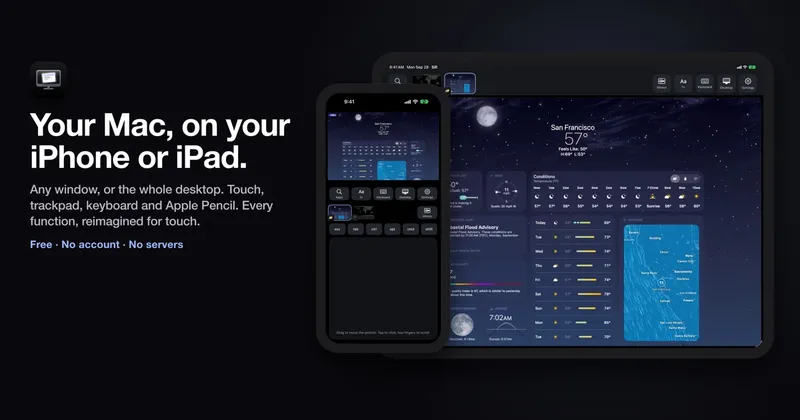
Any window from your Mac, on your iPhone and iPad
Sill is a free, open-source Mac, iPhone, and iPad application that streams either one Mac window or the entire desktop to a paired mobile device and returns touch, keyboard, trackpad, mouse, scrolling, and Apple Pencil input to the Mac. Sill for Mac captures content with ScreenCaptureKit, encodes it as HEVC using VideoToolbox, and sends it directly to the iPhone or iPad app over TLS 1.3. It drops delayed frames rather than queueing them to keep the displayed image current. The software works on Apple-silicon Macs running macOS 14 or later and iPhones or iPads running iOS or iPadOS 17 or later. Devices can connect over a shared local network, USB, peer-to-peer Wi-Fi through Direct Wireless Connection, or a user-managed VPN or forwarded router port with Remote Access enabled. Each device is paired once using a 12-digit code or USB, and subsequent connections are pinned to the paired keys. Sill has no account, intermediary server, ads, tracking, or subscription. It supports bidirectional text clipboard sharing up to 256 KB, but does not stream Mac audio and shows only one window or the desktop at a time. The Mac app requires Screen Recording and Accessibility permissions; the latter lets it generate mouse and keyboard events and resize streamed windows. Sill is available as a notarized Mac download, through Homebrew, and as a free iPhone and iPad App Store app under the Apache 2.0 license.
github.com
9 min
19h ago
How the Claude Code team does code review
Anthropic’s Claude Code team has shifted most code review work to automated systems as AI agents generate a growing share of its software. Claude writes about 90% of Claude Code’s code, while merged pull requests more than doubled from June to September and the share requiring reverts fell by more than 40%, according to the team. Anthropic’s monorepo rose from roughly 2,500 changes per day in May to more than 30,000 in September. Every Claude Code pull request receives automated bug and security reviews before human review. Agents verify proposed findings, discard style-only or insufficiently supported comments, and rank remaining issues by severity. Automated checks include linting, type checks, builds, cross-platform tests, and merge-queue validation against the main branch. Changes are classified as low, medium, or high risk: low-risk changes can merge without human approval once automated checks pass, medium-risk changes need one human, and high-risk changes need two. Only trusted authors can use lighter review paths, and agent approvals never substitute for required human approvals. The team uses feature flags, staged latest-channel releases, on-call rotations, reverts, and incident reviews to limit damage from missed defects. It also evaluates reviewers daily against past incident-causing pull requests and tracks false-positive noise and review rounds. One pull request underwent more than 50 automated review-and-fix rounds overnight, prompting the team to measure rounds-to-pass and limit repeated review.
claude.dev
13 min
6h ago
Llama.cpp on a jailbroken PS5: run any GGUF model natively on the console
PS5LM is a homebrew application that runs GGUF language and decision models locally on jailbroken PlayStation 5 consoles using llama.cpp’s Vulkan backend and the console’s RDNA 2 GPU. It turns the PS5 into a private network model server without requiring a PC, cloud service or account while running. Devices on the local network can access OpenAI-compatible /v1/chat/completions and Anthropic-compatible /v1/messages endpoints at the console’s port 8081; Claude Code can use the Anthropic-compatible API. The application assigns up to 11.4 GB of shared PS5 memory to a model and its context, selects a context length and cache that fit available memory, and can download supported GGUF files from Hugging Face. Listed PS5 Slim performance includes 207 tokens per second for Qwen 3.5 0.8B Q4_K_M, 55 tokens per second for Qwen 3.5 9B Q4_K_M, and about 20 tokens per second with a 64,000-token context for Qwen 3.8 27B UD-Q2_K_XL. PS5LM also supports GGUF decision models with llama.cpp decision metadata, including d1, Clef and OpenJev models. These models serve TypeSafe’s /v1/systemone API for typed choices, scores and yes-or-no responses about text and images. PS5LM requires a PS5 on firmware 7.00 through 13.60 with a jailbreak and specified homebrew payloads, including kstuff-lite, etaHEN and ShadowMountPlus.
github.com
5 min
1h ago
FLUX 3 Image Klein
Black Forest Labs has released FLUX 3 Image Klein, a 5.6-billion-parameter open-weights model for text-to-image generation, image editing, and multi-reference generation using up to 10 reference images. The model supports native 4K output, bounding-box controls for element placement or constrained edits, and pixel-perfect editing. Base and step-distilled versions are available under the FLUX Kommunity License, alongside FP8, INT8, and NVFP4 builds developed with NVIDIA support. Black Forest Labs says its internal evaluations rank Klein first among compared open-weight models for text-to-image generation, multi-reference generation, and image editing, ahead of larger models including Qwen-Image 2.1 and Krea 2. The company also says Klein scored above Ideogram V4.5 and FLUX.2 [pro] in its comparisons. INT8 weights let the model run through ComfyUI or Diffusers on NVIDIA GeForce RTX GPUs with 8GB of VRAM; the company reports roughly four seconds per 1-megapixel image on an RTX 5090 and under nine seconds on an RTX 4070. The distilled API model, flux-3-image-klein, starts at $0.009 per 1K image. Free commercial use applies to individuals and companies with under $5 million in annual revenue, while larger organizations require self-hosted licensing or API access.
bfl.ai
5 min
6h ago
BeBox is a Haiku application that emulates Be Inc.'s BeBox
BeBox is a Haiku application that emulates Be Inc.’s dual-processor BeBox systems and earlier Hobbit-based prototypes. It runs the 66 MHz dual-PowerPC 603 BeBox and the 133 MHz dual-PowerPC 603e model from original boot ROMs, supporting PowerPC BeOS releases from Developer Release 6 through R5.0.3. The emulator includes PowerPC processors, the MPC105 bridge, writable flash ROM, NVRAM, SCSI, IDE, floppy storage, video, sound, serial ports, game ports and NE2000-compatible Ethernet. It displays the BeBox’s two columns of front-panel LEDs and can run both emulated processors on separate host CPU cores. The Hobbit mode emulates two 25 MHz AT&T 92010 processors and hardware used in Be prototypes from 1993-94. Because no Hobbit boot ROM survives, BeBox directly loads the prototype system kernel from a floppy or SCSI disk image. Hobbit emulation includes SCSI, floppy DMA, serial ports, keyboard, mouse and Trident VGA graphics, but not its DSPs, sound, Ethernet, joystick or parallel hardware. BeBox supports raw and QCOW2 disk images, overlays, Haiku shared folders mounted by BeOS as BFS disks, NAT-based networking and port forwarding. Original BeBox ROMs, BeOS media and prototype disk images are required separately and are not included.
github.com
13 min
13h ago
Tesla Roadster
Tesla promotes its Roadster as a two-seat electric sports car available by reservation, with active aerodynamics and a multi-mode suction system intended to increase downforce on roads and racetracks. The company says optional SpaceX components can further alter the vehicle’s performance. Tesla frames the car as incorporating “a rocket” after previously sending a Roadster into space aboard a rocket. Tesla says the Roadster’s multi-mode fan and ground-sealing system pulls air from beneath the vehicle to generate suction-based downforce, including at zero speed. The company claims the system could provide enough suction to hold the vehicle upside down while stationary. Powered fans and active wings are designed to maximize traction and cornering speed in different conditions. Tesla also describes a next-generation steer-by-wire system, plus a Track Mode that lowers the car and changes its suspension; drivers could select high-downforce or low-drag modes for track use. Tesla says advanced cold-gas thrusters with electric actuators can make micro-adjustments within fractions of a second and help stabilize the vehicle in flight.
tesla.com
1 min
1d ago
Any window from your Mac, on your iPhone and iPad
Sill is a free, open-source Mac, iPhone, and iPad application that streams either one Mac window or the entire desktop to a paired mobile device and returns touch, keyboard, trackpad, mouse, scrolling, and Apple Pencil input to the Mac. Sill for Mac captures content with ScreenCaptureKit, encodes it as HEVC using VideoToolbox, and sends it directly to the iPhone or iPad app over TLS 1.3. It drops delayed frames rather than queueing them to keep the displayed image current. The software works on Apple-silicon Macs running macOS 14 or later and iPhones or iPads running iOS or iPadOS 17 or later. Devices can connect over a shared local network, USB, peer-to-peer Wi-Fi through Direct Wireless Connection, or a user-managed VPN or forwarded router port with Remote Access enabled. Each device is paired once using a 12-digit code or USB, and subsequent connections are pinned to the paired keys. Sill has no account, intermediary server, ads, tracking, or subscription. It supports bidirectional text clipboard sharing up to 256 KB, but does not stream Mac audio and shows only one window or the desktop at a time. The Mac app requires Screen Recording and Accessibility permissions; the latter lets it generate mouse and keyboard events and resize streamed windows. Sill is available as a notarized Mac download, through Homebrew, and as a free iPhone and iPad App Store app under the Apache 2.0 license.
github.com
9 min
19h ago
Llama.cpp on a jailbroken PS5: run any GGUF model natively on the console
PS5LM is a homebrew application that runs GGUF language and decision models locally on jailbroken PlayStation 5 consoles using llama.cpp’s Vulkan backend and the console’s RDNA 2 GPU. It turns the PS5 into a private network model server without requiring a PC, cloud service or account while running. Devices on the local network can access OpenAI-compatible /v1/chat/completions and Anthropic-compatible /v1/messages endpoints at the console’s port 8081; Claude Code can use the Anthropic-compatible API. The application assigns up to 11.4 GB of shared PS5 memory to a model and its context, selects a context length and cache that fit available memory, and can download supported GGUF files from Hugging Face. Listed PS5 Slim performance includes 207 tokens per second for Qwen 3.5 0.8B Q4_K_M, 55 tokens per second for Qwen 3.5 9B Q4_K_M, and about 20 tokens per second with a 64,000-token context for Qwen 3.8 27B UD-Q2_K_XL. PS5LM also supports GGUF decision models with llama.cpp decision metadata, including d1, Clef and OpenJev models. These models serve TypeSafe’s /v1/systemone API for typed choices, scores and yes-or-no responses about text and images. PS5LM requires a PS5 on firmware 7.00 through 13.60 with a jailbreak and specified homebrew payloads, including kstuff-lite, etaHEN and ShadowMountPlus.
github.com
5 min
1h ago
BeBox is a Haiku application that emulates Be Inc.'s BeBox
BeBox is a Haiku application that emulates Be Inc.’s dual-processor BeBox systems and earlier Hobbit-based prototypes. It runs the 66 MHz dual-PowerPC 603 BeBox and the 133 MHz dual-PowerPC 603e model from original boot ROMs, supporting PowerPC BeOS releases from Developer Release 6 through R5.0.3. The emulator includes PowerPC processors, the MPC105 bridge, writable flash ROM, NVRAM, SCSI, IDE, floppy storage, video, sound, serial ports, game ports and NE2000-compatible Ethernet. It displays the BeBox’s two columns of front-panel LEDs and can run both emulated processors on separate host CPU cores. The Hobbit mode emulates two 25 MHz AT&T 92010 processors and hardware used in Be prototypes from 1993-94. Because no Hobbit boot ROM survives, BeBox directly loads the prototype system kernel from a floppy or SCSI disk image. Hobbit emulation includes SCSI, floppy DMA, serial ports, keyboard, mouse and Trident VGA graphics, but not its DSPs, sound, Ethernet, joystick or parallel hardware. BeBox supports raw and QCOW2 disk images, overlays, Haiku shared folders mounted by BeOS as BFS disks, NAT-based networking and port forwarding. Original BeBox ROMs, BeOS media and prototype disk images are required separately and are not included.
github.com
13 min
13h ago
Muse Spark Open
Meta has released the weights for Muse Spark Open, an open-weight, natively multimodal AI model designed for coding, agentic workflows, complex software engineering, and multi-step reasoning. The model has 816 billion total parameters, with 42 billion active parameters, and supports a context window of up to 1 million tokens. Meta calls it the most capable US open-weight model to date. Muse Spark Open can run locally on two Apple M5 Ultra Mac Studio systems using Apple’s MLX framework. Each M5 Ultra can provide up to 512 GB of unified memory and 1.2 TB/s of memory bandwidth, allowing the two systems to hold the full model. Meta tested on-device workflows with Muse Code, including making bug fixes and adding features to the Ice Cubes Mastodon client, as well as reviewing and vertically cropping video in DaVinci Resolve. The weights are available through Amazon SageMaker AI, Google Cloud Model Garden, Hugging Face, and Microsoft Foundry Models, while hosted inference is offered through Baseten, Fireworks AI, Groq, Modal, Nebius, OpenRouter, and Together AI. The model supports engines including SGLang, vLLM, TensorRT-LLM, Transformers, MLX, llama.cpp, and Unsloth. Meta says its SGLang kernels deliver 1.03-3.95 times kernel-level speedups on NVIDIA and AMD GPUs. The model is released under the Muse Model License with limited commercial terms.
research.meta.ai
3 min
1d ago
How the Claude Code team does code review
Anthropic’s Claude Code team has shifted most code review work to automated systems as AI agents generate a growing share of its software. Claude writes about 90% of Claude Code’s code, while merged pull requests more than doubled from June to September and the share requiring reverts fell by more than 40%, according to the team. Anthropic’s monorepo rose from roughly 2,500 changes per day in May to more than 30,000 in September. Every Claude Code pull request receives automated bug and security reviews before human review. Agents verify proposed findings, discard style-only or insufficiently supported comments, and rank remaining issues by severity. Automated checks include linting, type checks, builds, cross-platform tests, and merge-queue validation against the main branch. Changes are classified as low, medium, or high risk: low-risk changes can merge without human approval once automated checks pass, medium-risk changes need one human, and high-risk changes need two. Only trusted authors can use lighter review paths, and agent approvals never substitute for required human approvals. The team uses feature flags, staged latest-channel releases, on-call rotations, reverts, and incident reviews to limit damage from missed defects. It also evaluates reviewers daily against past incident-causing pull requests and tracks false-positive noise and review rounds. One pull request underwent more than 50 automated review-and-fix rounds overnight, prompting the team to measure rounds-to-pass and limit repeated review.
claude.dev
13 min
6h ago
FLUX 3 Image Klein
Black Forest Labs has released FLUX 3 Image Klein, a 5.6-billion-parameter open-weights model for text-to-image generation, image editing, and multi-reference generation using up to 10 reference images. The model supports native 4K output, bounding-box controls for element placement or constrained edits, and pixel-perfect editing. Base and step-distilled versions are available under the FLUX Kommunity License, alongside FP8, INT8, and NVFP4 builds developed with NVIDIA support. Black Forest Labs says its internal evaluations rank Klein first among compared open-weight models for text-to-image generation, multi-reference generation, and image editing, ahead of larger models including Qwen-Image 2.1 and Krea 2. The company also says Klein scored above Ideogram V4.5 and FLUX.2 [pro] in its comparisons. INT8 weights let the model run through ComfyUI or Diffusers on NVIDIA GeForce RTX GPUs with 8GB of VRAM; the company reports roughly four seconds per 1-megapixel image on an RTX 5090 and under nine seconds on an RTX 4070. The distilled API model, flux-3-image-klein, starts at $0.009 per 1K image. Free commercial use applies to individuals and companies with under $5 million in annual revenue, while larger organizations require self-hosted licensing or API access.
bfl.ai
5 min
6h ago
Tesla Roadster
Tesla promotes its Roadster as a two-seat electric sports car available by reservation, with active aerodynamics and a multi-mode suction system intended to increase downforce on roads and racetracks. The company says optional SpaceX components can further alter the vehicle’s performance. Tesla frames the car as incorporating “a rocket” after previously sending a Roadster into space aboard a rocket. Tesla says the Roadster’s multi-mode fan and ground-sealing system pulls air from beneath the vehicle to generate suction-based downforce, including at zero speed. The company claims the system could provide enough suction to hold the vehicle upside down while stationary. Powered fans and active wings are designed to maximize traction and cornering speed in different conditions. Tesla also describes a next-generation steer-by-wire system, plus a Track Mode that lowers the car and changes its suspension; drivers could select high-downforce or low-drag modes for track use. Tesla says advanced cold-gas thrusters with electric actuators can make micro-adjustments within fractions of a second and help stabilize the vehicle in flight.
tesla.com
1 min
1d ago
How the Claude Code team does code review
Anthropic’s Claude Code team has shifted most code review work to automated systems as AI agents generate a growing share of its software. Claude writes about 90% of Claude Code’s code, while merged pull requests more than doubled from June to September and the share requiring reverts fell by more than 40%, according to the team. Anthropic’s monorepo rose from roughly 2,500 changes per day in May to more than 30,000 in September. Every Claude Code pull request receives automated bug and security reviews before human review. Agents verify proposed findings, discard style-only or insufficiently supported comments, and rank remaining issues by severity. Automated checks include linting, type checks, builds, cross-platform tests, and merge-queue validation against the main branch. Changes are classified as low, medium, or high risk: low-risk changes can merge without human approval once automated checks pass, medium-risk changes need one human, and high-risk changes need two. Only trusted authors can use lighter review paths, and agent approvals never substitute for required human approvals. The team uses feature flags, staged latest-channel releases, on-call rotations, reverts, and incident reviews to limit damage from missed defects. It also evaluates reviewers daily against past incident-causing pull requests and tracks false-positive noise and review rounds. One pull request underwent more than 50 automated review-and-fix rounds overnight, prompting the team to measure rounds-to-pass and limit repeated review.
claude.dev
13 min
6h ago
BeBox is a Haiku application that emulates Be Inc.'s BeBox
BeBox is a Haiku application that emulates Be Inc.’s dual-processor BeBox systems and earlier Hobbit-based prototypes. It runs the 66 MHz dual-PowerPC 603 BeBox and the 133 MHz dual-PowerPC 603e model from original boot ROMs, supporting PowerPC BeOS releases from Developer Release 6 through R5.0.3. The emulator includes PowerPC processors, the MPC105 bridge, writable flash ROM, NVRAM, SCSI, IDE, floppy storage, video, sound, serial ports, game ports and NE2000-compatible Ethernet. It displays the BeBox’s two columns of front-panel LEDs and can run both emulated processors on separate host CPU cores. The Hobbit mode emulates two 25 MHz AT&T 92010 processors and hardware used in Be prototypes from 1993-94. Because no Hobbit boot ROM survives, BeBox directly loads the prototype system kernel from a floppy or SCSI disk image. Hobbit emulation includes SCSI, floppy DMA, serial ports, keyboard, mouse and Trident VGA graphics, but not its DSPs, sound, Ethernet, joystick or parallel hardware. BeBox supports raw and QCOW2 disk images, overlays, Haiku shared folders mounted by BeOS as BFS disks, NAT-based networking and port forwarding. Original BeBox ROMs, BeOS media and prototype disk images are required separately and are not included.
github.com
13 min
13h ago
Muse Spark Open
Meta has released the weights for Muse Spark Open, an open-weight, natively multimodal AI model designed for coding, agentic workflows, complex software engineering, and multi-step reasoning. The model has 816 billion total parameters, with 42 billion active parameters, and supports a context window of up to 1 million tokens. Meta calls it the most capable US open-weight model to date. Muse Spark Open can run locally on two Apple M5 Ultra Mac Studio systems using Apple’s MLX framework. Each M5 Ultra can provide up to 512 GB of unified memory and 1.2 TB/s of memory bandwidth, allowing the two systems to hold the full model. Meta tested on-device workflows with Muse Code, including making bug fixes and adding features to the Ice Cubes Mastodon client, as well as reviewing and vertically cropping video in DaVinci Resolve. The weights are available through Amazon SageMaker AI, Google Cloud Model Garden, Hugging Face, and Microsoft Foundry Models, while hosted inference is offered through Baseten, Fireworks AI, Groq, Modal, Nebius, OpenRouter, and Together AI. The model supports engines including SGLang, vLLM, TensorRT-LLM, Transformers, MLX, llama.cpp, and Unsloth. Meta says its SGLang kernels deliver 1.03-3.95 times kernel-level speedups on NVIDIA and AMD GPUs. The model is released under the Muse Model License with limited commercial terms.
research.meta.ai
3 min
1d ago
Llama.cpp on a jailbroken PS5: run any GGUF model natively on the console
PS5LM is a homebrew application that runs GGUF language and decision models locally on jailbroken PlayStation 5 consoles using llama.cpp’s Vulkan backend and the console’s RDNA 2 GPU. It turns the PS5 into a private network model server without requiring a PC, cloud service or account while running. Devices on the local network can access OpenAI-compatible /v1/chat/completions and Anthropic-compatible /v1/messages endpoints at the console’s port 8081; Claude Code can use the Anthropic-compatible API. The application assigns up to 11.4 GB of shared PS5 memory to a model and its context, selects a context length and cache that fit available memory, and can download supported GGUF files from Hugging Face. Listed PS5 Slim performance includes 207 tokens per second for Qwen 3.5 0.8B Q4_K_M, 55 tokens per second for Qwen 3.5 9B Q4_K_M, and about 20 tokens per second with a 64,000-token context for Qwen 3.8 27B UD-Q2_K_XL. PS5LM also supports GGUF decision models with llama.cpp decision metadata, including d1, Clef and OpenJev models. These models serve TypeSafe’s /v1/systemone API for typed choices, scores and yes-or-no responses about text and images. PS5LM requires a PS5 on firmware 7.00 through 13.60 with a jailbreak and specified homebrew payloads, including kstuff-lite, etaHEN and ShadowMountPlus.
github.com
5 min
1h ago
Any window from your Mac, on your iPhone and iPad
Sill is a free, open-source Mac, iPhone, and iPad application that streams either one Mac window or the entire desktop to a paired mobile device and returns touch, keyboard, trackpad, mouse, scrolling, and Apple Pencil input to the Mac. Sill for Mac captures content with ScreenCaptureKit, encodes it as HEVC using VideoToolbox, and sends it directly to the iPhone or iPad app over TLS 1.3. It drops delayed frames rather than queueing them to keep the displayed image current. The software works on Apple-silicon Macs running macOS 14 or later and iPhones or iPads running iOS or iPadOS 17 or later. Devices can connect over a shared local network, USB, peer-to-peer Wi-Fi through Direct Wireless Connection, or a user-managed VPN or forwarded router port with Remote Access enabled. Each device is paired once using a 12-digit code or USB, and subsequent connections are pinned to the paired keys. Sill has no account, intermediary server, ads, tracking, or subscription. It supports bidirectional text clipboard sharing up to 256 KB, but does not stream Mac audio and shows only one window or the desktop at a time. The Mac app requires Screen Recording and Accessibility permissions; the latter lets it generate mouse and keyboard events and resize streamed windows. Sill is available as a notarized Mac download, through Homebrew, and as a free iPhone and iPad App Store app under the Apache 2.0 license.
github.com
9 min
19h ago
FLUX 3 Image Klein
Black Forest Labs has released FLUX 3 Image Klein, a 5.6-billion-parameter open-weights model for text-to-image generation, image editing, and multi-reference generation using up to 10 reference images. The model supports native 4K output, bounding-box controls for element placement or constrained edits, and pixel-perfect editing. Base and step-distilled versions are available under the FLUX Kommunity License, alongside FP8, INT8, and NVFP4 builds developed with NVIDIA support. Black Forest Labs says its internal evaluations rank Klein first among compared open-weight models for text-to-image generation, multi-reference generation, and image editing, ahead of larger models including Qwen-Image 2.1 and Krea 2. The company also says Klein scored above Ideogram V4.5 and FLUX.2 [pro] in its comparisons. INT8 weights let the model run through ComfyUI or Diffusers on NVIDIA GeForce RTX GPUs with 8GB of VRAM; the company reports roughly four seconds per 1-megapixel image on an RTX 5090 and under nine seconds on an RTX 4070. The distilled API model, flux-3-image-klein, starts at $0.009 per 1K image. Free commercial use applies to individuals and companies with under $5 million in annual revenue, while larger organizations require self-hosted licensing or API access.
bfl.ai
5 min
6h ago
No more articles to load