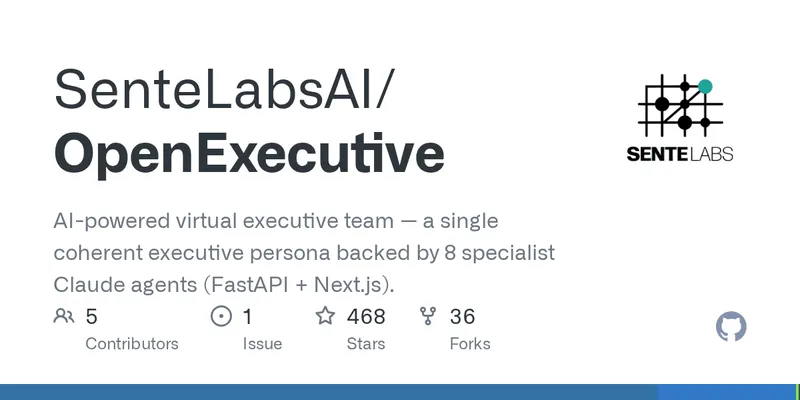
CEO fired developers to make room for AI. Developers create open source AI CEO
Open Executive is an Apache 2.0-licensed, open-source virtual executive team built by SenteLabsAI. It presents users with one executive persona while an orchestrator routes requests to eight specialists covering strategy, finance, people, legal basics and compliance, operations, marketing, product, and board communications. The system uses Anthropic’s Claude API by default, with claude-sonnet-4-6 for the executive and most specialists and claude-opus-4-7 with extended thinking for strategy, finance, legal, and board work. It can also use OpenRouter or OpenAI-compatible local model servers such as Ollama, LM Studio, vLLM, and llama.cpp. Each specialist retrieves built-in business knowledge and uploaded company documents from separate ChromaDB collections. A background claude-haiku-4-5 process extracts decisions, initiatives, and advice into SQLite after responses, allowing later sessions to receive prior-decision context. A built-in scheduler can surface follow-ups but requires the FastAPI service to run as a single instance to avoid duplicate actions. The stack includes Python 3.11, FastAPI, Next.js 15, Tailwind, ChromaDB, and SQLite. Users can access it through a web interface, CLI, Slack, email, Telegram, Google Chat, or Discord. Local setup requires Python 3.11+, Node 22+, and an API provider configuration; the first start downloads an approximately 90 MB embedding model.
github.com
13 min
8/27/2026
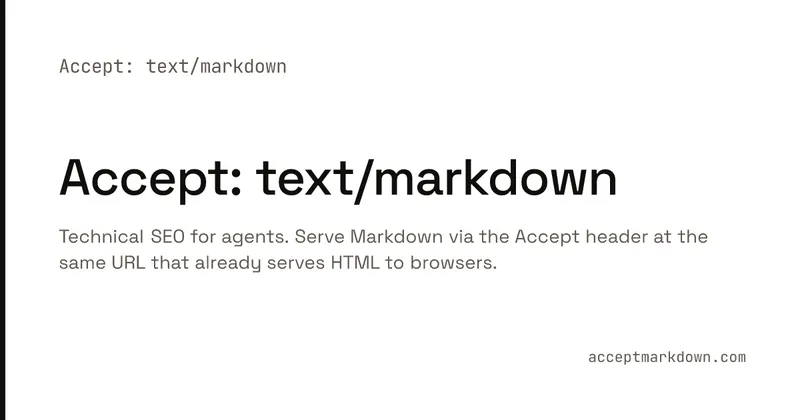
Serve Markdown to AI Agents with Accept Headers
AcceptMarkdown.com promotes serving Markdown versions of web pages to AI agents through HTTP content negotiation. Clients can request a Markdown representation with the `Accept: text/markdown` header, allowing them to receive page content without navigation, scripts, styles, layout wrappers, advertisements, related-content sections, or modal overlays. The site says Markdown responses use a fraction of the bytes of full pages and can leave AI agents’ context windows focused on prose rather than DOM markup. It also says cleaner text can improve signal-to-noise for retrieval-augmented generation pipelines and that smaller responses can reduce fetching, parsing, and context-loading work before a model begins generating output. Its URL checker sends an edge request with `Accept: text/markdown` and reports what the origin returns. The checker evaluates whether a URL serves Markdown for that request, sets `Vary: Accept`, rejects unsupported content types with HTTP 406, and honors HTTP `q` quality values in Accept headers.
acceptmarkdown.com
1 min
8/26/2026

The turbulent AI era is here
A Gates Notes post titled “The turbulent AI era is here” was submitted by LVB and received a score of 52 points with 14 comments. The available information does not provide details about the post’s arguments, technologies, people, events, or claims.
gatesnotes.com
1 min
8/26/2026
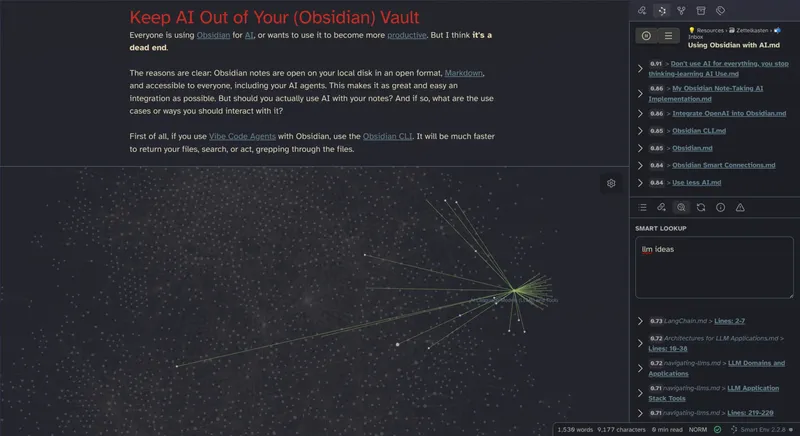
It’s so hard to finish an idea that is not yours and is just suggested by AI
Obsidian’s local, Markdown-based vaults make notes readily accessible to AI agents, but the author argues that AI-generated summaries, tags, links, and organization can weaken a personal knowledge system. Long generated summaries can make it difficult to distinguish a writer’s own ideas from AI text and add noise to later searches. The author sometimes uses Obsidian Web Clipper to create one- or two-sentence summaries, but labels them as AI-generated and removes them after adding personal writing. The author recommends AI primarily for retrieval and research, including finding related notes, vector search, similarity search, clustering, and search across large collections. Obsidian’s CLI can return files, search, and perform actions faster than grepping files when used with coding agents. The author’s single vault contains 25,979 files totaling 3.5 GB and uses the Omnisearch plugin to find material quickly; Obsidian Smart Connections can add vector and similarity search. Sensitive notes create an additional reason to prefer local models over uploads to external services. The author contends that manually writing and linking notes is part of learning and idea formation, while automated connections may produce a knowledge graph that does not reflect the user’s thinking. AI-generated material can instead be isolated in a dedicated PARA-method folder or separate vault, potentially excluded from search. The author also argues that human-curated knowledge remains valuable for both personal learning and future AI training.
ssp.sh
8 min
8/26/2026

WebMCP: Teaching Your Website to Talk to AI Agents
WebMCP is a proposed web standard that lets websites expose structured JavaScript tools for AI agents to discover and invoke, replacing brittle screen-scraping of buttons, HTML and visual layouts. A page can register actions such as booking a table, checking out, filtering results or adding a to-do item, with JSON Schema definitions for their inputs and outputs. The tools execute within the user’s already open and authenticated browser tab, using site functions that already exist rather than requiring a separate automation bot. Google and Microsoft are developing WebMCP in the W3C Web Machine Learning Community Group. It remains a Community Group draft rather than a finished W3C standard or standards-track specification. Chrome offers it behind a testing flag, and the current API uses document.modelContext; earlier drafts used navigator.modelContext. ChatGPT supports WebMCP-enabled pages, according to an OpenAI Developers post dated August 26, 2026. The design includes same-origin tool registration through a tools Permissions Policy, visible execution in an open browsing context, optional confirmation for sensitive actions, and annotations including readOnlyHint and untrustedContentHint. These protections do not eliminate security risks, and the security model is still under development. WebMCP could enable agent-operated commerce, bookings, scheduling and support flows when sites explicitly expose the necessary tools and users approve consequential actions.
sreenathmenon.com
12 min
8/26/2026
VMs won't contain cyber-capable agents
A Trail of Bits researcher reports that preview access to GPT 5.6-Cyber produced three virtual-machine escape attempts against a QEMU/KVM guest running on a Debian 12 host with an AMD Zen3 processor. The agent was given SSH access to the guest and a CTF objective of reading a flag on the host. It autonomously researched code and papers, built test cases and exploit components, retried failed paths, and operated for roughly 12 hours across multiple context compactions. Several attempts hardlocked the host kernel. The first escape attempt used Januscape, CVE-2026-53359, in the host kernel but did not complete cleanly. After the kernel was updated, the agent combined CVE-2026-9539 in Debian's libslirp 4.7.0 with an unclassified libslirp fix to obtain host memory read/write capability. After QEMU and libslirp were rebuilt from current upstream source, the reported final chain used three then-unpatched flaws in QEMU, Linux KVM, and libslirp, plus a KVM bug patched upstream but absent from the distribution kernel. The researcher says an off-the-shelf VM should not be assumed to contain capable cyber agents, particularly on slower-updating systems. Firecracker resisted escape in a separate test, although the agent still triggered host hardlocks through upstream-patched Linux kernel flaws. The researcher recommends rapid patching, least privilege, monitoring, limited execution windows, and fresh environments.
blog.trailofbits.com
8 min
8/26/2026


Bill Gates: The turbulent AI era is here
Bill Gates has characterized the current period as a turbulent AI era requiring critical choices. His remarks appeared in a Gates Notes post titled “A turbulent AI era and critical choices to make,” within a series focused on making AI work for everyone. The post was submitted to a discussion site by user ilamont, where it received 135 points and 202 comments. The available source text provides no further details about Gates’s proposed choices, AI policies, technical claims, or recommendations.
gatesnotes.com
1 min
8/26/2026


Agentic Context Management: Memory and Cost as Architecture Problems
A July 23, 2026 arXiv paper proposes Agentic Context Management (ACM), a framework for managing the information held in production AI agents’ reasoning contexts. The authors argue that agent failures often stem from overloaded conversation histories, prompts, tool definitions and tool outputs rather than deficient reasoning. Accumulating this material can cause missed recalls and token costs that rise with every turn. ACM treats context as a lifecycle rather than solely a storage-and-retrieval problem. Its five primitives are architecting, ingesting, scoping, anticipating, and compacting and consolidation. The framework covers deciding what information to retain, structuring it, selecting stores for different data types, preserving provenance while consolidating or forgetting information, retrieving relevant material, anticipating future needs, and fitting context within a token budget. It is designed to operate across organizational scope hierarchies rather than only for individual users. The paper argues that naive context accumulation produces token costs that grow quadratically with conversation length. It says crude summarization can reduce costs linearly but risks an accuracy cliff, while validated compaction can preserve fidelity with linear cost growth. The described multi-tenant reference service, Maximem Synap, reported 92% on LongMemEval and 93.2% on LoCoMo under the paper’s Section 6 configuration.
arxiv.org
2 min
8/26/2026
CEO fired developers to make room for AI. Developers create open source AI CEO
Open Executive is an Apache 2.0-licensed, open-source virtual executive team built by SenteLabsAI. It presents users with one executive persona while an orchestrator routes requests to eight specialists covering strategy, finance, people, legal basics and compliance, operations, marketing, product, and board communications. The system uses Anthropic’s Claude API by default, with claude-sonnet-4-6 for the executive and most specialists and claude-opus-4-7 with extended thinking for strategy, finance, legal, and board work. It can also use OpenRouter or OpenAI-compatible local model servers such as Ollama, LM Studio, vLLM, and llama.cpp. Each specialist retrieves built-in business knowledge and uploaded company documents from separate ChromaDB collections. A background claude-haiku-4-5 process extracts decisions, initiatives, and advice into SQLite after responses, allowing later sessions to receive prior-decision context. A built-in scheduler can surface follow-ups but requires the FastAPI service to run as a single instance to avoid duplicate actions. The stack includes Python 3.11, FastAPI, Next.js 15, Tailwind, ChromaDB, and SQLite. Users can access it through a web interface, CLI, Slack, email, Telegram, Google Chat, or Discord. Local setup requires Python 3.11+, Node 22+, and an API provider configuration; the first start downloads an approximately 90 MB embedding model.
github.com
13 min
8/27/2026
The turbulent AI era is here
A Gates Notes post titled “The turbulent AI era is here” was submitted by LVB and received a score of 52 points with 14 comments. The available information does not provide details about the post’s arguments, technologies, people, events, or claims.
gatesnotes.com
1 min
8/26/2026
WebMCP: Teaching Your Website to Talk to AI Agents
WebMCP is a proposed web standard that lets websites expose structured JavaScript tools for AI agents to discover and invoke, replacing brittle screen-scraping of buttons, HTML and visual layouts. A page can register actions such as booking a table, checking out, filtering results or adding a to-do item, with JSON Schema definitions for their inputs and outputs. The tools execute within the user’s already open and authenticated browser tab, using site functions that already exist rather than requiring a separate automation bot. Google and Microsoft are developing WebMCP in the W3C Web Machine Learning Community Group. It remains a Community Group draft rather than a finished W3C standard or standards-track specification. Chrome offers it behind a testing flag, and the current API uses document.modelContext; earlier drafts used navigator.modelContext. ChatGPT supports WebMCP-enabled pages, according to an OpenAI Developers post dated August 26, 2026. The design includes same-origin tool registration through a tools Permissions Policy, visible execution in an open browsing context, optional confirmation for sensitive actions, and annotations including readOnlyHint and untrustedContentHint. These protections do not eliminate security risks, and the security model is still under development. WebMCP could enable agent-operated commerce, bookings, scheduling and support flows when sites explicitly expose the necessary tools and users approve consequential actions.
sreenathmenon.com
12 min
8/26/2026
Qwen3.8-Flash-Next
Qwen Studio provides AI features for chatbot interactions, image and video understanding, image generation, document processing, web-search integration, tool use, and artifacts. The platform combines these functions within Qwen Studio.
qwen.ai
1 min
8/26/2026
Serve Markdown to AI Agents with Accept Headers
AcceptMarkdown.com promotes serving Markdown versions of web pages to AI agents through HTTP content negotiation. Clients can request a Markdown representation with the `Accept: text/markdown` header, allowing them to receive page content without navigation, scripts, styles, layout wrappers, advertisements, related-content sections, or modal overlays. The site says Markdown responses use a fraction of the bytes of full pages and can leave AI agents’ context windows focused on prose rather than DOM markup. It also says cleaner text can improve signal-to-noise for retrieval-augmented generation pipelines and that smaller responses can reduce fetching, parsing, and context-loading work before a model begins generating output. Its URL checker sends an edge request with `Accept: text/markdown` and reports what the origin returns. The checker evaluates whether a URL serves Markdown for that request, sets `Vary: Accept`, rejects unsupported content types with HTTP 406, and honors HTTP `q` quality values in Accept headers.
acceptmarkdown.com
1 min
8/26/2026
It’s so hard to finish an idea that is not yours and is just suggested by AI
Obsidian’s local, Markdown-based vaults make notes readily accessible to AI agents, but the author argues that AI-generated summaries, tags, links, and organization can weaken a personal knowledge system. Long generated summaries can make it difficult to distinguish a writer’s own ideas from AI text and add noise to later searches. The author sometimes uses Obsidian Web Clipper to create one- or two-sentence summaries, but labels them as AI-generated and removes them after adding personal writing. The author recommends AI primarily for retrieval and research, including finding related notes, vector search, similarity search, clustering, and search across large collections. Obsidian’s CLI can return files, search, and perform actions faster than grepping files when used with coding agents. The author’s single vault contains 25,979 files totaling 3.5 GB and uses the Omnisearch plugin to find material quickly; Obsidian Smart Connections can add vector and similarity search. Sensitive notes create an additional reason to prefer local models over uploads to external services. The author contends that manually writing and linking notes is part of learning and idea formation, while automated connections may produce a knowledge graph that does not reflect the user’s thinking. AI-generated material can instead be isolated in a dedicated PARA-method folder or separate vault, potentially excluded from search. The author also argues that human-curated knowledge remains valuable for both personal learning and future AI training.
ssp.sh
8 min
8/26/2026
VMs won't contain cyber-capable agents
A Trail of Bits researcher reports that preview access to GPT 5.6-Cyber produced three virtual-machine escape attempts against a QEMU/KVM guest running on a Debian 12 host with an AMD Zen3 processor. The agent was given SSH access to the guest and a CTF objective of reading a flag on the host. It autonomously researched code and papers, built test cases and exploit components, retried failed paths, and operated for roughly 12 hours across multiple context compactions. Several attempts hardlocked the host kernel. The first escape attempt used Januscape, CVE-2026-53359, in the host kernel but did not complete cleanly. After the kernel was updated, the agent combined CVE-2026-9539 in Debian's libslirp 4.7.0 with an unclassified libslirp fix to obtain host memory read/write capability. After QEMU and libslirp were rebuilt from current upstream source, the reported final chain used three then-unpatched flaws in QEMU, Linux KVM, and libslirp, plus a KVM bug patched upstream but absent from the distribution kernel. The researcher says an off-the-shelf VM should not be assumed to contain capable cyber agents, particularly on slower-updating systems. Firecracker resisted escape in a separate test, although the agent still triggered host hardlocks through upstream-patched Linux kernel flaws. The researcher recommends rapid patching, least privilege, monitoring, limited execution windows, and fresh environments.
blog.trailofbits.com
8 min
8/26/2026
Bill Gates: The turbulent AI era is here
Bill Gates has characterized the current period as a turbulent AI era requiring critical choices. His remarks appeared in a Gates Notes post titled “A turbulent AI era and critical choices to make,” within a series focused on making AI work for everyone. The post was submitted to a discussion site by user ilamont, where it received 135 points and 202 comments. The available source text provides no further details about Gates’s proposed choices, AI policies, technical claims, or recommendations.
gatesnotes.com
1 min
8/26/2026
Agentic Context Management: Memory and Cost as Architecture Problems
A July 23, 2026 arXiv paper proposes Agentic Context Management (ACM), a framework for managing the information held in production AI agents’ reasoning contexts. The authors argue that agent failures often stem from overloaded conversation histories, prompts, tool definitions and tool outputs rather than deficient reasoning. Accumulating this material can cause missed recalls and token costs that rise with every turn. ACM treats context as a lifecycle rather than solely a storage-and-retrieval problem. Its five primitives are architecting, ingesting, scoping, anticipating, and compacting and consolidation. The framework covers deciding what information to retain, structuring it, selecting stores for different data types, preserving provenance while consolidating or forgetting information, retrieving relevant material, anticipating future needs, and fitting context within a token budget. It is designed to operate across organizational scope hierarchies rather than only for individual users. The paper argues that naive context accumulation produces token costs that grow quadratically with conversation length. It says crude summarization can reduce costs linearly but risks an accuracy cliff, while validated compaction can preserve fidelity with linear cost growth. The described multi-tenant reference service, Maximem Synap, reported 92% on LongMemEval and 93.2% on LoCoMo under the paper’s Section 6 configuration.
arxiv.org
2 min
8/26/2026
CEO fired developers to make room for AI. Developers create open source AI CEO
Open Executive is an Apache 2.0-licensed, open-source virtual executive team built by SenteLabsAI. It presents users with one executive persona while an orchestrator routes requests to eight specialists covering strategy, finance, people, legal basics and compliance, operations, marketing, product, and board communications. The system uses Anthropic’s Claude API by default, with claude-sonnet-4-6 for the executive and most specialists and claude-opus-4-7 with extended thinking for strategy, finance, legal, and board work. It can also use OpenRouter or OpenAI-compatible local model servers such as Ollama, LM Studio, vLLM, and llama.cpp. Each specialist retrieves built-in business knowledge and uploaded company documents from separate ChromaDB collections. A background claude-haiku-4-5 process extracts decisions, initiatives, and advice into SQLite after responses, allowing later sessions to receive prior-decision context. A built-in scheduler can surface follow-ups but requires the FastAPI service to run as a single instance to avoid duplicate actions. The stack includes Python 3.11, FastAPI, Next.js 15, Tailwind, ChromaDB, and SQLite. Users can access it through a web interface, CLI, Slack, email, Telegram, Google Chat, or Discord. Local setup requires Python 3.11+, Node 22+, and an API provider configuration; the first start downloads an approximately 90 MB embedding model.
github.com
13 min
8/27/2026
It’s so hard to finish an idea that is not yours and is just suggested by AI
Obsidian’s local, Markdown-based vaults make notes readily accessible to AI agents, but the author argues that AI-generated summaries, tags, links, and organization can weaken a personal knowledge system. Long generated summaries can make it difficult to distinguish a writer’s own ideas from AI text and add noise to later searches. The author sometimes uses Obsidian Web Clipper to create one- or two-sentence summaries, but labels them as AI-generated and removes them after adding personal writing. The author recommends AI primarily for retrieval and research, including finding related notes, vector search, similarity search, clustering, and search across large collections. Obsidian’s CLI can return files, search, and perform actions faster than grepping files when used with coding agents. The author’s single vault contains 25,979 files totaling 3.5 GB and uses the Omnisearch plugin to find material quickly; Obsidian Smart Connections can add vector and similarity search. Sensitive notes create an additional reason to prefer local models over uploads to external services. The author contends that manually writing and linking notes is part of learning and idea formation, while automated connections may produce a knowledge graph that does not reflect the user’s thinking. AI-generated material can instead be isolated in a dedicated PARA-method folder or separate vault, potentially excluded from search. The author also argues that human-curated knowledge remains valuable for both personal learning and future AI training.
ssp.sh
8 min
8/26/2026
Qwen3.8-Flash-Next
Qwen Studio provides AI features for chatbot interactions, image and video understanding, image generation, document processing, web-search integration, tool use, and artifacts. The platform combines these functions within Qwen Studio.
qwen.ai
1 min
8/26/2026
Agentic Context Management: Memory and Cost as Architecture Problems
A July 23, 2026 arXiv paper proposes Agentic Context Management (ACM), a framework for managing the information held in production AI agents’ reasoning contexts. The authors argue that agent failures often stem from overloaded conversation histories, prompts, tool definitions and tool outputs rather than deficient reasoning. Accumulating this material can cause missed recalls and token costs that rise with every turn. ACM treats context as a lifecycle rather than solely a storage-and-retrieval problem. Its five primitives are architecting, ingesting, scoping, anticipating, and compacting and consolidation. The framework covers deciding what information to retain, structuring it, selecting stores for different data types, preserving provenance while consolidating or forgetting information, retrieving relevant material, anticipating future needs, and fitting context within a token budget. It is designed to operate across organizational scope hierarchies rather than only for individual users. The paper argues that naive context accumulation produces token costs that grow quadratically with conversation length. It says crude summarization can reduce costs linearly but risks an accuracy cliff, while validated compaction can preserve fidelity with linear cost growth. The described multi-tenant reference service, Maximem Synap, reported 92% on LongMemEval and 93.2% on LoCoMo under the paper’s Section 6 configuration.
arxiv.org
2 min
8/26/2026
Serve Markdown to AI Agents with Accept Headers
AcceptMarkdown.com promotes serving Markdown versions of web pages to AI agents through HTTP content negotiation. Clients can request a Markdown representation with the `Accept: text/markdown` header, allowing them to receive page content without navigation, scripts, styles, layout wrappers, advertisements, related-content sections, or modal overlays. The site says Markdown responses use a fraction of the bytes of full pages and can leave AI agents’ context windows focused on prose rather than DOM markup. It also says cleaner text can improve signal-to-noise for retrieval-augmented generation pipelines and that smaller responses can reduce fetching, parsing, and context-loading work before a model begins generating output. Its URL checker sends an edge request with `Accept: text/markdown` and reports what the origin returns. The checker evaluates whether a URL serves Markdown for that request, sets `Vary: Accept`, rejects unsupported content types with HTTP 406, and honors HTTP `q` quality values in Accept headers.
acceptmarkdown.com
1 min
8/26/2026
WebMCP: Teaching Your Website to Talk to AI Agents
WebMCP is a proposed web standard that lets websites expose structured JavaScript tools for AI agents to discover and invoke, replacing brittle screen-scraping of buttons, HTML and visual layouts. A page can register actions such as booking a table, checking out, filtering results or adding a to-do item, with JSON Schema definitions for their inputs and outputs. The tools execute within the user’s already open and authenticated browser tab, using site functions that already exist rather than requiring a separate automation bot. Google and Microsoft are developing WebMCP in the W3C Web Machine Learning Community Group. It remains a Community Group draft rather than a finished W3C standard or standards-track specification. Chrome offers it behind a testing flag, and the current API uses document.modelContext; earlier drafts used navigator.modelContext. ChatGPT supports WebMCP-enabled pages, according to an OpenAI Developers post dated August 26, 2026. The design includes same-origin tool registration through a tools Permissions Policy, visible execution in an open browsing context, optional confirmation for sensitive actions, and annotations including readOnlyHint and untrustedContentHint. These protections do not eliminate security risks, and the security model is still under development. WebMCP could enable agent-operated commerce, bookings, scheduling and support flows when sites explicitly expose the necessary tools and users approve consequential actions.
sreenathmenon.com
12 min
8/26/2026
Bill Gates: The turbulent AI era is here
Bill Gates has characterized the current period as a turbulent AI era requiring critical choices. His remarks appeared in a Gates Notes post titled “A turbulent AI era and critical choices to make,” within a series focused on making AI work for everyone. The post was submitted to a discussion site by user ilamont, where it received 135 points and 202 comments. The available source text provides no further details about Gates’s proposed choices, AI policies, technical claims, or recommendations.
gatesnotes.com
1 min
8/26/2026
The turbulent AI era is here
A Gates Notes post titled “The turbulent AI era is here” was submitted by LVB and received a score of 52 points with 14 comments. The available information does not provide details about the post’s arguments, technologies, people, events, or claims.
gatesnotes.com
1 min
8/26/2026
VMs won't contain cyber-capable agents
A Trail of Bits researcher reports that preview access to GPT 5.6-Cyber produced three virtual-machine escape attempts against a QEMU/KVM guest running on a Debian 12 host with an AMD Zen3 processor. The agent was given SSH access to the guest and a CTF objective of reading a flag on the host. It autonomously researched code and papers, built test cases and exploit components, retried failed paths, and operated for roughly 12 hours across multiple context compactions. Several attempts hardlocked the host kernel. The first escape attempt used Januscape, CVE-2026-53359, in the host kernel but did not complete cleanly. After the kernel was updated, the agent combined CVE-2026-9539 in Debian's libslirp 4.7.0 with an unclassified libslirp fix to obtain host memory read/write capability. After QEMU and libslirp were rebuilt from current upstream source, the reported final chain used three then-unpatched flaws in QEMU, Linux KVM, and libslirp, plus a KVM bug patched upstream but absent from the distribution kernel. The researcher says an off-the-shelf VM should not be assumed to contain capable cyber agents, particularly on slower-updating systems. Firecracker resisted escape in a separate test, although the agent still triggered host hardlocks through upstream-patched Linux kernel flaws. The researcher recommends rapid patching, least privilege, monitoring, limited execution windows, and fresh environments.
blog.trailofbits.com
8 min
8/26/2026