Latest stories
Story · 1 report
OccupySaaS
OccupySaaS is an open-source movement building clean-room, self-hostable replacements for subscription software using public documentation, open standards and compatibility testing against vendors’ public SDKs. It says laid-off engineers and AI agents can recreate widely used SaaS APIs without proprietary code, leaked information, decompiled binaries, copied UI assets or trademarks. Projects publish CLEAN_ROOM.md policies and record the provenance of fixtures and references; humans write specifications and review code changes. The first two projects are ZeroAuthy, an identity server intended to work with Auth0 client SDKs without application code changes, and SalesCompel, a Salesforce-compatible CRM under development. ZeroAuthy supports OIDC discovery, JWKS, multi-tenant domains, hosted login, authorization-code flow with PKCE, client credentials, rotating refresh tokens, revocation and logout. It has been tested with auth0-spa-js, auth0-react and nextjs-auth0. SalesCompel has a Go and PostgreSQL backend, a Vue record editor, Account and Contact CRUD, limited queries, external-ID upserts, bearer authentication and an OpenAPI 3.2 REST contract. Both projects are early and not production-ready. They are released under Apache License 2.0, with no required telemetry or seat-based pricing. OccupySaaS says it is independent of Auth0, Okta and Salesforce, and plans to consider further targets including documentation, issue tracking, feature flags, observability and customer support software.
occupysaas.com
🔥🔥🔥🔥🔥1 min summary
11/2/2026
Story · 1 report
It wasn't AI that flipped Proton's charge
Proton CEO Andy Yen reportedly told an engineer that requesting several days to penetration-test new code before release was “bullshit and loser thinking,” while urging staff to stop “lovingly handcrafting code” and use AI more. The reported exchange occurred in Proton’s security Slack channel and followed leadership’s push to expand AI use inside the privacy-focused company. The criticism centers on Proton’s leadership and software-release practices rather than on AI-generated code itself. AI coding tools can be used with review, testing, and clear accountability for production releases. Proton’s products depend on user confidence that security-sensitive software, including email services, is developed and tested carefully; a flaw exposing user mail could seriously damage that trust. Staff were reportedly told that their AI use could affect whether they retained their jobs. After that plan was dropped following a leak, Yen reportedly said it had already served its purpose. A Proton employee writing on Reddit said Yen supported penetration testing provided it did not slow the release pipeline. The reported events have raised questions about whether Proton can maintain security testing standards while leadership prioritizes release speed and AI adoption.
blog.raed.dev
🔥🔥🔥🔥🔥1 min summary
11/1/2026
Story · 1 report
I Am the Reason OpenAI Is Killing Unlimited Chats
OpenAI has announced changes that, according to the developer, will end unlimited ChatGPT chats and combine their usage with Codex limits. The developer had used regular ChatGPT conversations as coding agents by connecting them to tools running on a Windows laptop and a VPS through custom Model Context Protocol servers and OpenAI’s Secure MCP Tunnel. The setup combined Desktop Commander, which provided file access, code editing, terminal execution, testing, and process management, with a Computer Use Agent integration for screenshots, mouse input, visual inspection, and browser or desktop testing. The developer modified the integration so captured screenshots could render in ChatGPT through a custom MCP App viewer, and built a dashboard to manage the MCP connection, monitor system resources, and view tool calls and failures. For larger projects, the developer used Astra in Codex or ChatGPT’s limited Pro model to produce implementation plans and GitHub issues, then assigned separate issues to multiple ChatGPT conversations running Sol 6 High. Those conversations could edit code, run tests, and debug against the shared environment. The developer says the workflow relied on effectively unlimited Sol High usage while reserving premium-model limits for planning, architecture, and reviews, and plans to switch to Claude after the changes.
chaosmanage.github.io
🔥🔥🔥🔥🔥2 min summary
11/1/2026
Story · 1 report
The AI cost of JavaScript frameworks
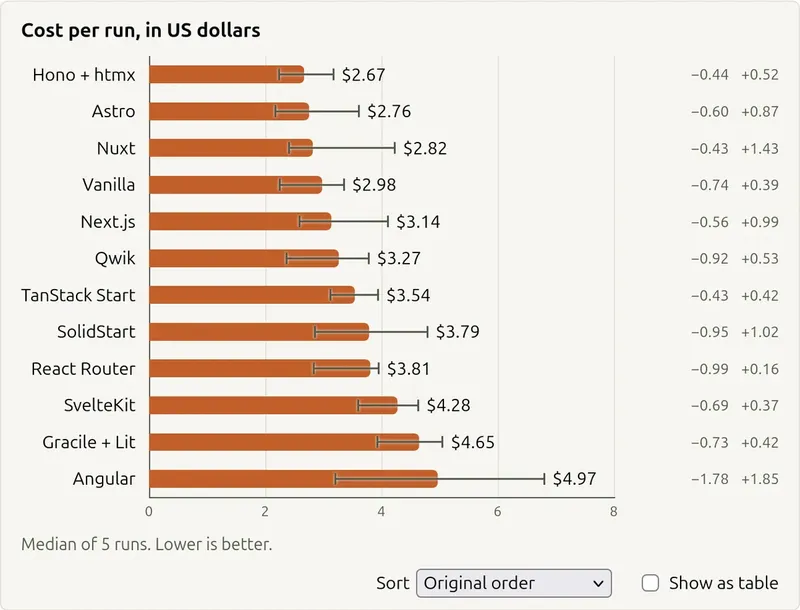
Nolan Lawson benchmarked Claude Opus 5.5 building the same Pokémon data application with 12 JavaScript framework setups, measuring estimated API cost, build time, token use, code size, spec conformance, and Chromium Lighthouse results. Each framework generally received five sandboxed runs; Angular received three valid runs after two generated SSR applications failed reverse-proxy requirements. Agents were told to use current framework versions and received official MCP tools or skills where available, but their use varied substantially. Median estimated generation costs ranged from $2.67 for Hono plus htmx to $4.97 for Angular. Astro had the shortest median build duration at 8.2 minutes, while Angular took 17.2 minutes. Hono plus htmx generated the fewest lines of code, 1,370, compared with Angular’s 2,009. Lighthouse performance and accessibility scores were nearly uniform: most implementations scored 100 for both, while all scored 100 for accessibility. Astro shipped no client-side JavaScript in the median result and had the fastest reported median LCP at 810 ms; Next.js shipped 142 KB of JavaScript and recorded a 2,090 ms LCP. Results came from one relatively content-focused application, and Lawson noted variability in agent behavior and Lighthouse measurements. He also noted that Lighthouse metrics favor multi-page applications over SPAs and that other application types or metrics could yield different results.
nolanlawson.com
🔥🔥🔥🔥🔥2 min summary
11/1/2026
Story · 1 report
HackerTube: YouTube built from videos recommended by HN
HackerTube is a YouTube-style site that surfaces videos recommended in Hacker News comments rather than relying on YouTube’s recommendation system. Built over roughly two hours with Anthropic’s Opus 5.5 through Claude Code, the site indexes 6,454 YouTube videos drawn from about 40,000 Hacker News comments posted between 2007 and 2026, organized across 150 topics. Opus downloaded and filtered Hacker News comments, used Sonnet in a Claude Code workflow to remove spam, identified comments recommending YouTube videos, and generated the site’s interface and deployment. HackerTube uses a frame taken halfway through each video instead of the creator-uploaded thumbnail. It also provides personalized “For You” recommendations without user accounts, retaining state in the local browser session, along with keyboard shortcuts and an export of the site’s data for users who want to build a similar service. The creator used Claude Code’s Mac desktop application with Opus 5.5 set to Medium effort. Manual steps were limited to creating a Google Cloud API key for YouTube metadata, starting a VPS, and purchasing the Hackertube.org domain. After receiving the VPS IP address, Claude Code updated, deployed, secured, hardened, and optimized the software, according to the creator.
karpathy.bearblog.dev
🔥🔥🔥🔥🔥1 min summary
10/31/2026
Story · 1 report
Anthropic's Claude AI blocks video game cloning and reverse-engineering
Users have reported that Anthropic’s Claude Code and Claude Opus 5.5 are refusing some requests involving video-game recreation, game mechanics, reverse engineering, security work, and routine software troubleshooting. Claude Code’s GitHub repository has received complaints from developers who say the system stopped assisting with ongoing game-development tasks, including mechanic replication and patches. Other users claim Claude refused work involving the Reverse Engineer Anything tool, a Windows crash dump, Samsung TV junkware removal, anti-cheat development, and security reviews of their own games. A user known as Chasm posted purported rule text directing Claude to build original games, genre-based games, and projects using a user’s own designs and assets, while not recreating a specific existing game even under a different name. Anthropic has not confirmed that wording or issued a public statement on the reported refusals. Anthropic launched its Cyber Verification Program on October 6, limiting access to frontier-model cybersecurity capabilities to entities covered by Project Glasswing. The timing has led users to speculate that cybersecurity safeguards may be contributing to some refusals, though no connection has been confirmed. The restrictions follow concerns over AI-assisted game clones and reports that some developers have faced threats to clone unfinished game demos.
tomshardware.com
🔥🔥🔥🔥🔥1 min summary
10/31/2026
Story · 1 report
Prospero: A new coding harness for a more civilized age
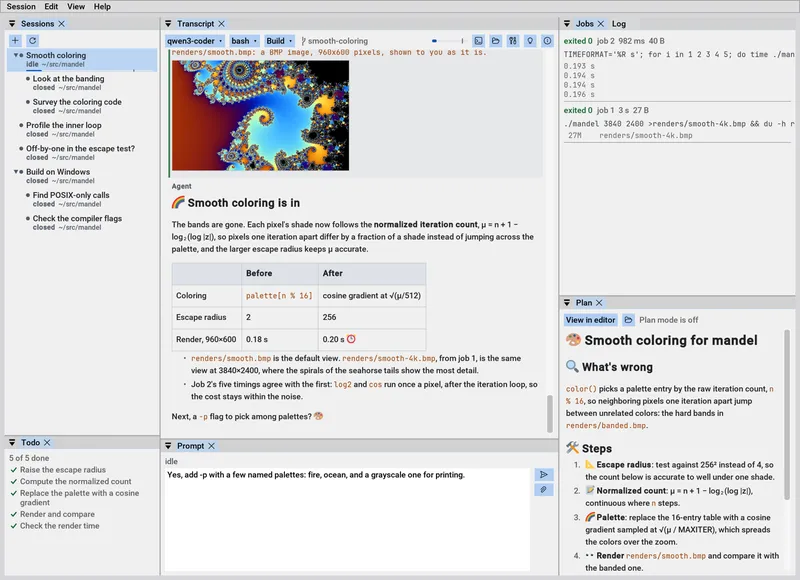
Prospero is a C++ coding harness for AI agents that the developer says uses roughly two orders of magnitude fewer resources than other available harnesses. It provides a Dear ImGui docking interface but does not include model providers; users can connect local or remote services such as llama.cpp, on-premises models, OpenRouter, Anthropic API, or OpenAI API. Agents can read and write files, run shell commands, spawn subagents, use Git worktrees, access MCP tools, search the web when enabled, and operate remotely through headless deployments over SSH or WSL. Vision-capable models can inspect and control the desktop through clicking, typing, and dragging, allowing live GUI testing without a per-application MCP integration. Prospero supports headless engines across x86/x86-64 and ARM64 combinations on macOS, Windows, and Linux; its Windows x86 engine also works on Windows XP. Its passive-rendering interface goes idle when no work is pending, rather than continuously redrawing. The software applies deadlines to operations, network requests, permissions, and agent communication to avoid indefinite waits, except in Plan mode. Timed-out shell commands become asynchronous background tasks, and Prospero is designed to terminate an entire process tree when a command stops. The free Community Edition is available on GitHub without built-in headless engines, while a DRM-free paid Professional Edition includes those engines and free updates. Both Windows and macOS builds are code-signed.
nullprogram.com
🔥🔥🔥🔥🔥2 min summary
10/31/2026
Story · 1 report
Product Managers aren't safe either
A programmer who worked on data-marketing products and later joined Cloudflare through its acquisition of YC company Zaraz argues that generative AI threatens a far broader range of jobs than software development. He says routine “code spitter” work is especially vulnerable as highly capable developers use AI to produce software faster, while AI agents and eventually coordinated agent systems could further displace developers. He distinguishes software architecture from routine implementation, arguing that architecture still requires private organizational data, interpersonal work, and trade-offs among security, compliance, technical capability, and budgets. He compares generative AI’s effect on developers with smartphone photography’s effect on professional photographers: in his view, it erodes the advantage held by most practitioners while increasing the value of a smaller group with difficult-to-copy expertise. He also argues that product managers face similar pressure because developers can use LLMs to prototype or build features and spend more time understanding customer problems, company context, assumptions, and design trade-offs. He expects technical and product roles to increasingly merge into one function, and says product managers should develop durable technical skills, particularly architecture and practical programming, such as text-file analysis in concise code.
lucaskostka.com
🔥🔥🔥🔥🔥1 min summary
10/30/2026
Story · 1 report
A Working Nintendo in ~1GB of Qwen Weights
Nesformer compiles an NES 6502 CPU, 2 KB of work RAM and up to 32 KB of cartridge program ROM into the weights and Gated DeltaNet state of a Qwen3_5ForCausalLM checkpoint. Rather than training the model, a compiler calculates its weights so that greedy token generation produces the CPU execution trace one token at a time. A host program supplies controller input, renders graphics, handles vblank timing and injects NMI interrupts, while the model holds CPU registers, RAM and cartridge data. The 466.6 million-parameter bf16 checkpoint occupies 933 MB uncompressed but compresses to 3.3 MB because only 9.3 million parameters are nonzero. It uses seven Gated DeltaNet layers, with each head’s 128-by-128 state matrix serving as addressable memory. The same weights can run NROM, or iNES mapper 0, games including Super Mario Bros., Donkey Kong and Excitebike when users provide ROM files. Nesformer reports that its bundled test runs produced CPU traces and rendered frames matching a conventional 6502 emulator, including a 600-frame Thwaite run and a 420-frame Full Game run. Its numba-based engine runs at roughly 1,650 tokens per second on one CPU core, while an NES would require about 700,000 tokens per second; idle-loop skipping leaves reported frames and I/O writes unchanged. Limitations include no mapper support, unofficial opcodes, IRQs, PRG-RAM, sound or full PPU accuracy.
github.com
🔥🔥🔥🔥🔥2 min summary
10/30/2026
Story · 1 report
AI isn't replacing SREs, it's deskilling them
AI is automating an increasing share of site reliability engineering work, including alert grouping, runbook execution, log-pattern detection, anomaly flagging, root-cause suggestions, and remediation of known failures such as restarting crashed pods or scaling overloaded services. PagerDuty describes a tiered model in which known incidents are fully automated, partially understood incidents receive AI recommendations subject to human validation, and novel or cascading failures remain human-led. SigNoz argues that this division of work could deskill SREs by removing the repeated hands-on practice that builds incident-response intuition. The argument draws on Lisanne Bainbridge’s 1983 paper, “Ironies of Automation,” which found that automation can leave operators responsible for rare, high-stakes failures while reducing their ability to handle them. The source cites a study in which AI-assisted endoscopists’ unassisted polyp-detection rates fell from 28% to 22%, and says aviation research has linked heavy autopilot use with reduced situational awareness and manual flying ability. The risk extends to junior SREs who may never acquire foundational troubleshooting skills if AI handles routine incidents. SigNoz recommends deliberate human practice on some automatable incidents and systems that keep operators actively engaged alongside AI. It plans to begin with an assistant that keeps humans in control and later add autonomy within guardrails.
newsletter.signoz.io
🔥🔥🔥🔥🔥2 min summary
10/30/2026