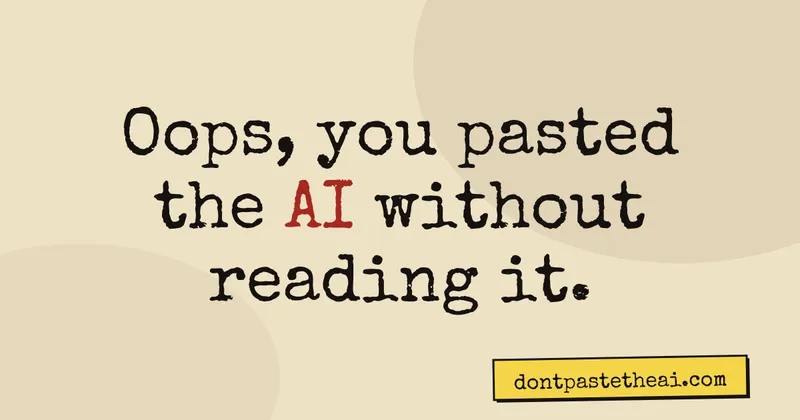
Don't Paste the AI, please
Don’t Paste the AI is a website urging people not to send unedited chatbot responses when answering others’ questions in direct messages, Slack conversations, or pull-request reviews. It argues that people ask specific individuals for their context, taste, and judgment rather than generic answers that they could generate themselves with the same AI tools. The site recommends using AI as a drafting partner, then reading its output and writing an original response. It advises extracting only the portion that answers the question, suggesting that three sentences can be enough. Useful model-generated material can be quoted when accompanied by an explanation of why it is relevant, such as noting that a point was checked with Claude. The site also says that saying “No strong opinion here” can be a helpful response when the sender has nothing to add. Don’t Paste the AI provides a link intended for sharing with people who send large blocks of model output and offers a separate, more confrontational “angry version.” It describes itself as written by a human on purpose.
dontpastetheai.com
2 min
8/20/2026

Analyst gets probation after telling ChatGPT about plans to rape and kill his ex
Darren Zhou, a 25-year-old financial analyst at Goldman Sachs, was sentenced to eight years of probation for communicating plans to kidnap, rape, and kill his ex-girlfriend to ChatGPT. His arrest followed reports made to the FBI by the AI company regarding his messages over several months.
miamiherald.com
1 min
8/15/2026

Why thinking out loud with someone beats thinking alone
Engaging in dialogue with others can lead to enhanced problem-solving and productivity. Collaborative conversations often yield better results than solitary thinking, even when participants do not have direct answers.
thesignalist.io
8 min
6/17/2026

It's Not Just X. It's Y
Large Language Models often utilize a construction known as negative parallelism, which establishes contrasts to reframe assumptions. This linguistic style is prevalent on social media platforms, particularly LinkedIn, and has generated significant discussion.
mail.cyberneticforests.com
10 min
5/31/2026
![US v. Heppner (S.D.N.Y. 2026) no attorney-client privilege for AI chats [pdf]](https://pub-90f0ac00d93c47daac3e1d2cdd28d496.r2.dev/articles/3b2d8d01b7e372f04e4db70046ea5740.webp)
US v. Heppner (S.D.N.Y. 2026) no attorney-client privilege for AI chats [pdf]
In the case of US v. Heppner, the court ruled that communications involving AI chat tools do not qualify for attorney-client privilege. This decision establishes that interactions with AI systems can be subject to disclosure in legal proceedings.
fingfx.thomsonreuters.com
1 min
4/15/2026
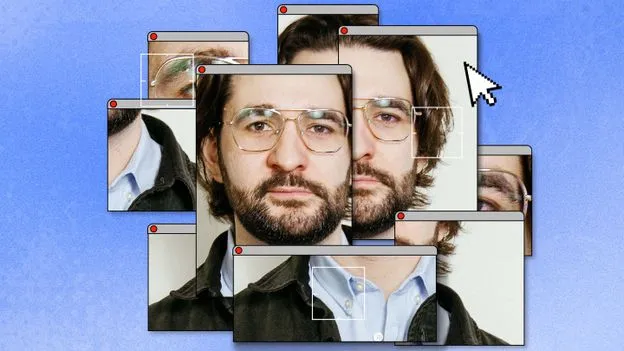
I tried to prove I'm not AI. My aunt wasn't convinced
AI deepfakes have become so convincing that even close relatives, like an aunt, may struggle to distinguish between a real person and a deepfake. A sitting prime minister also faced challenges proving his authenticity amid concerns over AI-generated impersonations.
bbc.com
9 min
3/25/2026


Don't Paste the AI, please
Don’t Paste the AI is a website urging people not to send unedited chatbot responses when answering others’ questions in direct messages, Slack conversations, or pull-request reviews. It argues that people ask specific individuals for their context, taste, and judgment rather than generic answers that they could generate themselves with the same AI tools. The site recommends using AI as a drafting partner, then reading its output and writing an original response. It advises extracting only the portion that answers the question, suggesting that three sentences can be enough. Useful model-generated material can be quoted when accompanied by an explanation of why it is relevant, such as noting that a point was checked with Claude. The site also says that saying “No strong opinion here” can be a helpful response when the sender has nothing to add. Don’t Paste the AI provides a link intended for sharing with people who send large blocks of model output and offers a separate, more confrontational “angry version.” It describes itself as written by a human on purpose.
dontpastetheai.com
2 min
8/20/2026
Why thinking out loud with someone beats thinking alone
Engaging in dialogue with others can lead to enhanced problem-solving and productivity. Collaborative conversations often yield better results than solitary thinking, even when participants do not have direct answers.
thesignalist.io
8 min
6/17/2026
US v. Heppner (S.D.N.Y. 2026) no attorney-client privilege for AI chats [pdf]
In the case of US v. Heppner, the court ruled that communications involving AI chat tools do not qualify for attorney-client privilege. This decision establishes that interactions with AI systems can be subject to disclosure in legal proceedings.
fingfx.thomsonreuters.com
1 min
4/15/2026
Analyst gets probation after telling ChatGPT about plans to rape and kill his ex
Darren Zhou, a 25-year-old financial analyst at Goldman Sachs, was sentenced to eight years of probation for communicating plans to kidnap, rape, and kill his ex-girlfriend to ChatGPT. His arrest followed reports made to the FBI by the AI company regarding his messages over several months.
miamiherald.com
1 min
8/15/2026
It's Not Just X. It's Y
Large Language Models often utilize a construction known as negative parallelism, which establishes contrasts to reframe assumptions. This linguistic style is prevalent on social media platforms, particularly LinkedIn, and has generated significant discussion.
mail.cyberneticforests.com
10 min
5/31/2026
I tried to prove I'm not AI. My aunt wasn't convinced
AI deepfakes have become so convincing that even close relatives, like an aunt, may struggle to distinguish between a real person and a deepfake. A sitting prime minister also faced challenges proving his authenticity amid concerns over AI-generated impersonations.
bbc.com
9 min
3/25/2026
Don't Paste the AI, please
Don’t Paste the AI is a website urging people not to send unedited chatbot responses when answering others’ questions in direct messages, Slack conversations, or pull-request reviews. It argues that people ask specific individuals for their context, taste, and judgment rather than generic answers that they could generate themselves with the same AI tools. The site recommends using AI as a drafting partner, then reading its output and writing an original response. It advises extracting only the portion that answers the question, suggesting that three sentences can be enough. Useful model-generated material can be quoted when accompanied by an explanation of why it is relevant, such as noting that a point was checked with Claude. The site also says that saying “No strong opinion here” can be a helpful response when the sender has nothing to add. Don’t Paste the AI provides a link intended for sharing with people who send large blocks of model output and offers a separate, more confrontational “angry version.” It describes itself as written by a human on purpose.
dontpastetheai.com
2 min
8/20/2026
It's Not Just X. It's Y
Large Language Models often utilize a construction known as negative parallelism, which establishes contrasts to reframe assumptions. This linguistic style is prevalent on social media platforms, particularly LinkedIn, and has generated significant discussion.
mail.cyberneticforests.com
10 min
5/31/2026
Analyst gets probation after telling ChatGPT about plans to rape and kill his ex
Darren Zhou, a 25-year-old financial analyst at Goldman Sachs, was sentenced to eight years of probation for communicating plans to kidnap, rape, and kill his ex-girlfriend to ChatGPT. His arrest followed reports made to the FBI by the AI company regarding his messages over several months.
miamiherald.com
1 min
8/15/2026
US v. Heppner (S.D.N.Y. 2026) no attorney-client privilege for AI chats [pdf]
In the case of US v. Heppner, the court ruled that communications involving AI chat tools do not qualify for attorney-client privilege. This decision establishes that interactions with AI systems can be subject to disclosure in legal proceedings.
fingfx.thomsonreuters.com
1 min
4/15/2026
Why thinking out loud with someone beats thinking alone
Engaging in dialogue with others can lead to enhanced problem-solving and productivity. Collaborative conversations often yield better results than solitary thinking, even when participants do not have direct answers.
thesignalist.io
8 min
6/17/2026
I tried to prove I'm not AI. My aunt wasn't convinced
AI deepfakes have become so convincing that even close relatives, like an aunt, may struggle to distinguish between a real person and a deepfake. A sitting prime minister also faced challenges proving his authenticity amid concerns over AI-generated impersonations.
bbc.com
9 min
3/25/2026
No more articles to load