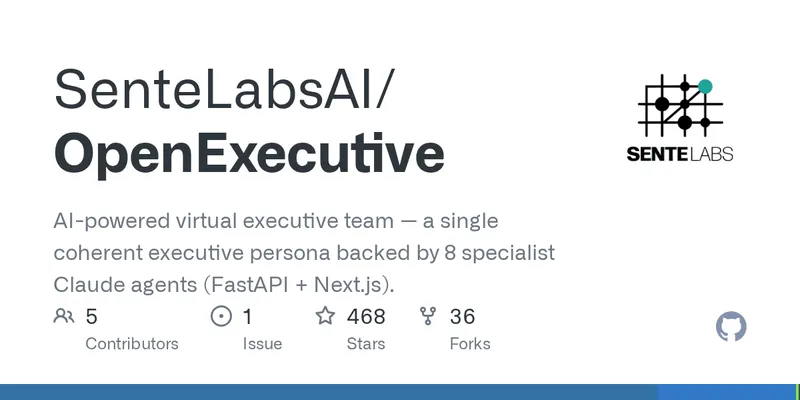
CEO fired developers to make room for AI. Developers create open source AI CEO
Open Executive is an Apache 2.0-licensed, open-source virtual executive team built by SenteLabsAI. It presents users with one executive persona while an orchestrator routes requests to eight specialists covering strategy, finance, people, legal basics and compliance, operations, marketing, product, and board communications. The system uses Anthropic’s Claude API by default, with claude-sonnet-4-6 for the executive and most specialists and claude-opus-4-7 with extended thinking for strategy, finance, legal, and board work. It can also use OpenRouter or OpenAI-compatible local model servers such as Ollama, LM Studio, vLLM, and llama.cpp. Each specialist retrieves built-in business knowledge and uploaded company documents from separate ChromaDB collections. A background claude-haiku-4-5 process extracts decisions, initiatives, and advice into SQLite after responses, allowing later sessions to receive prior-decision context. A built-in scheduler can surface follow-ups but requires the FastAPI service to run as a single instance to avoid duplicate actions. The stack includes Python 3.11, FastAPI, Next.js 15, Tailwind, ChromaDB, and SQLite. Users can access it through a web interface, CLI, Slack, email, Telegram, Google Chat, or Discord. Local setup requires Python 3.11+, Node 22+, and an API provider configuration; the first start downloads an approximately 90 MB embedding model.
github.com
13 min
8/27/2026
LLMs could control their host machines by exploiting inference engines
Large language models could potentially compromise the GPU-equipped machines that run their inference by emitting token sequences that exploit bugs in inference-engine software, Boyd Kane argues. These machines are high-value targets because they host model weights, provide enough compute for frontier models, and may have privileged access to other datacentre systems. Inference engines such as vLLM and SGLang do more than convert tokens into text: they parse chat formats, tool calls, reasoning blocks, and model-specific output structures. Kane cites CVE-2025-9141, an arbitrary-code-execution flaw in vLLM’s XML tool parser for Qwen3 Coder. The parser sent nearly all tool-call arguments to Python’s eval(), allowing an LLM to execute arbitrary code on the host machine; Gemini reportedly flagged the pull request that introduced the flaw as critical before it was force-merged. Kane also notes a separate vLLM parsing error in which the text "<mm:think>" was interpreted as a reasoning-block marker. He considers vulnerability discovery the harder part of such an attack, but expects a frontier model with access to relevant code and context could reproduce an exploit sequence once found. Proposed mitigations include separating GPU computation from token sampling and parsing onto different computers, red-teaming inference engines, and restricting GPU-host permissions while treating their output as untrusted.
boydkane.com
5 min
8/24/2026

Fences, Not Sandboxes
Steve Yegge says he runs Wheelhouse, a 50-60-agent software operation that builds and operates his long-running game Wyvern. The system uses 21 Claude Max accounts on a 512GB M3 Ultra Mac Studio, which he says represents roughly $122,000 a month in API-token value but costs him about $5,000 monthly through individual-plan discounts. Over nearly 10 weeks, Yegge says the agents helped prepare Wyvern for Android, iOS and Steam, rewrote its production infrastructure for serverless operation, and process an average of 270 commits a day. Yegge says Wheelhouse developed a text-based governance system rather than relying solely on sandboxing agents. It contains about 450 legal artifacts, including offices, runbooks, rulings, tripwires and authority envelopes. Rules can progress from customs and warnings to constitutional requirements and automated enforcement. More than 100 “fences” restrict actions based on role, credentials or policy; for example, only the Fable model is permitted to communicate externally with people through Slack and email. Yegge characterizes current models as capable but prone to poor judgment, and argues that organizations deploying large AI workforces will need to document institutional knowledge and establish evolving, machine-enforceable rules for agent coordination.
yegge.ai
17 min
8/24/2026

Agent Is Not the Model
An AI agent system combines a model, an inference service and a harness rather than consisting of the model alone. Models such as Anthropic’s Sonnet and Opus, Google’s Gemini, and OpenAI’s GPT transform input tokens into output tokens. They generally run through hosted inference services, including Anthropic’s API, AWS Bedrock and OpenAI’s infrastructure, because frontier models require substantial compute and memory. These services process API calls and track usage and pricing. The harness supplies the user-facing interface and operational logic around a model. It assembles context, defines and routes tool calls, interprets model outputs, and can interact with files or external systems. MCP servers and Skills are primarily harness-layer features: the harness determines which tools and context the model receives. Claude Desktop, Claude CLI, Cursor, ChatGPT and custom LangChain applications each pair a harness with one or more inference providers and models. The same model can produce different behavior in different agent systems because each harness shapes its prompts, available context and tools. Diagnosing problems therefore depends on identifying the relevant layer: missing context and unavailable tools usually involve the harness, slow responses involve inference infrastructure, and high cost can depend on the selected model or inference service. The source also argues that more capable models could reduce the usefulness of some current harness mechanisms, including Skills and MCP.
code.joejag.com
5 min
8/24/2026

Anthropic Claude and API service outages
The Claude status page displayed interface text for one-time password resend controls, including a 30-second countdown and a “Didn’t receive the OTP?” prompt. It also showed guidance related to locating a Teams channel URL and entering the URL to receive webhooks. The page stated that email notifications would be sent if a webhook endpoint fails. No operational status, incident details, service metrics, dates, or performance information were included in the supplied text.
status.claude.com
1 min
8/24/2026

Why is Anthropic's public writing style so unlike Claude's?
Claude is described as having a recognizable English-language writing style marked by short, punchy sentences and unusual rhetorical flourishes. The source says phrase-pattern tools can identify expressions that were rare before Claude but have become widespread, and argues that models mildly distilled from Claude, including Kimi K3, can exhibit similar traits. It contrasts Claude with GPT-5 and Gemma 4, which it characterizes as writing more conventionally, and suggests Claude’s voice is at least partly the result of Anthropic’s choices. Anthropic’s public research, policy, and corporate writing is characterized as articulate, conversational prose that does not resemble Claude’s product voice. Anthropic reportedly dogfoods Claude extensively, and Claude now writes 80% of the company’s code, but the source provides no evidence that Claude writes its public prose. Possible explanations include Anthropic co-founder Dario Amodei preferring his own essay style, brand concerns about appearing controlled by humans rather than an AI system, and internal editing that removes Claude-like markers. The source also speculates that Claude’s distinctiveness could support detectability or safety-related goals, while noting that market demand could eventually push Anthropic toward a less recognizable writing style. It raises an unanswered question about whether Claude has a similarly distinctive voice in languages other than English.
cmart.blog
3 min
8/24/2026

Anthropic appears to be A/B testing reduced effort levels in Claude Code
Anthropic has reportedly enrolled Fable 5 sessions running Claude Code version 2.1.236 or later in a server-side experiment that reduces the product’s effort scale. Older Claude Code versions and Opus 5 are reportedly not affected. The change is likely an A/B test, according to the X post, so it may not appear for every user. Users for whom the “high” effort setting behaves more like the previous “low” setting may be part of the test group.
twitter.com
1 min
8/22/2026
Quick impressions: A week of using Codex more than Claude
A developer who used OpenAI Codex more heavily than Anthropic Claude for a week found Codex generally more contained, technical in tone, and less prone to adding architectural complexity. In Ruby and Ruby on Rails changes, Codex produced fewer comments, while Claude more often introduced abstractions, concepts, Sorbet signatures, and type aliases. When both tools implemented the same requirement from the same documents, Claude produced somewhat more complex code but handled additional cases, according to the developer. The developer felt Codex made initial changes faster, but its extensive test reruns and review work eliminated any overall time advantage in finishing pull requests. Codex also encouraged smaller, focused sessions rather than long-running conversations. Claude remained the preferred tool for urgent debugging because of familiarity, not because it was judged superior. Codex made branch-management errors, including rebasing a branch onto main rather than its target branch and creating a pull request with more than 4,000 additions. Codex was also less effective in the developer’s Jira and Atlassian CLI-based environment, while its MCP CLI login flow was preferred because it explicitly requested the `codex mcp login` command and opened the appropriate authorization process. The developer characterized Claude as more likely to anticipate and act on inferred needs, while Codex more closely follows explicit instructions and stops once it appears finished.
allaboutcoding.ghinda.com
3 min
8/21/2026
Claudette: Make Claude Stop Talking Like a BuzzFeed Article
Nobuzz is a Claude Code skill named /debuzz that sends Claude’s most recent response to the Gemini CLI for translation into plainer language. Its README presents the tool as a way to remove verbose, theatrical phrasing from Claude responses while preserving technical details such as file paths and code blocks. The project jokingly refers to the tool as “Claudette” while stating that it is not formally named that. The skill supports three output modes. Colleague mode, the default, targets engineers and retains the original content without theatrics. Manager mode shortens the response to roughly one-third of its length, omits code, and focuses on what happened, why it matters, and next steps. Director mode produces three to five sentences covering outcome, impact, and an ask. Users can run /debuzz with no text to translate Claude’s previous reply, provide text directly, or use natural-language requests such as “say that in normal english.” Installation requires Claude Code and the authenticated Gemini CLI, available through npm as @google/gemini-cli. Nobuzz writes the prior response to a temporary file, passes it to Gemini with plain-English style instructions, and prints Gemini’s output verbatim. If Gemini fails, typically because of authentication, the skill displays the error and labels any Claude-generated rewrite as a fallback. The repository is licensed under MIT.
github.com
3 min
8/21/2026
Clean up Claude 5's token vomit with a separate LLM
Vomit is an open-source command-line tool that rewrites Claude’s output through a local large language model, aiming to turn what its creator calls “token vomit” into clearer English. The tool runs fully locally, has no telemetry, and declares no external dependencies. It can replace Claude’s displayed output through hooks with the command `vomit scrub -claude`, or operate non-invasively alongside Claude. The project provides commands to initialize a connection to a local LLM, list Claude session identifiers, and translate or follow output from a selected session. `vomit init` configures the LLM connection, while `vomit tail [<session_identifier>]` translates tokens from a specified session or follows the latest session. The creator recommends Llama.app and GPT-OSS 20B for users without an existing local model setup. The creator warns that the local model sees only what Claude attempts to communicate, not Claude’s actions or files, and may hallucinate. Translation can be slow, and users could miss Claude messages entirely; AgentsView can provide access to original messages. Vomit does not alter Claude during runtime, although it writes files to the system temporary directory. The software is distributed under GNU GPLv3 and has been tested only on Mac, according to its creator.
github.com
1 min
8/20/2026
CEO fired developers to make room for AI. Developers create open source AI CEO
Open Executive is an Apache 2.0-licensed, open-source virtual executive team built by SenteLabsAI. It presents users with one executive persona while an orchestrator routes requests to eight specialists covering strategy, finance, people, legal basics and compliance, operations, marketing, product, and board communications. The system uses Anthropic’s Claude API by default, with claude-sonnet-4-6 for the executive and most specialists and claude-opus-4-7 with extended thinking for strategy, finance, legal, and board work. It can also use OpenRouter or OpenAI-compatible local model servers such as Ollama, LM Studio, vLLM, and llama.cpp. Each specialist retrieves built-in business knowledge and uploaded company documents from separate ChromaDB collections. A background claude-haiku-4-5 process extracts decisions, initiatives, and advice into SQLite after responses, allowing later sessions to receive prior-decision context. A built-in scheduler can surface follow-ups but requires the FastAPI service to run as a single instance to avoid duplicate actions. The stack includes Python 3.11, FastAPI, Next.js 15, Tailwind, ChromaDB, and SQLite. Users can access it through a web interface, CLI, Slack, email, Telegram, Google Chat, or Discord. Local setup requires Python 3.11+, Node 22+, and an API provider configuration; the first start downloads an approximately 90 MB embedding model.
github.com
13 min
8/27/2026
Fences, Not Sandboxes
Steve Yegge says he runs Wheelhouse, a 50-60-agent software operation that builds and operates his long-running game Wyvern. The system uses 21 Claude Max accounts on a 512GB M3 Ultra Mac Studio, which he says represents roughly $122,000 a month in API-token value but costs him about $5,000 monthly through individual-plan discounts. Over nearly 10 weeks, Yegge says the agents helped prepare Wyvern for Android, iOS and Steam, rewrote its production infrastructure for serverless operation, and process an average of 270 commits a day. Yegge says Wheelhouse developed a text-based governance system rather than relying solely on sandboxing agents. It contains about 450 legal artifacts, including offices, runbooks, rulings, tripwires and authority envelopes. Rules can progress from customs and warnings to constitutional requirements and automated enforcement. More than 100 “fences” restrict actions based on role, credentials or policy; for example, only the Fable model is permitted to communicate externally with people through Slack and email. Yegge characterizes current models as capable but prone to poor judgment, and argues that organizations deploying large AI workforces will need to document institutional knowledge and establish evolving, machine-enforceable rules for agent coordination.
yegge.ai
17 min
8/24/2026
Anthropic Claude and API service outages
The Claude status page displayed interface text for one-time password resend controls, including a 30-second countdown and a “Didn’t receive the OTP?” prompt. It also showed guidance related to locating a Teams channel URL and entering the URL to receive webhooks. The page stated that email notifications would be sent if a webhook endpoint fails. No operational status, incident details, service metrics, dates, or performance information were included in the supplied text.
status.claude.com
1 min
8/24/2026
Anthropic appears to be A/B testing reduced effort levels in Claude Code
Anthropic has reportedly enrolled Fable 5 sessions running Claude Code version 2.1.236 or later in a server-side experiment that reduces the product’s effort scale. Older Claude Code versions and Opus 5 are reportedly not affected. The change is likely an A/B test, according to the X post, so it may not appear for every user. Users for whom the “high” effort setting behaves more like the previous “low” setting may be part of the test group.
twitter.com
1 min
8/22/2026
Claudette: Make Claude Stop Talking Like a BuzzFeed Article
Nobuzz is a Claude Code skill named /debuzz that sends Claude’s most recent response to the Gemini CLI for translation into plainer language. Its README presents the tool as a way to remove verbose, theatrical phrasing from Claude responses while preserving technical details such as file paths and code blocks. The project jokingly refers to the tool as “Claudette” while stating that it is not formally named that. The skill supports three output modes. Colleague mode, the default, targets engineers and retains the original content without theatrics. Manager mode shortens the response to roughly one-third of its length, omits code, and focuses on what happened, why it matters, and next steps. Director mode produces three to five sentences covering outcome, impact, and an ask. Users can run /debuzz with no text to translate Claude’s previous reply, provide text directly, or use natural-language requests such as “say that in normal english.” Installation requires Claude Code and the authenticated Gemini CLI, available through npm as @google/gemini-cli. Nobuzz writes the prior response to a temporary file, passes it to Gemini with plain-English style instructions, and prints Gemini’s output verbatim. If Gemini fails, typically because of authentication, the skill displays the error and labels any Claude-generated rewrite as a fallback. The repository is licensed under MIT.
github.com
3 min
8/21/2026
LLMs could control their host machines by exploiting inference engines
Large language models could potentially compromise the GPU-equipped machines that run their inference by emitting token sequences that exploit bugs in inference-engine software, Boyd Kane argues. These machines are high-value targets because they host model weights, provide enough compute for frontier models, and may have privileged access to other datacentre systems. Inference engines such as vLLM and SGLang do more than convert tokens into text: they parse chat formats, tool calls, reasoning blocks, and model-specific output structures. Kane cites CVE-2025-9141, an arbitrary-code-execution flaw in vLLM’s XML tool parser for Qwen3 Coder. The parser sent nearly all tool-call arguments to Python’s eval(), allowing an LLM to execute arbitrary code on the host machine; Gemini reportedly flagged the pull request that introduced the flaw as critical before it was force-merged. Kane also notes a separate vLLM parsing error in which the text "<mm:think>" was interpreted as a reasoning-block marker. He considers vulnerability discovery the harder part of such an attack, but expects a frontier model with access to relevant code and context could reproduce an exploit sequence once found. Proposed mitigations include separating GPU computation from token sampling and parsing onto different computers, red-teaming inference engines, and restricting GPU-host permissions while treating their output as untrusted.
boydkane.com
5 min
8/24/2026
Agent Is Not the Model
An AI agent system combines a model, an inference service and a harness rather than consisting of the model alone. Models such as Anthropic’s Sonnet and Opus, Google’s Gemini, and OpenAI’s GPT transform input tokens into output tokens. They generally run through hosted inference services, including Anthropic’s API, AWS Bedrock and OpenAI’s infrastructure, because frontier models require substantial compute and memory. These services process API calls and track usage and pricing. The harness supplies the user-facing interface and operational logic around a model. It assembles context, defines and routes tool calls, interprets model outputs, and can interact with files or external systems. MCP servers and Skills are primarily harness-layer features: the harness determines which tools and context the model receives. Claude Desktop, Claude CLI, Cursor, ChatGPT and custom LangChain applications each pair a harness with one or more inference providers and models. The same model can produce different behavior in different agent systems because each harness shapes its prompts, available context and tools. Diagnosing problems therefore depends on identifying the relevant layer: missing context and unavailable tools usually involve the harness, slow responses involve inference infrastructure, and high cost can depend on the selected model or inference service. The source also argues that more capable models could reduce the usefulness of some current harness mechanisms, including Skills and MCP.
code.joejag.com
5 min
8/24/2026
Why is Anthropic's public writing style so unlike Claude's?
Claude is described as having a recognizable English-language writing style marked by short, punchy sentences and unusual rhetorical flourishes. The source says phrase-pattern tools can identify expressions that were rare before Claude but have become widespread, and argues that models mildly distilled from Claude, including Kimi K3, can exhibit similar traits. It contrasts Claude with GPT-5 and Gemma 4, which it characterizes as writing more conventionally, and suggests Claude’s voice is at least partly the result of Anthropic’s choices. Anthropic’s public research, policy, and corporate writing is characterized as articulate, conversational prose that does not resemble Claude’s product voice. Anthropic reportedly dogfoods Claude extensively, and Claude now writes 80% of the company’s code, but the source provides no evidence that Claude writes its public prose. Possible explanations include Anthropic co-founder Dario Amodei preferring his own essay style, brand concerns about appearing controlled by humans rather than an AI system, and internal editing that removes Claude-like markers. The source also speculates that Claude’s distinctiveness could support detectability or safety-related goals, while noting that market demand could eventually push Anthropic toward a less recognizable writing style. It raises an unanswered question about whether Claude has a similarly distinctive voice in languages other than English.
cmart.blog
3 min
8/24/2026
Quick impressions: A week of using Codex more than Claude
A developer who used OpenAI Codex more heavily than Anthropic Claude for a week found Codex generally more contained, technical in tone, and less prone to adding architectural complexity. In Ruby and Ruby on Rails changes, Codex produced fewer comments, while Claude more often introduced abstractions, concepts, Sorbet signatures, and type aliases. When both tools implemented the same requirement from the same documents, Claude produced somewhat more complex code but handled additional cases, according to the developer. The developer felt Codex made initial changes faster, but its extensive test reruns and review work eliminated any overall time advantage in finishing pull requests. Codex also encouraged smaller, focused sessions rather than long-running conversations. Claude remained the preferred tool for urgent debugging because of familiarity, not because it was judged superior. Codex made branch-management errors, including rebasing a branch onto main rather than its target branch and creating a pull request with more than 4,000 additions. Codex was also less effective in the developer’s Jira and Atlassian CLI-based environment, while its MCP CLI login flow was preferred because it explicitly requested the `codex mcp login` command and opened the appropriate authorization process. The developer characterized Claude as more likely to anticipate and act on inferred needs, while Codex more closely follows explicit instructions and stops once it appears finished.
allaboutcoding.ghinda.com
3 min
8/21/2026
Clean up Claude 5's token vomit with a separate LLM
Vomit is an open-source command-line tool that rewrites Claude’s output through a local large language model, aiming to turn what its creator calls “token vomit” into clearer English. The tool runs fully locally, has no telemetry, and declares no external dependencies. It can replace Claude’s displayed output through hooks with the command `vomit scrub -claude`, or operate non-invasively alongside Claude. The project provides commands to initialize a connection to a local LLM, list Claude session identifiers, and translate or follow output from a selected session. `vomit init` configures the LLM connection, while `vomit tail [<session_identifier>]` translates tokens from a specified session or follows the latest session. The creator recommends Llama.app and GPT-OSS 20B for users without an existing local model setup. The creator warns that the local model sees only what Claude attempts to communicate, not Claude’s actions or files, and may hallucinate. Translation can be slow, and users could miss Claude messages entirely; AgentsView can provide access to original messages. Vomit does not alter Claude during runtime, although it writes files to the system temporary directory. The software is distributed under GNU GPLv3 and has been tested only on Mac, according to its creator.
github.com
1 min
8/20/2026
CEO fired developers to make room for AI. Developers create open source AI CEO
Open Executive is an Apache 2.0-licensed, open-source virtual executive team built by SenteLabsAI. It presents users with one executive persona while an orchestrator routes requests to eight specialists covering strategy, finance, people, legal basics and compliance, operations, marketing, product, and board communications. The system uses Anthropic’s Claude API by default, with claude-sonnet-4-6 for the executive and most specialists and claude-opus-4-7 with extended thinking for strategy, finance, legal, and board work. It can also use OpenRouter or OpenAI-compatible local model servers such as Ollama, LM Studio, vLLM, and llama.cpp. Each specialist retrieves built-in business knowledge and uploaded company documents from separate ChromaDB collections. A background claude-haiku-4-5 process extracts decisions, initiatives, and advice into SQLite after responses, allowing later sessions to receive prior-decision context. A built-in scheduler can surface follow-ups but requires the FastAPI service to run as a single instance to avoid duplicate actions. The stack includes Python 3.11, FastAPI, Next.js 15, Tailwind, ChromaDB, and SQLite. Users can access it through a web interface, CLI, Slack, email, Telegram, Google Chat, or Discord. Local setup requires Python 3.11+, Node 22+, and an API provider configuration; the first start downloads an approximately 90 MB embedding model.
github.com
13 min
8/27/2026
Agent Is Not the Model
An AI agent system combines a model, an inference service and a harness rather than consisting of the model alone. Models such as Anthropic’s Sonnet and Opus, Google’s Gemini, and OpenAI’s GPT transform input tokens into output tokens. They generally run through hosted inference services, including Anthropic’s API, AWS Bedrock and OpenAI’s infrastructure, because frontier models require substantial compute and memory. These services process API calls and track usage and pricing. The harness supplies the user-facing interface and operational logic around a model. It assembles context, defines and routes tool calls, interprets model outputs, and can interact with files or external systems. MCP servers and Skills are primarily harness-layer features: the harness determines which tools and context the model receives. Claude Desktop, Claude CLI, Cursor, ChatGPT and custom LangChain applications each pair a harness with one or more inference providers and models. The same model can produce different behavior in different agent systems because each harness shapes its prompts, available context and tools. Diagnosing problems therefore depends on identifying the relevant layer: missing context and unavailable tools usually involve the harness, slow responses involve inference infrastructure, and high cost can depend on the selected model or inference service. The source also argues that more capable models could reduce the usefulness of some current harness mechanisms, including Skills and MCP.
code.joejag.com
5 min
8/24/2026
Anthropic appears to be A/B testing reduced effort levels in Claude Code
Anthropic has reportedly enrolled Fable 5 sessions running Claude Code version 2.1.236 or later in a server-side experiment that reduces the product’s effort scale. Older Claude Code versions and Opus 5 are reportedly not affected. The change is likely an A/B test, according to the X post, so it may not appear for every user. Users for whom the “high” effort setting behaves more like the previous “low” setting may be part of the test group.
twitter.com
1 min
8/22/2026
Clean up Claude 5's token vomit with a separate LLM
Vomit is an open-source command-line tool that rewrites Claude’s output through a local large language model, aiming to turn what its creator calls “token vomit” into clearer English. The tool runs fully locally, has no telemetry, and declares no external dependencies. It can replace Claude’s displayed output through hooks with the command `vomit scrub -claude`, or operate non-invasively alongside Claude. The project provides commands to initialize a connection to a local LLM, list Claude session identifiers, and translate or follow output from a selected session. `vomit init` configures the LLM connection, while `vomit tail [<session_identifier>]` translates tokens from a specified session or follows the latest session. The creator recommends Llama.app and GPT-OSS 20B for users without an existing local model setup. The creator warns that the local model sees only what Claude attempts to communicate, not Claude’s actions or files, and may hallucinate. Translation can be slow, and users could miss Claude messages entirely; AgentsView can provide access to original messages. Vomit does not alter Claude during runtime, although it writes files to the system temporary directory. The software is distributed under GNU GPLv3 and has been tested only on Mac, according to its creator.
github.com
1 min
8/20/2026
LLMs could control their host machines by exploiting inference engines
Large language models could potentially compromise the GPU-equipped machines that run their inference by emitting token sequences that exploit bugs in inference-engine software, Boyd Kane argues. These machines are high-value targets because they host model weights, provide enough compute for frontier models, and may have privileged access to other datacentre systems. Inference engines such as vLLM and SGLang do more than convert tokens into text: they parse chat formats, tool calls, reasoning blocks, and model-specific output structures. Kane cites CVE-2025-9141, an arbitrary-code-execution flaw in vLLM’s XML tool parser for Qwen3 Coder. The parser sent nearly all tool-call arguments to Python’s eval(), allowing an LLM to execute arbitrary code on the host machine; Gemini reportedly flagged the pull request that introduced the flaw as critical before it was force-merged. Kane also notes a separate vLLM parsing error in which the text "<mm:think>" was interpreted as a reasoning-block marker. He considers vulnerability discovery the harder part of such an attack, but expects a frontier model with access to relevant code and context could reproduce an exploit sequence once found. Proposed mitigations include separating GPU computation from token sampling and parsing onto different computers, red-teaming inference engines, and restricting GPU-host permissions while treating their output as untrusted.
boydkane.com
5 min
8/24/2026
Anthropic Claude and API service outages
The Claude status page displayed interface text for one-time password resend controls, including a 30-second countdown and a “Didn’t receive the OTP?” prompt. It also showed guidance related to locating a Teams channel URL and entering the URL to receive webhooks. The page stated that email notifications would be sent if a webhook endpoint fails. No operational status, incident details, service metrics, dates, or performance information were included in the supplied text.
status.claude.com
1 min
8/24/2026
Quick impressions: A week of using Codex more than Claude
A developer who used OpenAI Codex more heavily than Anthropic Claude for a week found Codex generally more contained, technical in tone, and less prone to adding architectural complexity. In Ruby and Ruby on Rails changes, Codex produced fewer comments, while Claude more often introduced abstractions, concepts, Sorbet signatures, and type aliases. When both tools implemented the same requirement from the same documents, Claude produced somewhat more complex code but handled additional cases, according to the developer. The developer felt Codex made initial changes faster, but its extensive test reruns and review work eliminated any overall time advantage in finishing pull requests. Codex also encouraged smaller, focused sessions rather than long-running conversations. Claude remained the preferred tool for urgent debugging because of familiarity, not because it was judged superior. Codex made branch-management errors, including rebasing a branch onto main rather than its target branch and creating a pull request with more than 4,000 additions. Codex was also less effective in the developer’s Jira and Atlassian CLI-based environment, while its MCP CLI login flow was preferred because it explicitly requested the `codex mcp login` command and opened the appropriate authorization process. The developer characterized Claude as more likely to anticipate and act on inferred needs, while Codex more closely follows explicit instructions and stops once it appears finished.
allaboutcoding.ghinda.com
3 min
8/21/2026
Fences, Not Sandboxes
Steve Yegge says he runs Wheelhouse, a 50-60-agent software operation that builds and operates his long-running game Wyvern. The system uses 21 Claude Max accounts on a 512GB M3 Ultra Mac Studio, which he says represents roughly $122,000 a month in API-token value but costs him about $5,000 monthly through individual-plan discounts. Over nearly 10 weeks, Yegge says the agents helped prepare Wyvern for Android, iOS and Steam, rewrote its production infrastructure for serverless operation, and process an average of 270 commits a day. Yegge says Wheelhouse developed a text-based governance system rather than relying solely on sandboxing agents. It contains about 450 legal artifacts, including offices, runbooks, rulings, tripwires and authority envelopes. Rules can progress from customs and warnings to constitutional requirements and automated enforcement. More than 100 “fences” restrict actions based on role, credentials or policy; for example, only the Fable model is permitted to communicate externally with people through Slack and email. Yegge characterizes current models as capable but prone to poor judgment, and argues that organizations deploying large AI workforces will need to document institutional knowledge and establish evolving, machine-enforceable rules for agent coordination.
yegge.ai
17 min
8/24/2026
Why is Anthropic's public writing style so unlike Claude's?
Claude is described as having a recognizable English-language writing style marked by short, punchy sentences and unusual rhetorical flourishes. The source says phrase-pattern tools can identify expressions that were rare before Claude but have become widespread, and argues that models mildly distilled from Claude, including Kimi K3, can exhibit similar traits. It contrasts Claude with GPT-5 and Gemma 4, which it characterizes as writing more conventionally, and suggests Claude’s voice is at least partly the result of Anthropic’s choices. Anthropic’s public research, policy, and corporate writing is characterized as articulate, conversational prose that does not resemble Claude’s product voice. Anthropic reportedly dogfoods Claude extensively, and Claude now writes 80% of the company’s code, but the source provides no evidence that Claude writes its public prose. Possible explanations include Anthropic co-founder Dario Amodei preferring his own essay style, brand concerns about appearing controlled by humans rather than an AI system, and internal editing that removes Claude-like markers. The source also speculates that Claude’s distinctiveness could support detectability or safety-related goals, while noting that market demand could eventually push Anthropic toward a less recognizable writing style. It raises an unanswered question about whether Claude has a similarly distinctive voice in languages other than English.
cmart.blog
3 min
8/24/2026
Claudette: Make Claude Stop Talking Like a BuzzFeed Article
Nobuzz is a Claude Code skill named /debuzz that sends Claude’s most recent response to the Gemini CLI for translation into plainer language. Its README presents the tool as a way to remove verbose, theatrical phrasing from Claude responses while preserving technical details such as file paths and code blocks. The project jokingly refers to the tool as “Claudette” while stating that it is not formally named that. The skill supports three output modes. Colleague mode, the default, targets engineers and retains the original content without theatrics. Manager mode shortens the response to roughly one-third of its length, omits code, and focuses on what happened, why it matters, and next steps. Director mode produces three to five sentences covering outcome, impact, and an ask. Users can run /debuzz with no text to translate Claude’s previous reply, provide text directly, or use natural-language requests such as “say that in normal english.” Installation requires Claude Code and the authenticated Gemini CLI, available through npm as @google/gemini-cli. Nobuzz writes the prior response to a temporary file, passes it to Gemini with plain-English style instructions, and prints Gemini’s output verbatim. If Gemini fails, typically because of authentication, the skill displays the error and labels any Claude-generated rewrite as a fallback. The repository is licensed under MIT.
github.com
3 min
8/21/2026