CEO fired developers to make room for AI. Developers create open source AI CEO
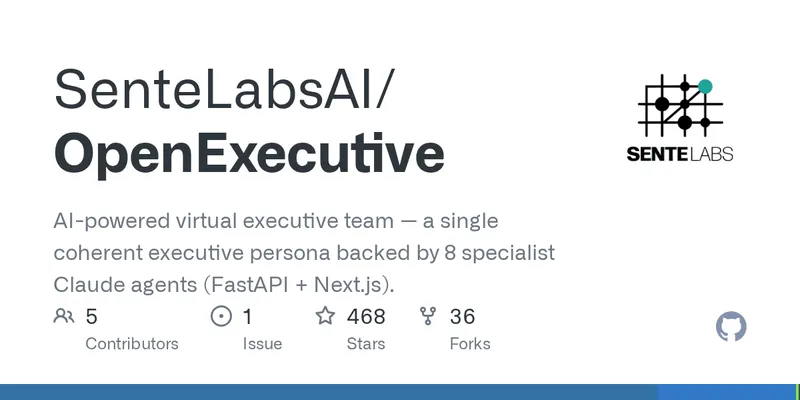
Open Executive is an Apache 2.0-licensed, open-source virtual executive team built by SenteLabsAI. It presents users with one executive persona while an orchestrator routes requests to eight specialists covering strategy, finance, people, legal basics and compliance, operations, marketing, product, and board communications. The system uses Anthropic’s Claude API by default, with claude-sonnet-4-6 for the executive and most specialists and claude-opus-4-7 with extended thinking for strategy, finance, legal, and board work. It can also use OpenRouter or OpenAI-compatible local model servers such as Ollama, LM Studio, vLLM, and llama.cpp. Each specialist retrieves built-in business knowledge and uploaded company documents from separate ChromaDB collections. A background claude-haiku-4-5 process extracts decisions, initiatives, and advice into SQLite after responses, allowing later sessions to receive prior-decision context. A built-in scheduler can surface follow-ups but requires the FastAPI service to run as a single instance to avoid duplicate actions. The stack includes Python 3.11, FastAPI, Next.js 15, Tailwind, ChromaDB, and SQLite. Users can access it through a web interface, CLI, Slack, email, Telegram, Google Chat, or Discord. Local setup requires Python 3.11+, Node 22+, and an API provider configuration; the first start downloads an approximately 90 MB embedding model.
github.com
13 min
8/27/2026
Serve Markdown to AI Agents with Accept Headers
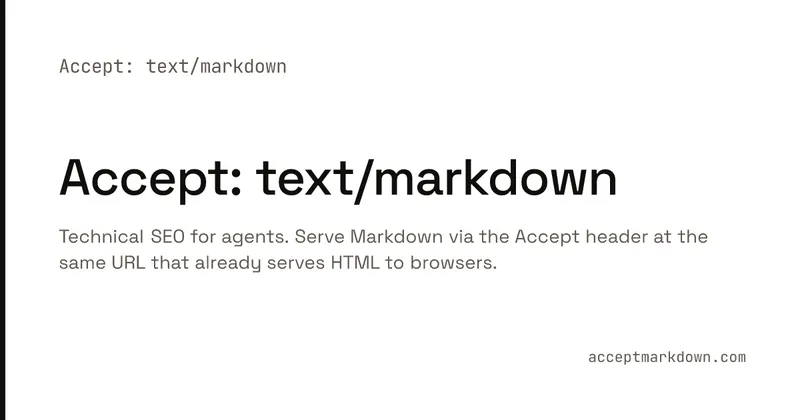
AcceptMarkdown.com promotes serving Markdown versions of web pages to AI agents through HTTP content negotiation. Clients can request a Markdown representation with the `Accept: text/markdown` header, allowing them to receive page content without navigation, scripts, styles, layout wrappers, advertisements, related-content sections, or modal overlays. The site says Markdown responses use a fraction of the bytes of full pages and can leave AI agents’ context windows focused on prose rather than DOM markup. It also says cleaner text can improve signal-to-noise for retrieval-augmented generation pipelines and that smaller responses can reduce fetching, parsing, and context-loading work before a model begins generating output. Its URL checker sends an edge request with `Accept: text/markdown` and reports what the origin returns. The checker evaluates whether a URL serves Markdown for that request, sets `Vary: Accept`, rejects unsupported content types with HTTP 406, and honors HTTP `q` quality values in Accept headers.
acceptmarkdown.com
1 min
8/26/2026

The Harness Is the Thing
Scott Fryxell describes an AI coding harness that lets Cursor, Claude, and Pi share instructions, skills, and an AGENTS.md file across terminal-based interfaces. He argues that this shared operating environment matters more than any individual model and says it has reduced his concern about switching from Cursor to Codex. His current setup uses two $20 subscriptions, Cursor and Claude, with Pi added for other models. Fryxell uses DeepSeek-V4-Flash-0731 for maintenance and simpler work, reserving frontier models and Anthropic API budget for complex features, refactors, and promotion tasks. His workflow separates work into explorer, planner, worker, critic, and promoter roles. Planning produces an explicit directed acyclic graph of tasks; a worker implements nodes, a critic reviews and may send work back for revision, and a promoter prepares communications about completed work. He says this cut his use of Fable by 75 percent in intensive work. The harness contains scripts, prompts, plans, skills, extensions, artifacts, and checked-out work repositories. It can control his poster-making web app through headless Chrome, including an npm command that generates an animation from an MP4. Fryxell says a government ban on Fable and signals of industry control made diversifying model access urgent, leading him to rely more heavily on Pi and Chinese models.
scott-fryxell.github.io
8 min
8/26/2026
It’s so hard to finish an idea that is not yours and is just suggested by AI
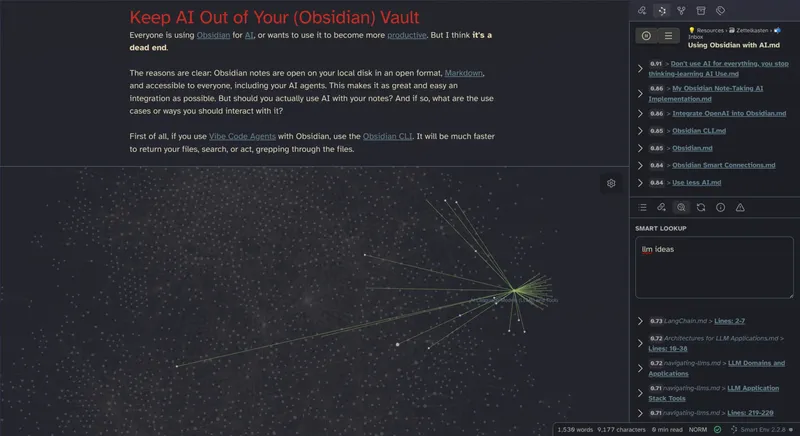
Obsidian’s local, Markdown-based vaults make notes readily accessible to AI agents, but the author argues that AI-generated summaries, tags, links, and organization can weaken a personal knowledge system. Long generated summaries can make it difficult to distinguish a writer’s own ideas from AI text and add noise to later searches. The author sometimes uses Obsidian Web Clipper to create one- or two-sentence summaries, but labels them as AI-generated and removes them after adding personal writing. The author recommends AI primarily for retrieval and research, including finding related notes, vector search, similarity search, clustering, and search across large collections. Obsidian’s CLI can return files, search, and perform actions faster than grepping files when used with coding agents. The author’s single vault contains 25,979 files totaling 3.5 GB and uses the Omnisearch plugin to find material quickly; Obsidian Smart Connections can add vector and similarity search. Sensitive notes create an additional reason to prefer local models over uploads to external services. The author contends that manually writing and linking notes is part of learning and idea formation, while automated connections may produce a knowledge graph that does not reflect the user’s thinking. AI-generated material can instead be isolated in a dedicated PARA-method folder or separate vault, potentially excluded from search. The author also argues that human-curated knowledge remains valuable for both personal learning and future AI training.
ssp.sh
8 min
8/26/2026

WebMCP: Teaching Your Website to Talk to AI Agents
WebMCP is a proposed web standard that lets websites expose structured JavaScript tools for AI agents to discover and invoke, replacing brittle screen-scraping of buttons, HTML and visual layouts. A page can register actions such as booking a table, checking out, filtering results or adding a to-do item, with JSON Schema definitions for their inputs and outputs. The tools execute within the user’s already open and authenticated browser tab, using site functions that already exist rather than requiring a separate automation bot. Google and Microsoft are developing WebMCP in the W3C Web Machine Learning Community Group. It remains a Community Group draft rather than a finished W3C standard or standards-track specification. Chrome offers it behind a testing flag, and the current API uses document.modelContext; earlier drafts used navigator.modelContext. ChatGPT supports WebMCP-enabled pages, according to an OpenAI Developers post dated August 26, 2026. The design includes same-origin tool registration through a tools Permissions Policy, visible execution in an open browsing context, optional confirmation for sensitive actions, and annotations including readOnlyHint and untrustedContentHint. These protections do not eliminate security risks, and the security model is still under development. WebMCP could enable agent-operated commerce, bookings, scheduling and support flows when sites explicitly expose the necessary tools and users approve consequential actions.
sreenathmenon.com
12 min
8/26/2026

Omarchy development practices lead to predictable security issues
HappyFellow.dev criticized Omarchy 4.0, a Linux distribution project promoted by David Heinemeier Hansson, arguing that users should not run it on machines where security matters. The post alleges that the release contained security flaws including bash injection through video titles and a notification mechanism that could allow arbitrary bash commands to run. It says these flaws stem from unsafe handling of untrusted input and from using AI-generated bash scripts to process such input without sufficient review. The author contends that starting from insecure shell scripts cannot produce a reasonably secure system through later fixes. The post acknowledges that all software projects have security vulnerabilities but argues that Omarchy’s reported issues were predictable and reflect development practices that do not prioritize security. It contrasts that view with Omarchy’s security-team announcements and recent point release, which reportedly listed numerous resolved issues. The author characterizes DHH’s promotion of Omarchy as strong marketing but says its security messaging is misleading, and predicts that some companies may prohibit its use. The stated concern is that users may underestimate the risks of installing Omarchy because the project does not, in the author’s view, clearly communicate its security limitations.
blog.happyfellow.dev
2 min
8/26/2026

Beyond Recall and the Illusion of Competence
AI-assisted programming can automate boilerplate, syntax recall, unfamiliar-library exploration and other routine implementation work, but software engineers still need to understand the systems they maintain. The source argues that code ownership has never depended on personally writing every line: developers routinely use documentation, internet searches, Stack Overflow examples, colleagues’ code and inherited services. Ownership instead depends on knowing a system’s behavior, boundaries, dependencies and failure modes. The source distinguishes delegating typing from delegating understanding. A developer who defines the required behavior and asks an AI to implement it retains control, while a developer who repeatedly submits errors and applies generated patches without understanding them may produce working software without a mental model of it. The source says debugging builds that model by requiring engineers to compare expected and observed behavior and trace where they diverge. The source warns that this risk may be greater for junior developers, whose experience traditionally develops through difficult debugging sessions. It recommends using AI aggressively for tedious coding tasks while keeping architectural decisions, system design and explanation of component interactions under human control. It predicts that as code generation becomes cheaper, architecture, integration, distributed systems, observability, failure modes, boundaries and trade-offs will become more important differentiators for developers.
var0.xyz
5 min
8/26/2026

RAG Is Simpler Than You Think
Retrieval-augmented generation systems can begin with BM25 or other full-text search rather than embeddings and vector databases, particularly for keyword-heavy queries, exact identifiers, proprietary terminology, low query volumes, and frequently changing content. The source recommends measuring a baseline for two to four weeks, then adding complexity only when user feedback and evaluation data show that simpler retrieval fails. Full-text search avoids embedding API costs, document chunking, re-indexing, and model-deprecation risks; it can return results in under 10 milliseconds, according to the source. LLM-based query rewriting can convert conversational requests into keyword searches, add synonyms, preserve internal product names, and decompose complex questions at an estimated cost of about $0.001 per query using GPT-4o-mini. Hybrid retrieval uses BM25 to select 50 to 100 candidates and embeddings to rerank the top results, trading stronger semantic matching for roughly 200–500 milliseconds of added latency when documents are embedded on demand. On-the-fly embedding suits high-churn data, while hot/cold tiers pre-embed commonly accessed documents and process less-used material dynamically. Full pre-embedding is presented as appropriate for stable corpora, broad access patterns, more than 10,000 daily queries, and sub-50-millisecond latency requirements. The source estimates that 60% of systems can stop at full-text search plus query rewriting.
lighthousenewsletter.com
13 min
8/26/2026

The End of Programming
Bun 1.4 includes a rewrite of Bun from Zig to Rust, adding more than 1 million lines of Rust code. Bun creator Jarred Sumner reportedly used a pre-release model called Fable 5, an agent framework that could work in parallel, and an effectively unlimited token budget to complete the initial translation in 11 days. The effort generated 6,778 commits and would have cost about $165,000 at API pricing, according to the account. Agents then continued refining the code for months before the supported release, which Paul Dix says is running on millions of developer machines. Dix argues that AI agents will increasingly write, test and improve software while people specify requirements, build verification systems and assess end results rather than review every line of code. He reports using Fable to build unshipped InfluxDB prototypes: an Iceberg integration in 14 hours and an edge-data replication system in 28 hours, followed by testing and bug fixes. Dix says neither project is production-ready or supported, but both reached end-to-end working implementations. Dix predicts that cheaper, faster frontier models and larger token budgets could make this workflow widely accessible by the end of the following year. He expects organizational inertia to preserve manual programming and code review at many companies, while more productive teams rely on AI-directed software factories and automated verification.
pauldix.com
10 min
8/26/2026
Queryable Executables
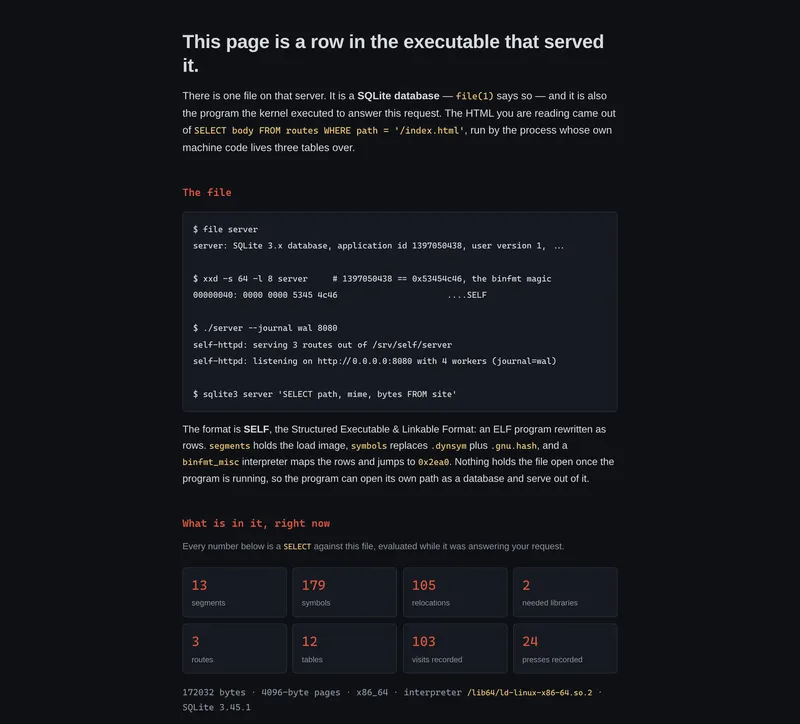
SELF is an executable format that stores a program as a SQLite database, with executable segments represented as database rows. A Linux binfmt_misc interpreter maps those rows and transfers control to the program entry point, allowing executable contents and related metadata to be queried with SQL. The format can also let a running program open its own SQLite file through argv[0] and persist state in that same file; /proc/self/exe does not currently provide the original file in this setup. The self-httpd proof of concept packages a web server, website routes, visitor logs and button-press records into one SQLite database file. Its routes, visits and presses tables store page content and runtime data, while the server can query its own segments, symbols and relocations. A POST request to its /api/press endpoint inserts a button press into the executable’s database, and the live demonstration is hosted at selfdb.exe.xyz. SQLite transactions allow site content in the running file to be updated or rolled back without restarting the server. SQLite tools such as sqldiff can compare code, route and metadata changes between versions, and FTS5 can index pages stored in the executable. Deployments can copy a single file, while SQL INSERT ... SELECT statements can migrate tables such as visitor logs and button presses from an old file to a new build before it is swapped in.
fzakaria.com
7 min
8/26/2026
CEO fired developers to make room for AI. Developers create open source AI CEO
Open Executive is an Apache 2.0-licensed, open-source virtual executive team built by SenteLabsAI. It presents users with one executive persona while an orchestrator routes requests to eight specialists covering strategy, finance, people, legal basics and compliance, operations, marketing, product, and board communications. The system uses Anthropic’s Claude API by default, with claude-sonnet-4-6 for the executive and most specialists and claude-opus-4-7 with extended thinking for strategy, finance, legal, and board work. It can also use OpenRouter or OpenAI-compatible local model servers such as Ollama, LM Studio, vLLM, and llama.cpp. Each specialist retrieves built-in business knowledge and uploaded company documents from separate ChromaDB collections. A background claude-haiku-4-5 process extracts decisions, initiatives, and advice into SQLite after responses, allowing later sessions to receive prior-decision context. A built-in scheduler can surface follow-ups but requires the FastAPI service to run as a single instance to avoid duplicate actions. The stack includes Python 3.11, FastAPI, Next.js 15, Tailwind, ChromaDB, and SQLite. Users can access it through a web interface, CLI, Slack, email, Telegram, Google Chat, or Discord. Local setup requires Python 3.11+, Node 22+, and an API provider configuration; the first start downloads an approximately 90 MB embedding model.
github.com
13 min
8/27/2026
The Harness Is the Thing
Scott Fryxell describes an AI coding harness that lets Cursor, Claude, and Pi share instructions, skills, and an AGENTS.md file across terminal-based interfaces. He argues that this shared operating environment matters more than any individual model and says it has reduced his concern about switching from Cursor to Codex. His current setup uses two $20 subscriptions, Cursor and Claude, with Pi added for other models. Fryxell uses DeepSeek-V4-Flash-0731 for maintenance and simpler work, reserving frontier models and Anthropic API budget for complex features, refactors, and promotion tasks. His workflow separates work into explorer, planner, worker, critic, and promoter roles. Planning produces an explicit directed acyclic graph of tasks; a worker implements nodes, a critic reviews and may send work back for revision, and a promoter prepares communications about completed work. He says this cut his use of Fable by 75 percent in intensive work. The harness contains scripts, prompts, plans, skills, extensions, artifacts, and checked-out work repositories. It can control his poster-making web app through headless Chrome, including an npm command that generates an animation from an MP4. Fryxell says a government ban on Fable and signals of industry control made diversifying model access urgent, leading him to rely more heavily on Pi and Chinese models.
scott-fryxell.github.io
8 min
8/26/2026
WebMCP: Teaching Your Website to Talk to AI Agents
WebMCP is a proposed web standard that lets websites expose structured JavaScript tools for AI agents to discover and invoke, replacing brittle screen-scraping of buttons, HTML and visual layouts. A page can register actions such as booking a table, checking out, filtering results or adding a to-do item, with JSON Schema definitions for their inputs and outputs. The tools execute within the user’s already open and authenticated browser tab, using site functions that already exist rather than requiring a separate automation bot. Google and Microsoft are developing WebMCP in the W3C Web Machine Learning Community Group. It remains a Community Group draft rather than a finished W3C standard or standards-track specification. Chrome offers it behind a testing flag, and the current API uses document.modelContext; earlier drafts used navigator.modelContext. ChatGPT supports WebMCP-enabled pages, according to an OpenAI Developers post dated August 26, 2026. The design includes same-origin tool registration through a tools Permissions Policy, visible execution in an open browsing context, optional confirmation for sensitive actions, and annotations including readOnlyHint and untrustedContentHint. These protections do not eliminate security risks, and the security model is still under development. WebMCP could enable agent-operated commerce, bookings, scheduling and support flows when sites explicitly expose the necessary tools and users approve consequential actions.
sreenathmenon.com
12 min
8/26/2026
Beyond Recall and the Illusion of Competence
AI-assisted programming can automate boilerplate, syntax recall, unfamiliar-library exploration and other routine implementation work, but software engineers still need to understand the systems they maintain. The source argues that code ownership has never depended on personally writing every line: developers routinely use documentation, internet searches, Stack Overflow examples, colleagues’ code and inherited services. Ownership instead depends on knowing a system’s behavior, boundaries, dependencies and failure modes. The source distinguishes delegating typing from delegating understanding. A developer who defines the required behavior and asks an AI to implement it retains control, while a developer who repeatedly submits errors and applies generated patches without understanding them may produce working software without a mental model of it. The source says debugging builds that model by requiring engineers to compare expected and observed behavior and trace where they diverge. The source warns that this risk may be greater for junior developers, whose experience traditionally develops through difficult debugging sessions. It recommends using AI aggressively for tedious coding tasks while keeping architectural decisions, system design and explanation of component interactions under human control. It predicts that as code generation becomes cheaper, architecture, integration, distributed systems, observability, failure modes, boundaries and trade-offs will become more important differentiators for developers.
var0.xyz
5 min
8/26/2026
The End of Programming
Bun 1.4 includes a rewrite of Bun from Zig to Rust, adding more than 1 million lines of Rust code. Bun creator Jarred Sumner reportedly used a pre-release model called Fable 5, an agent framework that could work in parallel, and an effectively unlimited token budget to complete the initial translation in 11 days. The effort generated 6,778 commits and would have cost about $165,000 at API pricing, according to the account. Agents then continued refining the code for months before the supported release, which Paul Dix says is running on millions of developer machines. Dix argues that AI agents will increasingly write, test and improve software while people specify requirements, build verification systems and assess end results rather than review every line of code. He reports using Fable to build unshipped InfluxDB prototypes: an Iceberg integration in 14 hours and an edge-data replication system in 28 hours, followed by testing and bug fixes. Dix says neither project is production-ready or supported, but both reached end-to-end working implementations. Dix predicts that cheaper, faster frontier models and larger token budgets could make this workflow widely accessible by the end of the following year. He expects organizational inertia to preserve manual programming and code review at many companies, while more productive teams rely on AI-directed software factories and automated verification.
pauldix.com
10 min
8/26/2026
Serve Markdown to AI Agents with Accept Headers
AcceptMarkdown.com promotes serving Markdown versions of web pages to AI agents through HTTP content negotiation. Clients can request a Markdown representation with the `Accept: text/markdown` header, allowing them to receive page content without navigation, scripts, styles, layout wrappers, advertisements, related-content sections, or modal overlays. The site says Markdown responses use a fraction of the bytes of full pages and can leave AI agents’ context windows focused on prose rather than DOM markup. It also says cleaner text can improve signal-to-noise for retrieval-augmented generation pipelines and that smaller responses can reduce fetching, parsing, and context-loading work before a model begins generating output. Its URL checker sends an edge request with `Accept: text/markdown` and reports what the origin returns. The checker evaluates whether a URL serves Markdown for that request, sets `Vary: Accept`, rejects unsupported content types with HTTP 406, and honors HTTP `q` quality values in Accept headers.
acceptmarkdown.com
1 min
8/26/2026
It’s so hard to finish an idea that is not yours and is just suggested by AI
Obsidian’s local, Markdown-based vaults make notes readily accessible to AI agents, but the author argues that AI-generated summaries, tags, links, and organization can weaken a personal knowledge system. Long generated summaries can make it difficult to distinguish a writer’s own ideas from AI text and add noise to later searches. The author sometimes uses Obsidian Web Clipper to create one- or two-sentence summaries, but labels them as AI-generated and removes them after adding personal writing. The author recommends AI primarily for retrieval and research, including finding related notes, vector search, similarity search, clustering, and search across large collections. Obsidian’s CLI can return files, search, and perform actions faster than grepping files when used with coding agents. The author’s single vault contains 25,979 files totaling 3.5 GB and uses the Omnisearch plugin to find material quickly; Obsidian Smart Connections can add vector and similarity search. Sensitive notes create an additional reason to prefer local models over uploads to external services. The author contends that manually writing and linking notes is part of learning and idea formation, while automated connections may produce a knowledge graph that does not reflect the user’s thinking. AI-generated material can instead be isolated in a dedicated PARA-method folder or separate vault, potentially excluded from search. The author also argues that human-curated knowledge remains valuable for both personal learning and future AI training.
ssp.sh
8 min
8/26/2026
Omarchy development practices lead to predictable security issues
HappyFellow.dev criticized Omarchy 4.0, a Linux distribution project promoted by David Heinemeier Hansson, arguing that users should not run it on machines where security matters. The post alleges that the release contained security flaws including bash injection through video titles and a notification mechanism that could allow arbitrary bash commands to run. It says these flaws stem from unsafe handling of untrusted input and from using AI-generated bash scripts to process such input without sufficient review. The author contends that starting from insecure shell scripts cannot produce a reasonably secure system through later fixes. The post acknowledges that all software projects have security vulnerabilities but argues that Omarchy’s reported issues were predictable and reflect development practices that do not prioritize security. It contrasts that view with Omarchy’s security-team announcements and recent point release, which reportedly listed numerous resolved issues. The author characterizes DHH’s promotion of Omarchy as strong marketing but says its security messaging is misleading, and predicts that some companies may prohibit its use. The stated concern is that users may underestimate the risks of installing Omarchy because the project does not, in the author’s view, clearly communicate its security limitations.
blog.happyfellow.dev
2 min
8/26/2026
RAG Is Simpler Than You Think
Retrieval-augmented generation systems can begin with BM25 or other full-text search rather than embeddings and vector databases, particularly for keyword-heavy queries, exact identifiers, proprietary terminology, low query volumes, and frequently changing content. The source recommends measuring a baseline for two to four weeks, then adding complexity only when user feedback and evaluation data show that simpler retrieval fails. Full-text search avoids embedding API costs, document chunking, re-indexing, and model-deprecation risks; it can return results in under 10 milliseconds, according to the source. LLM-based query rewriting can convert conversational requests into keyword searches, add synonyms, preserve internal product names, and decompose complex questions at an estimated cost of about $0.001 per query using GPT-4o-mini. Hybrid retrieval uses BM25 to select 50 to 100 candidates and embeddings to rerank the top results, trading stronger semantic matching for roughly 200–500 milliseconds of added latency when documents are embedded on demand. On-the-fly embedding suits high-churn data, while hot/cold tiers pre-embed commonly accessed documents and process less-used material dynamically. Full pre-embedding is presented as appropriate for stable corpora, broad access patterns, more than 10,000 daily queries, and sub-50-millisecond latency requirements. The source estimates that 60% of systems can stop at full-text search plus query rewriting.
lighthousenewsletter.com
13 min
8/26/2026
Queryable Executables
SELF is an executable format that stores a program as a SQLite database, with executable segments represented as database rows. A Linux binfmt_misc interpreter maps those rows and transfers control to the program entry point, allowing executable contents and related metadata to be queried with SQL. The format can also let a running program open its own SQLite file through argv[0] and persist state in that same file; /proc/self/exe does not currently provide the original file in this setup. The self-httpd proof of concept packages a web server, website routes, visitor logs and button-press records into one SQLite database file. Its routes, visits and presses tables store page content and runtime data, while the server can query its own segments, symbols and relocations. A POST request to its /api/press endpoint inserts a button press into the executable’s database, and the live demonstration is hosted at selfdb.exe.xyz. SQLite transactions allow site content in the running file to be updated or rolled back without restarting the server. SQLite tools such as sqldiff can compare code, route and metadata changes between versions, and FTS5 can index pages stored in the executable. Deployments can copy a single file, while SQL INSERT ... SELECT statements can migrate tables such as visitor logs and button presses from an old file to a new build before it is swapped in.
fzakaria.com
7 min
8/26/2026
CEO fired developers to make room for AI. Developers create open source AI CEO
Open Executive is an Apache 2.0-licensed, open-source virtual executive team built by SenteLabsAI. It presents users with one executive persona while an orchestrator routes requests to eight specialists covering strategy, finance, people, legal basics and compliance, operations, marketing, product, and board communications. The system uses Anthropic’s Claude API by default, with claude-sonnet-4-6 for the executive and most specialists and claude-opus-4-7 with extended thinking for strategy, finance, legal, and board work. It can also use OpenRouter or OpenAI-compatible local model servers such as Ollama, LM Studio, vLLM, and llama.cpp. Each specialist retrieves built-in business knowledge and uploaded company documents from separate ChromaDB collections. A background claude-haiku-4-5 process extracts decisions, initiatives, and advice into SQLite after responses, allowing later sessions to receive prior-decision context. A built-in scheduler can surface follow-ups but requires the FastAPI service to run as a single instance to avoid duplicate actions. The stack includes Python 3.11, FastAPI, Next.js 15, Tailwind, ChromaDB, and SQLite. Users can access it through a web interface, CLI, Slack, email, Telegram, Google Chat, or Discord. Local setup requires Python 3.11+, Node 22+, and an API provider configuration; the first start downloads an approximately 90 MB embedding model.
github.com
13 min
8/27/2026
It’s so hard to finish an idea that is not yours and is just suggested by AI
Obsidian’s local, Markdown-based vaults make notes readily accessible to AI agents, but the author argues that AI-generated summaries, tags, links, and organization can weaken a personal knowledge system. Long generated summaries can make it difficult to distinguish a writer’s own ideas from AI text and add noise to later searches. The author sometimes uses Obsidian Web Clipper to create one- or two-sentence summaries, but labels them as AI-generated and removes them after adding personal writing. The author recommends AI primarily for retrieval and research, including finding related notes, vector search, similarity search, clustering, and search across large collections. Obsidian’s CLI can return files, search, and perform actions faster than grepping files when used with coding agents. The author’s single vault contains 25,979 files totaling 3.5 GB and uses the Omnisearch plugin to find material quickly; Obsidian Smart Connections can add vector and similarity search. Sensitive notes create an additional reason to prefer local models over uploads to external services. The author contends that manually writing and linking notes is part of learning and idea formation, while automated connections may produce a knowledge graph that does not reflect the user’s thinking. AI-generated material can instead be isolated in a dedicated PARA-method folder or separate vault, potentially excluded from search. The author also argues that human-curated knowledge remains valuable for both personal learning and future AI training.
ssp.sh
8 min
8/26/2026
Beyond Recall and the Illusion of Competence
AI-assisted programming can automate boilerplate, syntax recall, unfamiliar-library exploration and other routine implementation work, but software engineers still need to understand the systems they maintain. The source argues that code ownership has never depended on personally writing every line: developers routinely use documentation, internet searches, Stack Overflow examples, colleagues’ code and inherited services. Ownership instead depends on knowing a system’s behavior, boundaries, dependencies and failure modes. The source distinguishes delegating typing from delegating understanding. A developer who defines the required behavior and asks an AI to implement it retains control, while a developer who repeatedly submits errors and applies generated patches without understanding them may produce working software without a mental model of it. The source says debugging builds that model by requiring engineers to compare expected and observed behavior and trace where they diverge. The source warns that this risk may be greater for junior developers, whose experience traditionally develops through difficult debugging sessions. It recommends using AI aggressively for tedious coding tasks while keeping architectural decisions, system design and explanation of component interactions under human control. It predicts that as code generation becomes cheaper, architecture, integration, distributed systems, observability, failure modes, boundaries and trade-offs will become more important differentiators for developers.
var0.xyz
5 min
8/26/2026
Queryable Executables
SELF is an executable format that stores a program as a SQLite database, with executable segments represented as database rows. A Linux binfmt_misc interpreter maps those rows and transfers control to the program entry point, allowing executable contents and related metadata to be queried with SQL. The format can also let a running program open its own SQLite file through argv[0] and persist state in that same file; /proc/self/exe does not currently provide the original file in this setup. The self-httpd proof of concept packages a web server, website routes, visitor logs and button-press records into one SQLite database file. Its routes, visits and presses tables store page content and runtime data, while the server can query its own segments, symbols and relocations. A POST request to its /api/press endpoint inserts a button press into the executable’s database, and the live demonstration is hosted at selfdb.exe.xyz. SQLite transactions allow site content in the running file to be updated or rolled back without restarting the server. SQLite tools such as sqldiff can compare code, route and metadata changes between versions, and FTS5 can index pages stored in the executable. Deployments can copy a single file, while SQL INSERT ... SELECT statements can migrate tables such as visitor logs and button presses from an old file to a new build before it is swapped in.
fzakaria.com
7 min
8/26/2026
Serve Markdown to AI Agents with Accept Headers
AcceptMarkdown.com promotes serving Markdown versions of web pages to AI agents through HTTP content negotiation. Clients can request a Markdown representation with the `Accept: text/markdown` header, allowing them to receive page content without navigation, scripts, styles, layout wrappers, advertisements, related-content sections, or modal overlays. The site says Markdown responses use a fraction of the bytes of full pages and can leave AI agents’ context windows focused on prose rather than DOM markup. It also says cleaner text can improve signal-to-noise for retrieval-augmented generation pipelines and that smaller responses can reduce fetching, parsing, and context-loading work before a model begins generating output. Its URL checker sends an edge request with `Accept: text/markdown` and reports what the origin returns. The checker evaluates whether a URL serves Markdown for that request, sets `Vary: Accept`, rejects unsupported content types with HTTP 406, and honors HTTP `q` quality values in Accept headers.
acceptmarkdown.com
1 min
8/26/2026
WebMCP: Teaching Your Website to Talk to AI Agents
WebMCP is a proposed web standard that lets websites expose structured JavaScript tools for AI agents to discover and invoke, replacing brittle screen-scraping of buttons, HTML and visual layouts. A page can register actions such as booking a table, checking out, filtering results or adding a to-do item, with JSON Schema definitions for their inputs and outputs. The tools execute within the user’s already open and authenticated browser tab, using site functions that already exist rather than requiring a separate automation bot. Google and Microsoft are developing WebMCP in the W3C Web Machine Learning Community Group. It remains a Community Group draft rather than a finished W3C standard or standards-track specification. Chrome offers it behind a testing flag, and the current API uses document.modelContext; earlier drafts used navigator.modelContext. ChatGPT supports WebMCP-enabled pages, according to an OpenAI Developers post dated August 26, 2026. The design includes same-origin tool registration through a tools Permissions Policy, visible execution in an open browsing context, optional confirmation for sensitive actions, and annotations including readOnlyHint and untrustedContentHint. These protections do not eliminate security risks, and the security model is still under development. WebMCP could enable agent-operated commerce, bookings, scheduling and support flows when sites explicitly expose the necessary tools and users approve consequential actions.
sreenathmenon.com
12 min
8/26/2026
RAG Is Simpler Than You Think
Retrieval-augmented generation systems can begin with BM25 or other full-text search rather than embeddings and vector databases, particularly for keyword-heavy queries, exact identifiers, proprietary terminology, low query volumes, and frequently changing content. The source recommends measuring a baseline for two to four weeks, then adding complexity only when user feedback and evaluation data show that simpler retrieval fails. Full-text search avoids embedding API costs, document chunking, re-indexing, and model-deprecation risks; it can return results in under 10 milliseconds, according to the source. LLM-based query rewriting can convert conversational requests into keyword searches, add synonyms, preserve internal product names, and decompose complex questions at an estimated cost of about $0.001 per query using GPT-4o-mini. Hybrid retrieval uses BM25 to select 50 to 100 candidates and embeddings to rerank the top results, trading stronger semantic matching for roughly 200–500 milliseconds of added latency when documents are embedded on demand. On-the-fly embedding suits high-churn data, while hot/cold tiers pre-embed commonly accessed documents and process less-used material dynamically. Full pre-embedding is presented as appropriate for stable corpora, broad access patterns, more than 10,000 daily queries, and sub-50-millisecond latency requirements. The source estimates that 60% of systems can stop at full-text search plus query rewriting.
lighthousenewsletter.com
13 min
8/26/2026
The Harness Is the Thing
Scott Fryxell describes an AI coding harness that lets Cursor, Claude, and Pi share instructions, skills, and an AGENTS.md file across terminal-based interfaces. He argues that this shared operating environment matters more than any individual model and says it has reduced his concern about switching from Cursor to Codex. His current setup uses two $20 subscriptions, Cursor and Claude, with Pi added for other models. Fryxell uses DeepSeek-V4-Flash-0731 for maintenance and simpler work, reserving frontier models and Anthropic API budget for complex features, refactors, and promotion tasks. His workflow separates work into explorer, planner, worker, critic, and promoter roles. Planning produces an explicit directed acyclic graph of tasks; a worker implements nodes, a critic reviews and may send work back for revision, and a promoter prepares communications about completed work. He says this cut his use of Fable by 75 percent in intensive work. The harness contains scripts, prompts, plans, skills, extensions, artifacts, and checked-out work repositories. It can control his poster-making web app through headless Chrome, including an npm command that generates an animation from an MP4. Fryxell says a government ban on Fable and signals of industry control made diversifying model access urgent, leading him to rely more heavily on Pi and Chinese models.
scott-fryxell.github.io
8 min
8/26/2026
Omarchy development practices lead to predictable security issues
HappyFellow.dev criticized Omarchy 4.0, a Linux distribution project promoted by David Heinemeier Hansson, arguing that users should not run it on machines where security matters. The post alleges that the release contained security flaws including bash injection through video titles and a notification mechanism that could allow arbitrary bash commands to run. It says these flaws stem from unsafe handling of untrusted input and from using AI-generated bash scripts to process such input without sufficient review. The author contends that starting from insecure shell scripts cannot produce a reasonably secure system through later fixes. The post acknowledges that all software projects have security vulnerabilities but argues that Omarchy’s reported issues were predictable and reflect development practices that do not prioritize security. It contrasts that view with Omarchy’s security-team announcements and recent point release, which reportedly listed numerous resolved issues. The author characterizes DHH’s promotion of Omarchy as strong marketing but says its security messaging is misleading, and predicts that some companies may prohibit its use. The stated concern is that users may underestimate the risks of installing Omarchy because the project does not, in the author’s view, clearly communicate its security limitations.
blog.happyfellow.dev
2 min
8/26/2026
The End of Programming
Bun 1.4 includes a rewrite of Bun from Zig to Rust, adding more than 1 million lines of Rust code. Bun creator Jarred Sumner reportedly used a pre-release model called Fable 5, an agent framework that could work in parallel, and an effectively unlimited token budget to complete the initial translation in 11 days. The effort generated 6,778 commits and would have cost about $165,000 at API pricing, according to the account. Agents then continued refining the code for months before the supported release, which Paul Dix says is running on millions of developer machines. Dix argues that AI agents will increasingly write, test and improve software while people specify requirements, build verification systems and assess end results rather than review every line of code. He reports using Fable to build unshipped InfluxDB prototypes: an Iceberg integration in 14 hours and an edge-data replication system in 28 hours, followed by testing and bug fixes. Dix says neither project is production-ready or supported, but both reached end-to-end working implementations. Dix predicts that cheaper, faster frontier models and larger token budgets could make this workflow widely accessible by the end of the following year. He expects organizational inertia to preserve manual programming and code review at many companies, while more productive teams rely on AI-directed software factories and automated verification.
pauldix.com
10 min
8/26/2026