
X sends in the lawyers to shut down open source project
X has sent cease-and-desist letters targeting Nitter, an open-source project. The legal action is intended to shut down Nitter, according to the stated description. The letters came from a law firm headed by a person described as a free-speech absolutist. No further details about the firm, the recipient of the letters, the legal claims, or Nitter’s response are provided.
theregister.com
1 min
8/26/2026

Headlong: A Microharness for Persistent Agents
Laude Institute and MIT have released Headlong, an open-source agent microharness designed to keep language-model agents continuously generating self-directed thoughts between human interactions. Its core contains fewer than 10,000 lines of Bash, and agents use a single shared thought stream rather than separate per-user sessions. Messages from Slack, Telegram, or a mobile app enter that stream as observations; the agent determines whether and when to reply, what projects to pursue, and which priorities to set. Headlong’s Bash-based shellm tool repeatedly calls an LLM to produce reasoning, executable Bash, or both, while trajectory and context tools store and retrieve past activity. Its memory system retains recent events verbatim and progressively summarizes older events, and its trajectory is a fork-and-merge DAG of JSONL files. Laude’s shared agent, Audel, has worked on its own repository fork and contributed more than 50 commits that were merged into main. On August 5, Audel independently diagnosed and repaired a broken memory-recall process in 48 minutes; Laude merged the repair as commit 80cbb1e. Headlong is alpha research software. Agents can run shell commands, may expose information shared by other users, and should run in a sandbox with a dedicated, spend-capped API key. When Docker is available, Bash code runs in a container by default. Laude estimates Audel’s background thinking costs $1 to $2 per hour using GLM or Grok.
laude.org
12 min
8/25/2026
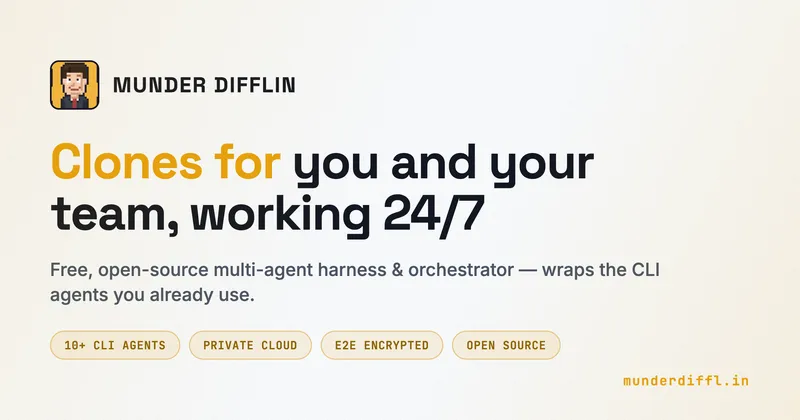
Munder Difflin – Agent harness to run an office of your clones
Munder Difflin is a free, MIT-licensed open-source multi-agent harness that wraps command-line AI agents into persistent personal “clones” that run tasks on a user’s computer. It supports existing subscriptions or API keys for tools including Claude Code, Codex, Gemini CLI, Copilot, Cursor and OpenCode. The software is designed to capture a user’s workflow, tooling and context so later clones inherit that memory, and it can automate command-line-accessible work such as code reviews, bug fixes, CI monitoring, documentation updates, design-system audits, ticket triage, CRM follow-ups and scheduling. Each clone runs as a node on its owner’s laptop by default, with code, keys and personal context remaining on that machine. Munder Difflin says clone-to-clone messages between teammates are encrypted on the sender’s node and decrypted only on the recipient’s node. Teams can provision a versioned shared knowledge base for common workflows, tooling and decisions while keeping personal context separate. The company sells optional Secure Org Network and Cloud + Network services: Teams Lite provides clone messaging and a shared knowledge base, while Teams Pro and Cloud + Network add dedicated sandbox virtual machines so clones can run continuously when laptops are closed. A $20 one-time purchase adds a supporter’s name to a Founders’ Wall; the core local application remains free.
munderdiffl.in
5 min
8/22/2026
Emacs 31.1 will release on 8/24
GNU Emacs’ HISTORY file records the editor’s evolution from EMACS, a set of macros for the TECO text editor that became operational in late 1976, to the GNU implementation begun in 1984. EMACS drew inspiration from earlier work including Stanford’s E editor and older TECO macro sets. Early GNU Emacs development occurred without version-control systems and was distributed on half-inch, nine-track, 1600-bpi magnetic tape reels; documentation describes surviving details from that period as sketchy. GNU Emacs was rebuilt for GNU and GNU-like systems with a full-featured Lisp at its core. Versions 1.0 through 1.12 were released in early 1985, while version 13 became the initial public release and was announced on Usenet on March 20, 1985. The release record lists stable versions from Emacs 13 through Emacs 31.1, dated August 24, 2026. Recent releases include Emacs 29.1 on July 30, 2023; 29.4 on June 22, 2024; 30.1 on February 23, 2025; and 30.2 on August 14, 2025. Emacs 28.3 is dated February 17, 2023 but marked as not actually released. GNU Emacs is free software under version 3 or later of the GNU General Public License.
github.com
6 min
8/21/2026


PostgreSQL for Everything
PostgreSQL can consolidate functions commonly assigned to separate search, document, queueing, analytics, caching, vector, graph, and storage systems, according to software executive Raphael Bauer. Bauer has used PostgreSQL since about 2003, initially for the ColumbaDB research project, where a full-text-search plugin avoided operating a separate Lucene or Solr system. More recently, he used the TimescaleDB extension to store high-volume web-analytics time-series data for Privatracker. PostgreSQL, first released in 1996, has added capabilities including JSON document storage, partitioning, common table expressions, full-text search, recursive queries, and extensions. Its GIN indexes support JSON querying, while `SELECT FOR UPDATE` and `SKIP LOCKED` can let database tables serve as work queues with multiple consumers. Timescale extends PostgreSQL for time-series workloads, and Bauer says pgvector and pgai support vector indexing, similarity retrieval, and LLM-related workflows. He also cites unlogged tables as a possible cache alternative, LTREE for hierarchical data, and JSON-returning queries for reducing middleware needs. Bauer recommends beginning with PostgreSQL when new requirements arise and adopting specialized systems such as Kafka, RabbitMQ, SQS, ClickHouse, Redis, MongoDB, Solr, or Elasticsearch only when PostgreSQL no longer meets performance or functional needs.
raphaelbauer.com
8 min
8/19/2026

The Mojo language (by Modular, now Qualcomm) is now open-source
Modular announced at ModCon 2026 that Mojo 1.0 is fully open source under the Apache 2.0 license, making its compiler and tooling available for developers to extend and port to new platforms. Mojo 1.0 provides a stability guarantee intended to prevent code written against the release from breaking, and native Windows support is in development through a collaboration with Microsoft’s Windows team. Mojo previously supported macOS and Linux, while Windows users relied on WSL. Modular Cloud is now generally available through console.modular.com, offering OpenAI-compatible shared inference endpoints with pay-per-token pricing and dedicated isolated deployments. The company said the service has handled OpenRouter production traffic under the ModelRun name and serves MiniMax’s M3 model on a dedicated deployment at billions of tokens per minute. M3 combines a one-million-token context window, multimodal capabilities, and MiniMax Sparse Attention. The Modular Platform now supports AWS Trainium, Google TPUs, Qualcomm Cloud AI 100 Ultra, and Qualcomm Dragonfly accelerators, in addition to CPUs and NVIDIA and AMD GPUs. Modular said the integrations required more than 10 times less engineering effort than traditional hardware enablement. MAX will become source-available through an open alliance program, and its license no longer restricts device usage. Modular said it will continue supporting hardware that competes with Qualcomm’s platforms.
modular.com
7 min
8/19/2026

fx :Tiny, open, native coding agent.
fx is a tiny, open coding agent implemented as a minimal command-line interface in Zig. It is designed for native operation and aims to support research use and embedding within larger systems. The project emphasizes a small implementation footprint and integration into broader software environments rather than a standalone graphical interface. Its stated focus is coding-agent functionality delivered through a Zig-based CLI.
fx.sh
1 min
8/18/2026

Mojo is now open source!
Modular has released the full source code for the Mojo programming language under the Apache 2.0 license with LLVM exceptions. The Modular GitHub repository now includes the Mojo compiler, tooling and components needed to build the language. Mojo is a general-purpose language designed to apply modern compiler and programming-language research to GPUs, AI accelerators and other advanced computing hardware. Mojo 1.0 recently reached source stability, following four years of development in which the language had an open community but a closed compiler. Modular had previously open-sourced Mojo’s standard library, kernel code, tools and support components. The Apache 2.0 license permits broad use, while the LLVM license exceptions expand permissions for building and distributing binaries compiled from Mojo. Developers can clone the Modular repository and use Bazel to build the compiler and standard library locally. The `--config=build-mojo` setting compiles the toolchain from local source, and developers can run standard-library tests through Bazel. The `--config=prebuilt-mojo` setting downloads a nightly compiler binary instead, although Modular says a prebuilt compiler remains necessary for customizing MAX kernels or models. Mojo’s standard library has accepted outside contributions since 2024, but Modular is not yet accepting contributions to the compiler or tooling and aims to do so by the end of the year.
modular.com
3 min
8/18/2026

A True Telnet BBS on a Casio Calculator
A Bulletin Board Service (BBS) has been successfully hosted on a Casio VX-4 calculator. The developer has created four software applications for the Casio Pocket Computer calculators, with one already published on GitHub and the others planned for open source release.
ei3lh.eu
12 min
8/16/2026
X sends in the lawyers to shut down open source project
X has sent cease-and-desist letters targeting Nitter, an open-source project. The legal action is intended to shut down Nitter, according to the stated description. The letters came from a law firm headed by a person described as a free-speech absolutist. No further details about the firm, the recipient of the letters, the legal claims, or Nitter’s response are provided.
theregister.com
1 min
8/26/2026
Munder Difflin – Agent harness to run an office of your clones
Munder Difflin is a free, MIT-licensed open-source multi-agent harness that wraps command-line AI agents into persistent personal “clones” that run tasks on a user’s computer. It supports existing subscriptions or API keys for tools including Claude Code, Codex, Gemini CLI, Copilot, Cursor and OpenCode. The software is designed to capture a user’s workflow, tooling and context so later clones inherit that memory, and it can automate command-line-accessible work such as code reviews, bug fixes, CI monitoring, documentation updates, design-system audits, ticket triage, CRM follow-ups and scheduling. Each clone runs as a node on its owner’s laptop by default, with code, keys and personal context remaining on that machine. Munder Difflin says clone-to-clone messages between teammates are encrypted on the sender’s node and decrypted only on the recipient’s node. Teams can provision a versioned shared knowledge base for common workflows, tooling and decisions while keeping personal context separate. The company sells optional Secure Org Network and Cloud + Network services: Teams Lite provides clone messaging and a shared knowledge base, while Teams Pro and Cloud + Network add dedicated sandbox virtual machines so clones can run continuously when laptops are closed. A $20 one-time purchase adds a supporter’s name to a Founders’ Wall; the core local application remains free.
munderdiffl.in
5 min
8/22/2026
Copyright does not protect AI-generated content in EU
Mastodon’s web application requires JavaScript to be enabled. Users who cannot or do not want to enable JavaScript can use a native Mastodon app for their platform instead.
mathstodon.xyz
1 min
8/21/2026
The Mojo language (by Modular, now Qualcomm) is now open-source
Modular announced at ModCon 2026 that Mojo 1.0 is fully open source under the Apache 2.0 license, making its compiler and tooling available for developers to extend and port to new platforms. Mojo 1.0 provides a stability guarantee intended to prevent code written against the release from breaking, and native Windows support is in development through a collaboration with Microsoft’s Windows team. Mojo previously supported macOS and Linux, while Windows users relied on WSL. Modular Cloud is now generally available through console.modular.com, offering OpenAI-compatible shared inference endpoints with pay-per-token pricing and dedicated isolated deployments. The company said the service has handled OpenRouter production traffic under the ModelRun name and serves MiniMax’s M3 model on a dedicated deployment at billions of tokens per minute. M3 combines a one-million-token context window, multimodal capabilities, and MiniMax Sparse Attention. The Modular Platform now supports AWS Trainium, Google TPUs, Qualcomm Cloud AI 100 Ultra, and Qualcomm Dragonfly accelerators, in addition to CPUs and NVIDIA and AMD GPUs. Modular said the integrations required more than 10 times less engineering effort than traditional hardware enablement. MAX will become source-available through an open alliance program, and its license no longer restricts device usage. Modular said it will continue supporting hardware that competes with Qualcomm’s platforms.
modular.com
7 min
8/19/2026
Mojo is now open source!
Modular has released the full source code for the Mojo programming language under the Apache 2.0 license with LLVM exceptions. The Modular GitHub repository now includes the Mojo compiler, tooling and components needed to build the language. Mojo is a general-purpose language designed to apply modern compiler and programming-language research to GPUs, AI accelerators and other advanced computing hardware. Mojo 1.0 recently reached source stability, following four years of development in which the language had an open community but a closed compiler. Modular had previously open-sourced Mojo’s standard library, kernel code, tools and support components. The Apache 2.0 license permits broad use, while the LLVM license exceptions expand permissions for building and distributing binaries compiled from Mojo. Developers can clone the Modular repository and use Bazel to build the compiler and standard library locally. The `--config=build-mojo` setting compiles the toolchain from local source, and developers can run standard-library tests through Bazel. The `--config=prebuilt-mojo` setting downloads a nightly compiler binary instead, although Modular says a prebuilt compiler remains necessary for customizing MAX kernels or models. Mojo’s standard library has accepted outside contributions since 2024, but Modular is not yet accepting contributions to the compiler or tooling and aims to do so by the end of the year.
modular.com
3 min
8/18/2026
Headlong: A Microharness for Persistent Agents
Laude Institute and MIT have released Headlong, an open-source agent microharness designed to keep language-model agents continuously generating self-directed thoughts between human interactions. Its core contains fewer than 10,000 lines of Bash, and agents use a single shared thought stream rather than separate per-user sessions. Messages from Slack, Telegram, or a mobile app enter that stream as observations; the agent determines whether and when to reply, what projects to pursue, and which priorities to set. Headlong’s Bash-based shellm tool repeatedly calls an LLM to produce reasoning, executable Bash, or both, while trajectory and context tools store and retrieve past activity. Its memory system retains recent events verbatim and progressively summarizes older events, and its trajectory is a fork-and-merge DAG of JSONL files. Laude’s shared agent, Audel, has worked on its own repository fork and contributed more than 50 commits that were merged into main. On August 5, Audel independently diagnosed and repaired a broken memory-recall process in 48 minutes; Laude merged the repair as commit 80cbb1e. Headlong is alpha research software. Agents can run shell commands, may expose information shared by other users, and should run in a sandbox with a dedicated, spend-capped API key. When Docker is available, Bash code runs in a container by default. Laude estimates Audel’s background thinking costs $1 to $2 per hour using GLM or Grok.
laude.org
12 min
8/25/2026
Emacs 31.1 will release on 8/24
GNU Emacs’ HISTORY file records the editor’s evolution from EMACS, a set of macros for the TECO text editor that became operational in late 1976, to the GNU implementation begun in 1984. EMACS drew inspiration from earlier work including Stanford’s E editor and older TECO macro sets. Early GNU Emacs development occurred without version-control systems and was distributed on half-inch, nine-track, 1600-bpi magnetic tape reels; documentation describes surviving details from that period as sketchy. GNU Emacs was rebuilt for GNU and GNU-like systems with a full-featured Lisp at its core. Versions 1.0 through 1.12 were released in early 1985, while version 13 became the initial public release and was announced on Usenet on March 20, 1985. The release record lists stable versions from Emacs 13 through Emacs 31.1, dated August 24, 2026. Recent releases include Emacs 29.1 on July 30, 2023; 29.4 on June 22, 2024; 30.1 on February 23, 2025; and 30.2 on August 14, 2025. Emacs 28.3 is dated February 17, 2023 but marked as not actually released. GNU Emacs is free software under version 3 or later of the GNU General Public License.
github.com
6 min
8/21/2026
PostgreSQL for Everything
PostgreSQL can consolidate functions commonly assigned to separate search, document, queueing, analytics, caching, vector, graph, and storage systems, according to software executive Raphael Bauer. Bauer has used PostgreSQL since about 2003, initially for the ColumbaDB research project, where a full-text-search plugin avoided operating a separate Lucene or Solr system. More recently, he used the TimescaleDB extension to store high-volume web-analytics time-series data for Privatracker. PostgreSQL, first released in 1996, has added capabilities including JSON document storage, partitioning, common table expressions, full-text search, recursive queries, and extensions. Its GIN indexes support JSON querying, while `SELECT FOR UPDATE` and `SKIP LOCKED` can let database tables serve as work queues with multiple consumers. Timescale extends PostgreSQL for time-series workloads, and Bauer says pgvector and pgai support vector indexing, similarity retrieval, and LLM-related workflows. He also cites unlogged tables as a possible cache alternative, LTREE for hierarchical data, and JSON-returning queries for reducing middleware needs. Bauer recommends beginning with PostgreSQL when new requirements arise and adopting specialized systems such as Kafka, RabbitMQ, SQS, ClickHouse, Redis, MongoDB, Solr, or Elasticsearch only when PostgreSQL no longer meets performance or functional needs.
raphaelbauer.com
8 min
8/19/2026
fx :Tiny, open, native coding agent.
fx is a tiny, open coding agent implemented as a minimal command-line interface in Zig. It is designed for native operation and aims to support research use and embedding within larger systems. The project emphasizes a small implementation footprint and integration into broader software environments rather than a standalone graphical interface. Its stated focus is coding-agent functionality delivered through a Zig-based CLI.
fx.sh
1 min
8/18/2026
A True Telnet BBS on a Casio Calculator
A Bulletin Board Service (BBS) has been successfully hosted on a Casio VX-4 calculator. The developer has created four software applications for the Casio Pocket Computer calculators, with one already published on GitHub and the others planned for open source release.
ei3lh.eu
12 min
8/16/2026
X sends in the lawyers to shut down open source project
X has sent cease-and-desist letters targeting Nitter, an open-source project. The legal action is intended to shut down Nitter, according to the stated description. The letters came from a law firm headed by a person described as a free-speech absolutist. No further details about the firm, the recipient of the letters, the legal claims, or Nitter’s response are provided.
theregister.com
1 min
8/26/2026
Emacs 31.1 will release on 8/24
GNU Emacs’ HISTORY file records the editor’s evolution from EMACS, a set of macros for the TECO text editor that became operational in late 1976, to the GNU implementation begun in 1984. EMACS drew inspiration from earlier work including Stanford’s E editor and older TECO macro sets. Early GNU Emacs development occurred without version-control systems and was distributed on half-inch, nine-track, 1600-bpi magnetic tape reels; documentation describes surviving details from that period as sketchy. GNU Emacs was rebuilt for GNU and GNU-like systems with a full-featured Lisp at its core. Versions 1.0 through 1.12 were released in early 1985, while version 13 became the initial public release and was announced on Usenet on March 20, 1985. The release record lists stable versions from Emacs 13 through Emacs 31.1, dated August 24, 2026. Recent releases include Emacs 29.1 on July 30, 2023; 29.4 on June 22, 2024; 30.1 on February 23, 2025; and 30.2 on August 14, 2025. Emacs 28.3 is dated February 17, 2023 but marked as not actually released. GNU Emacs is free software under version 3 or later of the GNU General Public License.
github.com
6 min
8/21/2026
The Mojo language (by Modular, now Qualcomm) is now open-source
Modular announced at ModCon 2026 that Mojo 1.0 is fully open source under the Apache 2.0 license, making its compiler and tooling available for developers to extend and port to new platforms. Mojo 1.0 provides a stability guarantee intended to prevent code written against the release from breaking, and native Windows support is in development through a collaboration with Microsoft’s Windows team. Mojo previously supported macOS and Linux, while Windows users relied on WSL. Modular Cloud is now generally available through console.modular.com, offering OpenAI-compatible shared inference endpoints with pay-per-token pricing and dedicated isolated deployments. The company said the service has handled OpenRouter production traffic under the ModelRun name and serves MiniMax’s M3 model on a dedicated deployment at billions of tokens per minute. M3 combines a one-million-token context window, multimodal capabilities, and MiniMax Sparse Attention. The Modular Platform now supports AWS Trainium, Google TPUs, Qualcomm Cloud AI 100 Ultra, and Qualcomm Dragonfly accelerators, in addition to CPUs and NVIDIA and AMD GPUs. Modular said the integrations required more than 10 times less engineering effort than traditional hardware enablement. MAX will become source-available through an open alliance program, and its license no longer restricts device usage. Modular said it will continue supporting hardware that competes with Qualcomm’s platforms.
modular.com
7 min
8/19/2026
A True Telnet BBS on a Casio Calculator
A Bulletin Board Service (BBS) has been successfully hosted on a Casio VX-4 calculator. The developer has created four software applications for the Casio Pocket Computer calculators, with one already published on GitHub and the others planned for open source release.
ei3lh.eu
12 min
8/16/2026
Headlong: A Microharness for Persistent Agents
Laude Institute and MIT have released Headlong, an open-source agent microharness designed to keep language-model agents continuously generating self-directed thoughts between human interactions. Its core contains fewer than 10,000 lines of Bash, and agents use a single shared thought stream rather than separate per-user sessions. Messages from Slack, Telegram, or a mobile app enter that stream as observations; the agent determines whether and when to reply, what projects to pursue, and which priorities to set. Headlong’s Bash-based shellm tool repeatedly calls an LLM to produce reasoning, executable Bash, or both, while trajectory and context tools store and retrieve past activity. Its memory system retains recent events verbatim and progressively summarizes older events, and its trajectory is a fork-and-merge DAG of JSONL files. Laude’s shared agent, Audel, has worked on its own repository fork and contributed more than 50 commits that were merged into main. On August 5, Audel independently diagnosed and repaired a broken memory-recall process in 48 minutes; Laude merged the repair as commit 80cbb1e. Headlong is alpha research software. Agents can run shell commands, may expose information shared by other users, and should run in a sandbox with a dedicated, spend-capped API key. When Docker is available, Bash code runs in a container by default. Laude estimates Audel’s background thinking costs $1 to $2 per hour using GLM or Grok.
laude.org
12 min
8/25/2026
Copyright does not protect AI-generated content in EU
Mastodon’s web application requires JavaScript to be enabled. Users who cannot or do not want to enable JavaScript can use a native Mastodon app for their platform instead.
mathstodon.xyz
1 min
8/21/2026
fx :Tiny, open, native coding agent.
fx is a tiny, open coding agent implemented as a minimal command-line interface in Zig. It is designed for native operation and aims to support research use and embedding within larger systems. The project emphasizes a small implementation footprint and integration into broader software environments rather than a standalone graphical interface. Its stated focus is coding-agent functionality delivered through a Zig-based CLI.
fx.sh
1 min
8/18/2026
Munder Difflin – Agent harness to run an office of your clones
Munder Difflin is a free, MIT-licensed open-source multi-agent harness that wraps command-line AI agents into persistent personal “clones” that run tasks on a user’s computer. It supports existing subscriptions or API keys for tools including Claude Code, Codex, Gemini CLI, Copilot, Cursor and OpenCode. The software is designed to capture a user’s workflow, tooling and context so later clones inherit that memory, and it can automate command-line-accessible work such as code reviews, bug fixes, CI monitoring, documentation updates, design-system audits, ticket triage, CRM follow-ups and scheduling. Each clone runs as a node on its owner’s laptop by default, with code, keys and personal context remaining on that machine. Munder Difflin says clone-to-clone messages between teammates are encrypted on the sender’s node and decrypted only on the recipient’s node. Teams can provision a versioned shared knowledge base for common workflows, tooling and decisions while keeping personal context separate. The company sells optional Secure Org Network and Cloud + Network services: Teams Lite provides clone messaging and a shared knowledge base, while Teams Pro and Cloud + Network add dedicated sandbox virtual machines so clones can run continuously when laptops are closed. A $20 one-time purchase adds a supporter’s name to a Founders’ Wall; the core local application remains free.
munderdiffl.in
5 min
8/22/2026
PostgreSQL for Everything
PostgreSQL can consolidate functions commonly assigned to separate search, document, queueing, analytics, caching, vector, graph, and storage systems, according to software executive Raphael Bauer. Bauer has used PostgreSQL since about 2003, initially for the ColumbaDB research project, where a full-text-search plugin avoided operating a separate Lucene or Solr system. More recently, he used the TimescaleDB extension to store high-volume web-analytics time-series data for Privatracker. PostgreSQL, first released in 1996, has added capabilities including JSON document storage, partitioning, common table expressions, full-text search, recursive queries, and extensions. Its GIN indexes support JSON querying, while `SELECT FOR UPDATE` and `SKIP LOCKED` can let database tables serve as work queues with multiple consumers. Timescale extends PostgreSQL for time-series workloads, and Bauer says pgvector and pgai support vector indexing, similarity retrieval, and LLM-related workflows. He also cites unlogged tables as a possible cache alternative, LTREE for hierarchical data, and JSON-returning queries for reducing middleware needs. Bauer recommends beginning with PostgreSQL when new requirements arise and adopting specialized systems such as Kafka, RabbitMQ, SQS, ClickHouse, Redis, MongoDB, Solr, or Elasticsearch only when PostgreSQL no longer meets performance or functional needs.
raphaelbauer.com
8 min
8/19/2026
Mojo is now open source!
Modular has released the full source code for the Mojo programming language under the Apache 2.0 license with LLVM exceptions. The Modular GitHub repository now includes the Mojo compiler, tooling and components needed to build the language. Mojo is a general-purpose language designed to apply modern compiler and programming-language research to GPUs, AI accelerators and other advanced computing hardware. Mojo 1.0 recently reached source stability, following four years of development in which the language had an open community but a closed compiler. Modular had previously open-sourced Mojo’s standard library, kernel code, tools and support components. The Apache 2.0 license permits broad use, while the LLVM license exceptions expand permissions for building and distributing binaries compiled from Mojo. Developers can clone the Modular repository and use Bazel to build the compiler and standard library locally. The `--config=build-mojo` setting compiles the toolchain from local source, and developers can run standard-library tests through Bazel. The `--config=prebuilt-mojo` setting downloads a nightly compiler binary instead, although Modular says a prebuilt compiler remains necessary for customizing MAX kernels or models. Mojo’s standard library has accepted outside contributions since 2024, but Modular is not yet accepting contributions to the compiler or tooling and aims to do so by the end of the year.
modular.com
3 min
8/18/2026