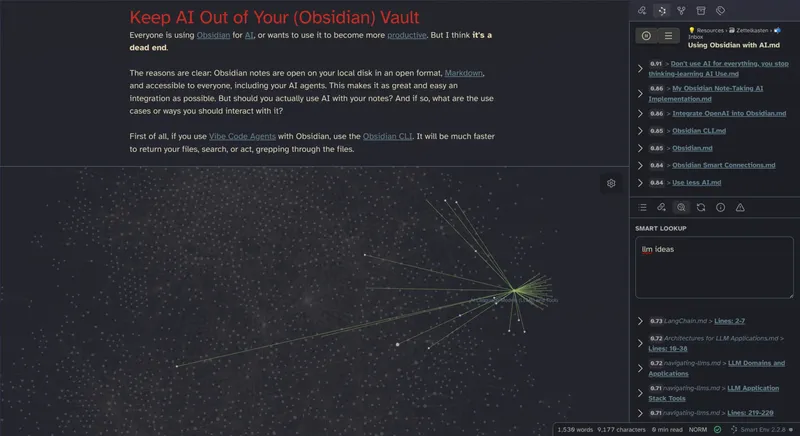
It’s so hard to finish an idea that is not yours and is just suggested by AI
Obsidian’s local, Markdown-based vaults make notes readily accessible to AI agents, but the author argues that AI-generated summaries, tags, links, and organization can weaken a personal knowledge system. Long generated summaries can make it difficult to distinguish a writer’s own ideas from AI text and add noise to later searches. The author sometimes uses Obsidian Web Clipper to create one- or two-sentence summaries, but labels them as AI-generated and removes them after adding personal writing. The author recommends AI primarily for retrieval and research, including finding related notes, vector search, similarity search, clustering, and search across large collections. Obsidian’s CLI can return files, search, and perform actions faster than grepping files when used with coding agents. The author’s single vault contains 25,979 files totaling 3.5 GB and uses the Omnisearch plugin to find material quickly; Obsidian Smart Connections can add vector and similarity search. Sensitive notes create an additional reason to prefer local models over uploads to external services. The author contends that manually writing and linking notes is part of learning and idea formation, while automated connections may produce a knowledge graph that does not reflect the user’s thinking. AI-generated material can instead be isolated in a dedicated PARA-method folder or separate vault, potentially excluded from search. The author also argues that human-curated knowledge remains valuable for both personal learning and future AI training.
ssp.sh
8 min
8/26/2026

I'm Becoming AI-Blind
A software professional reports becoming less able to concentrate on workplace documents that show what they perceive as strong signs of low-effort AI generation. They describe rereading such material without absorbing it, then asking senders questions already answered in the documents. Examples include a design document using Claude-like phrasing, a 20-page marketing deck that combines strategy with implausible technical jargon, and a verbose requirements document that resembles uncertain internal reasoning. The writer says AI-generated workplace text can be recognizable through distinctive wording, sentence flow, excessive verbosity, and efforts to portray routine details as major breakthroughs. They disagree with research suggesting people generally cannot reliably identify AI-generated text, arguing that low-effort output is easier to spot. They compare their reaction to banner blindness: repeated exposure to AI-generated LinkedIn posts, emails, and websites that they consider wordy but lacking meaning has trained them to mentally filter similar material. The writer says this filtering creates an unexpected productivity cost, because AI tools intended to improve efficiency can instead make them disengage from documents. They also recount noticing an apparently AI-generated restaurant image on the Baltic coast that seemed to depict moldy quiche.
cymerys.com
3 min
8/21/2026

The New AI Superpowers: Focus and Followthrough
Burnout is increasing despite advancements in AI that can enhance task completion speed significantly. The complexity and overwhelming nature of managing multiple AI-driven tasks may contribute to feelings of burnout rather than alleviating them.
rickmanelius.com
4 min
7/26/2026
ChatGPT Work
ChatGPT Work is an agent designed to assist users with ambitious tasks by gathering information across apps and workflows. It can create finished materials such as sheets, slides, documents, and web apps, and manage complex projects by breaking them into smaller steps over extended periods.
openai.com
9 min
7/9/2026

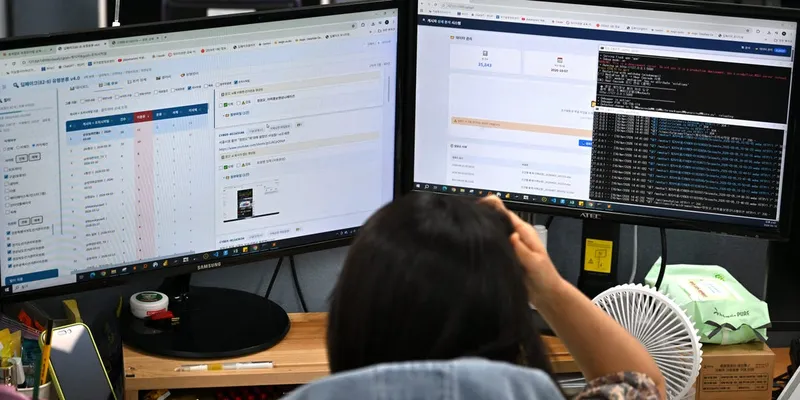
Workers are spending over 6 hours a week botsitting AI, fueling job frustration
White-collar workers spend an average of 6.4 hours per week "botsitting" AI, which includes providing context, verifying outputs, debugging errors, and correcting mistakes. A report from Glean's Work AI Institute, based on a survey of 6,000 full-time workers in the US, UK, and Australia, highlights this hidden labor associated with AI usage.
businessinsider.com
3 min
6/11/2026
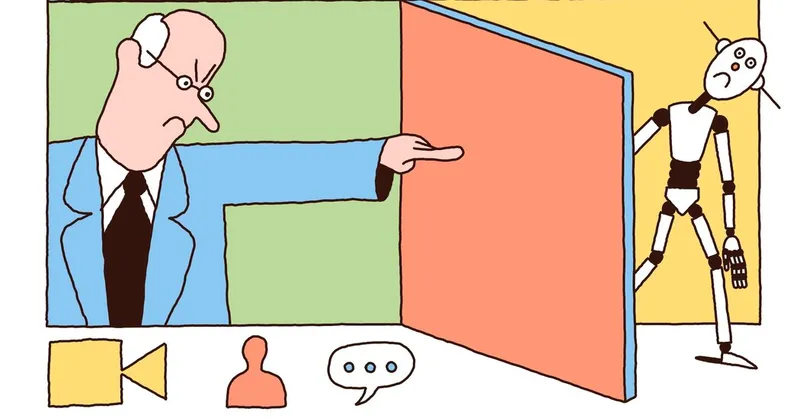
A.I. note takers are making lawyers nervous
AI note takers are capturing detailed conversations during meetings, raising concerns about potential violations of attorney-client privilege. Lawyers like Jeffrey Gifford are proactively addressing these risks by warning participants before meetings when AI note takers are present.
nytimes.com
1 min
5/11/2026
![g[ilber]t.de](https://pub-90f0ac00d93c47daac3e1d2cdd28d496.r2.dev/articles/f21ca0c2dff85d2a4cc861dc68a7a550.webp)
It’s so hard to finish an idea that is not yours and is just suggested by AI
Obsidian’s local, Markdown-based vaults make notes readily accessible to AI agents, but the author argues that AI-generated summaries, tags, links, and organization can weaken a personal knowledge system. Long generated summaries can make it difficult to distinguish a writer’s own ideas from AI text and add noise to later searches. The author sometimes uses Obsidian Web Clipper to create one- or two-sentence summaries, but labels them as AI-generated and removes them after adding personal writing. The author recommends AI primarily for retrieval and research, including finding related notes, vector search, similarity search, clustering, and search across large collections. Obsidian’s CLI can return files, search, and perform actions faster than grepping files when used with coding agents. The author’s single vault contains 25,979 files totaling 3.5 GB and uses the Omnisearch plugin to find material quickly; Obsidian Smart Connections can add vector and similarity search. Sensitive notes create an additional reason to prefer local models over uploads to external services. The author contends that manually writing and linking notes is part of learning and idea formation, while automated connections may produce a knowledge graph that does not reflect the user’s thinking. AI-generated material can instead be isolated in a dedicated PARA-method folder or separate vault, potentially excluded from search. The author also argues that human-curated knowledge remains valuable for both personal learning and future AI training.
ssp.sh
8 min
8/26/2026
Grok Bot
Grok Bot automates tasks by logging into applications and websites, functioning like a human colleague. Users can assign projects to Grok Bot, which manages tasks from start to finish, retains contextual awareness, and improves its performance over time.
x.ai
2 min
8/11/2026
ChatGPT Work
ChatGPT Work is an agent designed to assist users with ambitious tasks by gathering information across apps and workflows. It can create finished materials such as sheets, slides, documents, and web apps, and manage complex projects by breaking them into smaller steps over extended periods.
openai.com
9 min
7/9/2026
"Don't You Just Upload It to ChatGPT?"
Busy schedules can lead to overwhelming workloads, resulting in missed commitments like gym classes. Last-minute assignments arriving close to deadlines can disrupt personal plans and create stress.
correresmidestino.com
5 min
6/12/2026
A.I. note takers are making lawyers nervous
AI note takers are capturing detailed conversations during meetings, raising concerns about potential violations of attorney-client privilege. Lawyers like Jeffrey Gifford are proactively addressing these risks by warning participants before meetings when AI note takers are present.
nytimes.com
1 min
5/11/2026
I'm Becoming AI-Blind
A software professional reports becoming less able to concentrate on workplace documents that show what they perceive as strong signs of low-effort AI generation. They describe rereading such material without absorbing it, then asking senders questions already answered in the documents. Examples include a design document using Claude-like phrasing, a 20-page marketing deck that combines strategy with implausible technical jargon, and a verbose requirements document that resembles uncertain internal reasoning. The writer says AI-generated workplace text can be recognizable through distinctive wording, sentence flow, excessive verbosity, and efforts to portray routine details as major breakthroughs. They disagree with research suggesting people generally cannot reliably identify AI-generated text, arguing that low-effort output is easier to spot. They compare their reaction to banner blindness: repeated exposure to AI-generated LinkedIn posts, emails, and websites that they consider wordy but lacking meaning has trained them to mentally filter similar material. The writer says this filtering creates an unexpected productivity cost, because AI tools intended to improve efficiency can instead make them disengage from documents. They also recount noticing an apparently AI-generated restaurant image on the Baltic coast that seemed to depict moldy quiche.
cymerys.com
3 min
8/21/2026
The New AI Superpowers: Focus and Followthrough
Burnout is increasing despite advancements in AI that can enhance task completion speed significantly. The complexity and overwhelming nature of managing multiple AI-driven tasks may contribute to feelings of burnout rather than alleviating them.
rickmanelius.com
4 min
7/26/2026
How to Write an Email
Emails should begin with the main point to facilitate quick understanding and decision-making. Bad news should be stated early in the message to avoid obscuring the issue with unnecessary context or politeness.
blog.dannycastonguay.com
4 min
7/9/2026
Workers are spending over 6 hours a week botsitting AI, fueling job frustration
White-collar workers spend an average of 6.4 hours per week "botsitting" AI, which includes providing context, verifying outputs, debugging errors, and correcting mistakes. A report from Glean's Work AI Institute, based on a survey of 6,000 full-time workers in the US, UK, and Australia, highlights this hidden labor associated with AI usage.
businessinsider.com
3 min
6/11/2026
It’s so hard to finish an idea that is not yours and is just suggested by AI
Obsidian’s local, Markdown-based vaults make notes readily accessible to AI agents, but the author argues that AI-generated summaries, tags, links, and organization can weaken a personal knowledge system. Long generated summaries can make it difficult to distinguish a writer’s own ideas from AI text and add noise to later searches. The author sometimes uses Obsidian Web Clipper to create one- or two-sentence summaries, but labels them as AI-generated and removes them after adding personal writing. The author recommends AI primarily for retrieval and research, including finding related notes, vector search, similarity search, clustering, and search across large collections. Obsidian’s CLI can return files, search, and perform actions faster than grepping files when used with coding agents. The author’s single vault contains 25,979 files totaling 3.5 GB and uses the Omnisearch plugin to find material quickly; Obsidian Smart Connections can add vector and similarity search. Sensitive notes create an additional reason to prefer local models over uploads to external services. The author contends that manually writing and linking notes is part of learning and idea formation, while automated connections may produce a knowledge graph that does not reflect the user’s thinking. AI-generated material can instead be isolated in a dedicated PARA-method folder or separate vault, potentially excluded from search. The author also argues that human-curated knowledge remains valuable for both personal learning and future AI training.
ssp.sh
8 min
8/26/2026
The New AI Superpowers: Focus and Followthrough
Burnout is increasing despite advancements in AI that can enhance task completion speed significantly. The complexity and overwhelming nature of managing multiple AI-driven tasks may contribute to feelings of burnout rather than alleviating them.
rickmanelius.com
4 min
7/26/2026
"Don't You Just Upload It to ChatGPT?"
Busy schedules can lead to overwhelming workloads, resulting in missed commitments like gym classes. Last-minute assignments arriving close to deadlines can disrupt personal plans and create stress.
correresmidestino.com
5 min
6/12/2026
I'm Becoming AI-Blind
A software professional reports becoming less able to concentrate on workplace documents that show what they perceive as strong signs of low-effort AI generation. They describe rereading such material without absorbing it, then asking senders questions already answered in the documents. Examples include a design document using Claude-like phrasing, a 20-page marketing deck that combines strategy with implausible technical jargon, and a verbose requirements document that resembles uncertain internal reasoning. The writer says AI-generated workplace text can be recognizable through distinctive wording, sentence flow, excessive verbosity, and efforts to portray routine details as major breakthroughs. They disagree with research suggesting people generally cannot reliably identify AI-generated text, arguing that low-effort output is easier to spot. They compare their reaction to banner blindness: repeated exposure to AI-generated LinkedIn posts, emails, and websites that they consider wordy but lacking meaning has trained them to mentally filter similar material. The writer says this filtering creates an unexpected productivity cost, because AI tools intended to improve efficiency can instead make them disengage from documents. They also recount noticing an apparently AI-generated restaurant image on the Baltic coast that seemed to depict moldy quiche.
cymerys.com
3 min
8/21/2026
ChatGPT Work
ChatGPT Work is an agent designed to assist users with ambitious tasks by gathering information across apps and workflows. It can create finished materials such as sheets, slides, documents, and web apps, and manage complex projects by breaking them into smaller steps over extended periods.
openai.com
9 min
7/9/2026
Workers are spending over 6 hours a week botsitting AI, fueling job frustration
White-collar workers spend an average of 6.4 hours per week "botsitting" AI, which includes providing context, verifying outputs, debugging errors, and correcting mistakes. A report from Glean's Work AI Institute, based on a survey of 6,000 full-time workers in the US, UK, and Australia, highlights this hidden labor associated with AI usage.
businessinsider.com
3 min
6/11/2026
Grok Bot
Grok Bot automates tasks by logging into applications and websites, functioning like a human colleague. Users can assign projects to Grok Bot, which manages tasks from start to finish, retains contextual awareness, and improves its performance over time.
x.ai
2 min
8/11/2026
How to Write an Email
Emails should begin with the main point to facilitate quick understanding and decision-making. Bad news should be stated early in the message to avoid obscuring the issue with unnecessary context or politeness.
blog.dannycastonguay.com
4 min
7/9/2026
A.I. note takers are making lawyers nervous
AI note takers are capturing detailed conversations during meetings, raising concerns about potential violations of attorney-client privilege. Lawyers like Jeffrey Gifford are proactively addressing these risks by warning participants before meetings when AI note takers are present.
nytimes.com
1 min
5/11/2026