DeepSeek just open-sourced its inference engine
github.com
October 20, 2026
2 min read
69/100
Summary
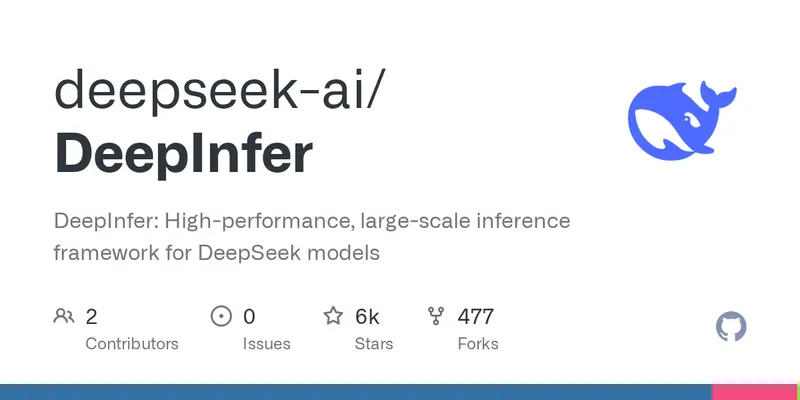
DeepSeek has open-sourced DeepInfer, the high-performance inference framework used in its large-scale production services. The release supports offline inference for DeepSeek-V4.1-Flash and includes optimized kernels and model and sampler runtimes. Its parallelism features include attention data parallelism, balanced context parallelism, mixture-of-experts expert parallelism, and expert parallel load balancing. DeepInfer uses FlashMLA, DeepGEMM, DeepEP, TileKernels, DeepSelect, and custom TileLang kernels. The framework supports DSpark and confidence-scheduled verification to accelerate decoding with draft tokens, decoder sliding-window-attention bounded replay to reduce prefill work, and asynchronous scheduling that overlaps CPU batch scheduling with device execution. It can provide batch-invariant inference and deterministic sampling on NVIDIA hardware, and it can constrain outputs with regular expressions, JSON schemas, or EBNF grammars. Supported hardware includes NVIDIA SM100 GPUs and Huawei Ascend 950 NPUs. DeepInfer requires Linux, GCC 13 or newer, and Python 3.12, plus CUDA 13 for NVIDIA or CANN 9.2 for Ascend. A complete serving system still requires components such as a KV-cache system, prefill/decode disaggregation, and load balancing across data-parallel replicas. DeepInfer is available under the Apache License 2.0.
Key Takeaways
- DeepInfer is DeepSeek's open-source inference framework for offline serving of DeepSeek-V4.1-Flash, derived primarily from vLLM with additional inspiration from SGLang and TensorRT-LLM.
- DeepInfer supports optimized decoding, asynchronous zero-overhead batch scheduling, mixture-of-experts parallelism, and structured outputs constrained by regexes, JSON schemas, or EBNF grammars.
- NVIDIA SM100 GPUs and Huawei Ascend 950 NPUs are supported; NVIDIA deployments require CUDA 13, while Ascend deployments require CANN 9.2.
- A complete production inference service requires additional systems not included in the release, including KV-cache management and load balancing for prefill and decode replicas.
What the discussion said
Commenters treated the release less as a routine code drop than as a stress test for the economics and concentration of AI inference. The bullish case is that DeepSeek has published optimization work capable of pushing enormous token volume at striking reported revenue per accelerator hour, while supporting both NVIDIA and Huawei hardware. Several readers see that as a way for independent providers to inherit hard-won serving optimizations rather than each rebuilding a proprietary engine, potentially lowering the cost of deploying capable models and weakening NVIDIA’s software-and-hardware grip. One user’s switch from a premium Claude subscription to DeepSeek’s API was offered as practical evidence that the cheaper model is already fast and useful enough for everyday work. The excitement was tempered by implementation details and geopolitical suspicion. This is not a complete turnkey serving stack: key-value cache management, prefill/decode disaggregation, and replica load balancing remain outside the release, so running a reliable production service is still far beyond simply pointing a small GPU cluster at the repository. Readers also challenged the profit claims because the cited revenue figure lacks enough deployment detail, including a clear accelerator comparison, latency, concurrency, and utilization. Debate over motive stayed unresolved: some framed openness as a deliberate way to commoditize rivals’ infrastructure, while others saw ordinary commercial reputation-building and compute constraints, not centralized state strategy. Subscription pricing and predictable monthly spend also remain areas where US incumbents retain practical appeal.
Where opinion split
The sharpest dispute is whether this release meaningfully threatens frontier AI incumbents. Enthusiasts argue that high-throughput open inference and multi-vendor hardware support can commoditize serving, make capable models cheap to deploy, and puncture premium API margins. Skeptics counter that the code is incomplete for production, requires serious hardware and operational expertise, and does not erase the model, data, capacity, trust, or procurement advantages of established providers.
Coverage & discussions
Hacker News · github.com
Community discussions
Community Sentiment
Positives
- Reported throughput and per-card revenue make AI inference look like a real business rather than a permanently subsidized money furnace, if the operating assumptions hold.
- Publishing optimized serving code lets third-party hosts converge on better DeepSeek performance instead of repeatedly reinventing the same inference machinery.
- Huawei Ascend support gives smaller labs a plausible route around NVIDIA-only infrastructure, turning an inference-engine release into a broader hardware competition story.
- DeepSeek V4.1 Flash is described as fast, broadly capable, and unusually permissive in practice, enough for one reader to replace a costly premium assistant subscription.
Concerns
- The release omits cache management, prefill/decode separation, and distributed load balancing, leaving crucial work before anyone can call it a turnkey production inference service.
- The celebrated revenue number is hard to evaluate without the card model, latency, concurrency, utilization, and deployment shape; headline economics can conceal expensive tradeoffs.
- Cheap usage-based APIs do not offer every developer the spending certainty and bundled convenience of fixed-price subscriptions from major US providers.
- Some readers see open releases as strategic commoditization driven by Chinese compute constraints or state interests, which can complicate trust and enterprise adoption.
Related Articles
DeepSeek-v4.1-Flash-1017
Oct 17, 2026
DeepSeek-V4 on Day 0: From Fast Inference to Verified RL with SGLang and Miles
Apr 25, 2026
DeepSeek V4 Flash on a Single AMD MI300X
Aug 4, 2026

Bringing Up DeepSeek-V4-Flash on AMD MI300X
Jun 2, 2026

DeepSeek V4–almost on the frontier, a fraction of the price
May 1, 2026