GLM-5.3-Flash Intelligence, Performance and Price Analysis
artificialanalysis.ai
August 26, 2026
4 min read
54/100
Summary
Z AI released GLM-5.3-Flash on August 26, 2026, an open-weight reasoning model with 320 billion total parameters and 18 billion active parameters per inference token. The Mixture-of-Experts model accepts text and image inputs, produces text outputs, and supports a 1 million-token context window. Its weights are available on Hugging Face under the MIT license, which permits commercial use. Artificial Analysis gave GLM-5.3-Flash a score of 57 on its Intelligence Index, compared with a median score of 27 for open-weight models of a similar size. The composite benchmark covers reasoning, knowledge, mathematics and coding. The evaluation generated 150 million output tokens, above the comparable-model median of 110 million, indicating relatively verbose outputs. Z AI's API charges $0.15 per million input tokens and $0.50 per million output tokens; Artificial Analysis lists a blended cache-hit/input/output rate of $0.10 per million tokens using a 7:2:1 ratio. The Intelligence Index evaluation cost $138.02. The model produces about 50.2 tokens per second, below the comparable median of 65.8, while its 1.56-second time to first token is faster than the 2.13-second median.
Key Takeaways
- GLM-5.3-Flash is Z AI's open-weight reasoning model, released August 26, 2026, with 320 billion total parameters and 18 billion active parameters.
- The model scored 57 on the Artificial Analysis Intelligence Index, versus a median of 27 among similarly sized open-weight models.
- GLM-5.3-Flash supports text and image input, text output, and a 1 million-token context window.
- Z AI's API pricing is $0.15 per million input tokens and $0.50 per million output tokens, while measured output speed is 50.2 tokens per second.
What the discussion said
Commenters treated GLM-5.3-Flash less as a standalone launch than as another move in the fast-moving price war among frontier and near-frontier models. The strongest praise focused on its reported Pareto position: one reader saw it clearing out much of the space between cheaper models and higher-end reasoning systems, while another highlighted a claimed advantage over DeepSeek V4 Pro at roughly one-third the task cost. Multimodal capability also mattered, with readers correcting the article’s claim that the model is text-only and reporting that its image and video understanding is unexpectedly strong. Still, the launch did not automatically dislodge established workflows. Several readers argued that Luna remains the better practical choice because its recent sharp price cut, higher throughput, and satisfactory planning, coding, and agent performance outweigh GLM’s small intelligence-score edge. The discussion also exposed distrust of the comparison site itself: inconsistent rank displays, absent speed-chart placement, and incorrect context and modality fields make a precision price-performance analysis feel shakier than advertised. At the industry level, commenters questioned whether massive AI training expenditures can ever be repaid, with responses framing continued free or cheap model releases as a gamble on transformative AI, government contracts, or eventual public backstops.
Where opinion split
The central dispute is whether GLM-5.3-Flash’s benchmarked intelligence and low per-task cost make it the new default, or whether Luna still wins in real use. GLM supporters see a model that beats expensive rivals at a radically better cost frontier; Luna users argue that a marginal score advantage is irrelevant when Luna is faster, cheaper for their workloads, and already reliable for coding and agents.
Community Sentiment
Positives
- Reportedly outperforming DeepSeek V4 Pro at about a third of the task cost, GLM-5.3-Flash looks like a serious compression of frontier-model economics.
- Its claimed Pareto-frontier position excites readers because it may erase the usual tradeoff between cheap fast models and stronger reasoning tiers.
- Image and video input support, omitted by the article, broadens GLM-5.3-Flash from a text model into a more useful multimodal agent component.
- Luna’s steep price reduction has made capable planning, code generation, and agent work affordable enough that users are consolidating workloads onto it.
Concerns
- A tiny intelligence-score lead over Luna does not justify switching when Luna is reported faster, cheaper per task, and already dependable across everyday agent workloads.
- Incorrect modality and context-window data, contradictory ranking displays, and missing speed-chart placement undermine confidence in the article’s model comparison claims.
- Readers question whether enormous AI training investments have a plausible commercial payoff, rather than depending on AGI-level transformation, state contracts, or bailouts.
Related Articles
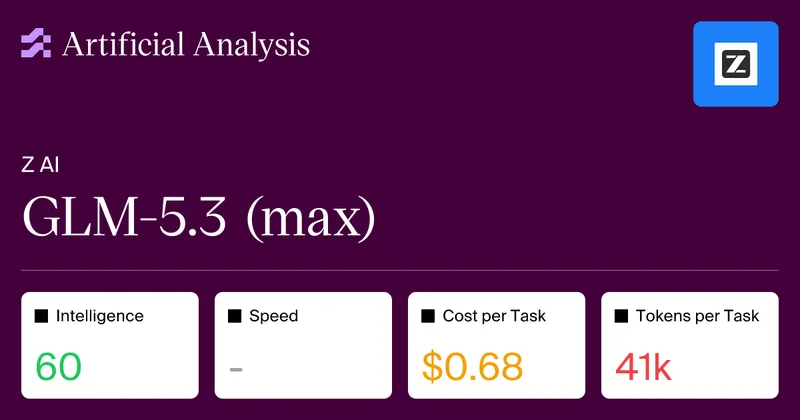
GLM-5.3 Artificial Analysis Benchmarks
Aug 18, 2026
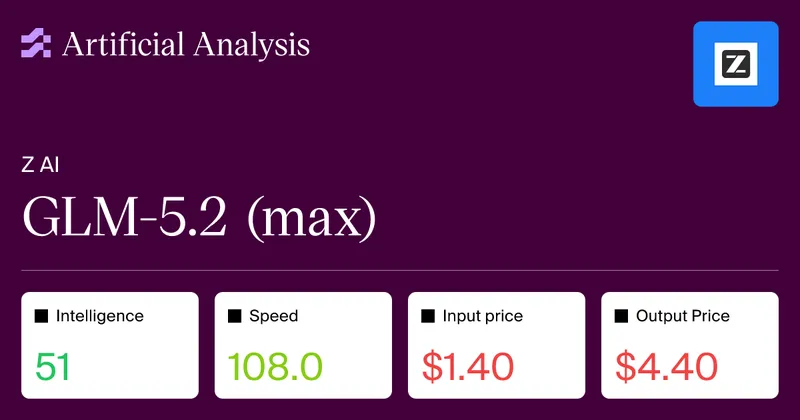
GLM 5.2 Performance Benchmarks
Jun 17, 2026
Opus 5 is currently #1 on Artificial Analysis Intelligence Leaderboard
Jul 24, 2026
GLM-5.2 is the new leading open weights model on Artificial Analysis
Jun 17, 2026

Step 3.5 Flash – Open-source foundation model, supports deep reasoning at speed
Feb 19, 2026