GLM-5.3 Artificial Analysis Benchmarks
artificialanalysis.ai
August 18, 2026
3 min read
54/100
Summary
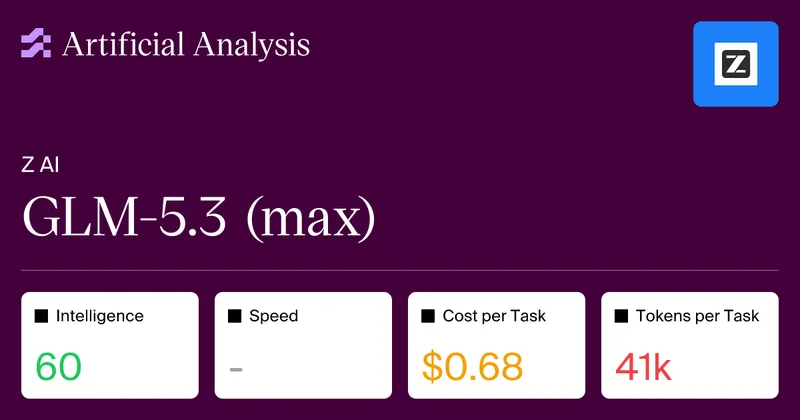
Z AI released the proprietary reasoning model GLM-5.3 (max) on August 18, 2026. The model accepts and generates text only, does not process images, and supports a 1 million-token context window, roughly equivalent to 1,500 A4 pages in 12-point Arial. It has 753 billion parameters and is available through one API provider. GLM-5.3 (max) scored 60 on the Artificial Analysis Intelligence Index, compared with a median score of 35 for reasoning models in a similar price tier. The composite index measures capabilities including reasoning, knowledge, mathematics and coding. The model produced 170 million output tokens during the evaluation, substantially above the 72 million-token median for comparable models, and the full evaluation cost $1,238.50. Z AI’s API pricing is $1.40 per million input tokens and $4.40 per million output tokens, versus medians of $1.75 and $10.00, respectively, for comparable models. Artificial Analysis calculates a blended price of $0.90 per million tokens using a 7:2:1 cache-hit, input and output token mix. The model uses extended thinking or chain-of-thought reasoning for complex problems, while its weights are not publicly available.
Key Takeaways
- Z AI released GLM-5.3 (max), a proprietary 753-billion-parameter reasoning model, on August 18, 2026.
- GLM-5.3 (max) scored 60 on the Artificial Analysis Intelligence Index, above the 35 median for comparable reasoning models.
- The model supports text input and output with a 1 million-token context window, but does not support image input or other multimodal capabilities.
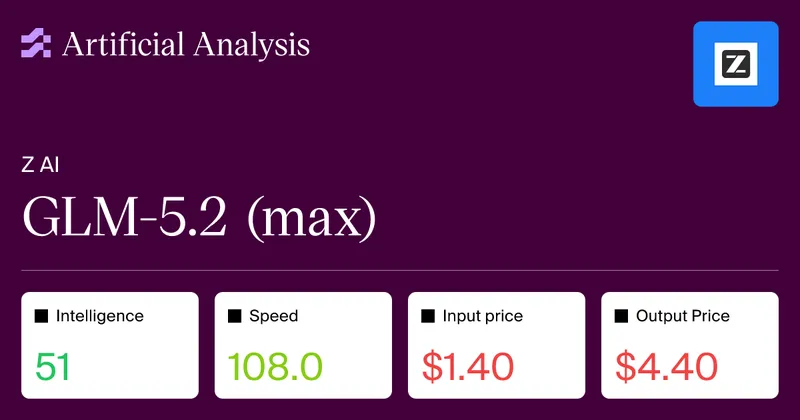
- Z AI prices GLM-5.3 (max) at $1.40 per million input tokens and $4.40 per million output tokens through its API.
- GLM-5.3 (max) generated 170 million output tokens during Artificial Analysis Intelligence Index testing, compared with a 72 million-token median for similar models.
What the discussion said
The thread treated GLM-5.3 less as a benchmark headline than as a practical choice for coding agents: can it dislodge an existing Claude subscription, and what does its apparent performance actually cost in a real workflow? Several readers were impressed by a model of this size reaching the top tier of an agentic ranking, with one early hands-on test broadly validating the Artificial Analysis result. The strongest enthusiasm centered on visible reasoning traces: unlike opaque closed models, users can catch an agent misunderstanding its environment, clarify the task mid-run, and stop a long expensive failure before it burns through a huge token budget. But the applause came with price and evaluation caveats. Commenters argued that GLM is not automatically cheaper for someone already paying a flat Claude subscription; its advantage is mainly for API-priced usage, especially through routing services. Readers also stressed that cost-per-task and token-per-task summaries cannot establish whether the model completed tasks correctly. High default reasoning effort may explain GLM’s large output footprint, but it still weakens its price-performance edge against K3 and proprietary alternatives. Skeptics further warned that named benchmark suites can be misleading and that Chinese models may lag frontier closed systems on scientific and biotech knowledge. The consensus was promising and useful, not a clean replacement for Claude.
Where opinion split
The sharp dispute is whether GLM-5.3 is genuinely the better-value coding model than a Claude subscription. Supporters see top agentic performance, flexible API routing, and cheaper metered access as a route to strong capability without proprietary-model pricing; critics say subscription Claude remains cheaper for many users, while GLM’s heavier token use and uncertain benchmark validity erode the claimed bargain.
Community Sentiment
Positives
- A top agentic-index tie with a frontier proprietary model makes GLM-5.3 look like unusually capable open-weight competition rather than a budget-only compromise.
- Visible reasoning tokens let operators spot a confused coding agent, inject missing context, and abort costly dead ends before hours of useless inference accumulate.
- Early release-day use reportedly matched the benchmark picture, giving at least one practitioner confidence that the strong score survives direct testing.
- Unified model proxies make a volatile model market less punishing: teams can route workloads across providers instead of betting their entire AI stack on one vendor.
Concerns
- For people already on a flat Claude plan, GLM’s API bill may not be a saving at all; the economic case mainly appears for metered API workloads.
- Cost and output-token figures are incomplete performance measures, because a cheap-looking run has no value if the model silently fails the task.
- GLM’s elevated token consumption, even if driven partly by maximum reasoning effort, narrows its practical price-performance lead over K3 and closed models.
- Benchmark caution is warranted: some cited task suites may not reflect robust capability, and commenters report weaker scientific and biotech knowledge than leading ChatGPT-class systems.
Related Articles
GLM 5.2 Performance Benchmarks
Jun 17, 2026
GLM-5.3-Flash Intelligence, Performance and Price Analysis
Aug 26, 2026

GLM-5.2 is the new leading open weights model on Artificial Analysis
Jun 17, 2026
Opus 5 is currently #1 on Artificial Analysis Intelligence Leaderboard
Jul 24, 2026
![[AINews] Why OpenAI Should Build Slack](https://substackcdn.com/image/fetch/$s_!XQAE!,w_1200,h_675,c_fill,f_jpg,q_auto:good,fl_progressive:steep,g_auto/https%3A%2F%2Fsubstack-post-media.s3.amazonaws.com%2Fpublic%2Fimages%2F89ee056a-0ea2-4473-8e1c-9b21f034c717_1474x2116.png)
OpenAI should build Slack
Feb 14, 2026