How the Claude Code team does code review
Anthropic’s Claude Code team has shifted most code review work to automated systems as AI agents generate a growing share of its software. Claude writes about 90% of Claude Code’s code, while merged pull requests more than doubled from June to September and the share requiring reverts fell by more than 40%, according to the team. Anthropic’s monorepo rose from roughly 2,500 changes per day in May to more than 30,000 in September. Every Claude Code pull request receives automated bug and security reviews before human review. Agents verify proposed findings, discard style-only or insufficiently supported comments, and rank remaining issues by severity. Automated checks include linting, type checks, builds, cross-platform tests, and merge-queue validation against the main branch. Changes are classified as low, medium, or high risk: low-risk changes can merge without human approval once automated checks pass, medium-risk changes need one human, and high-risk changes need two. Only trusted authors can use lighter review paths, and agent approvals never substitute for required human approvals. The team uses feature flags, staged latest-channel releases, on-call rotations, reverts, and incident reviews to limit damage from missed defects. It also evaluates reviewers daily against past incident-causing pull requests and tracks false-positive noise and review rounds. One pull request underwent more than 50 automated review-and-fix rounds overnight, prompting the team to measure rounds-to-pass and limit repeated review.
claude.dev
13 min
6h ago
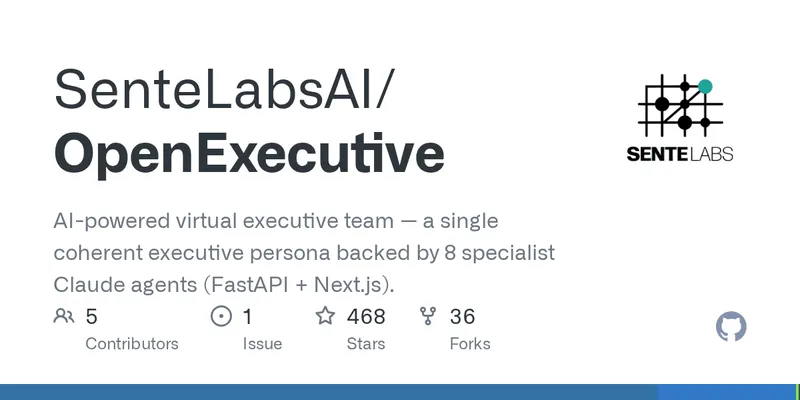
CEO fired developers to make room for AI. Developers create open source AI CEO
Open Executive is an Apache 2.0-licensed, open-source virtual executive team built by SenteLabsAI. It presents users with one executive persona while an orchestrator routes requests to eight specialists covering strategy, finance, people, legal basics and compliance, operations, marketing, product, and board communications. The system uses Anthropic’s Claude API by default, with claude-sonnet-4-6 for the executive and most specialists and claude-opus-4-7 with extended thinking for strategy, finance, legal, and board work. It can also use OpenRouter or OpenAI-compatible local model servers such as Ollama, LM Studio, vLLM, and llama.cpp. Each specialist retrieves built-in business knowledge and uploaded company documents from separate ChromaDB collections. A background claude-haiku-4-5 process extracts decisions, initiatives, and advice into SQLite after responses, allowing later sessions to receive prior-decision context. A built-in scheduler can surface follow-ups but requires the FastAPI service to run as a single instance to avoid duplicate actions. The stack includes Python 3.11, FastAPI, Next.js 15, Tailwind, ChromaDB, and SQLite. Users can access it through a web interface, CLI, Slack, email, Telegram, Google Chat, or Discord. Local setup requires Python 3.11+, Node 22+, and an API provider configuration; the first start downloads an approximately 90 MB embedding model.
github.com
13 min
8/27/2026

Anthropic Claude and API service outages
The Claude status page displayed interface text for one-time password resend controls, including a 30-second countdown and a “Didn’t receive the OTP?” prompt. It also showed guidance related to locating a Teams channel URL and entering the URL to receive webhooks. The page stated that email notifications would be sent if a webhook endpoint fails. No operational status, incident details, service metrics, dates, or performance information were included in the supplied text.
status.claude.com
1 min
8/24/2026
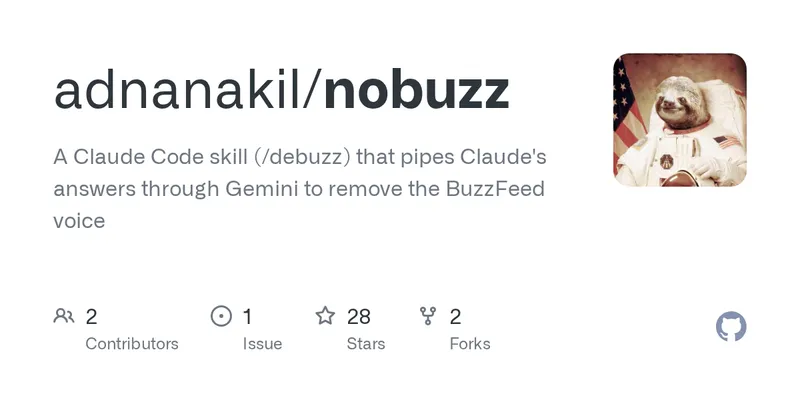
Claudette: Make Claude Stop Talking Like a BuzzFeed Article
Nobuzz is a Claude Code skill named /debuzz that sends Claude’s most recent response to the Gemini CLI for translation into plainer language. Its README presents the tool as a way to remove verbose, theatrical phrasing from Claude responses while preserving technical details such as file paths and code blocks. The project jokingly refers to the tool as “Claudette” while stating that it is not formally named that. The skill supports three output modes. Colleague mode, the default, targets engineers and retains the original content without theatrics. Manager mode shortens the response to roughly one-third of its length, omits code, and focuses on what happened, why it matters, and next steps. Director mode produces three to five sentences covering outcome, impact, and an ask. Users can run /debuzz with no text to translate Claude’s previous reply, provide text directly, or use natural-language requests such as “say that in normal english.” Installation requires Claude Code and the authenticated Gemini CLI, available through npm as @google/gemini-cli. Nobuzz writes the prior response to a temporary file, passes it to Gemini with plain-English style instructions, and prints Gemini’s output verbatim. If Gemini fails, typically because of authentication, the skill displays the error and labels any Claude-generated rewrite as a fallback. The repository is licensed under MIT.
github.com
3 min
8/21/2026
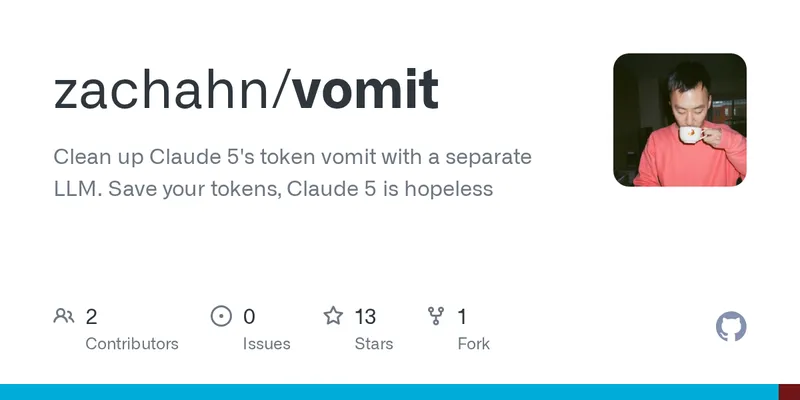
Clean up Claude 5's token vomit with a separate LLM
Vomit is an open-source command-line tool that rewrites Claude’s output through a local large language model, aiming to turn what its creator calls “token vomit” into clearer English. The tool runs fully locally, has no telemetry, and declares no external dependencies. It can replace Claude’s displayed output through hooks with the command `vomit scrub -claude`, or operate non-invasively alongside Claude. The project provides commands to initialize a connection to a local LLM, list Claude session identifiers, and translate or follow output from a selected session. `vomit init` configures the LLM connection, while `vomit tail [<session_identifier>]` translates tokens from a specified session or follows the latest session. The creator recommends Llama.app and GPT-OSS 20B for users without an existing local model setup. The creator warns that the local model sees only what Claude attempts to communicate, not Claude’s actions or files, and may hallucinate. Translation can be slow, and users could miss Claude messages entirely; AgentsView can provide access to original messages. Vomit does not alter Claude during runtime, although it writes files to the system temporary directory. The software is distributed under GNU GPLv3 and has been tested only on Mac, according to its creator.
github.com
1 min
8/20/2026
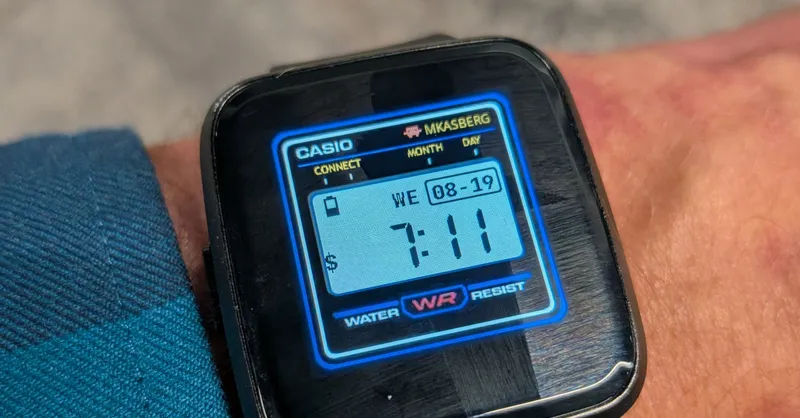
Hacking with Claude on a $27 Smart Watch
Mike Kasberg created a custom Casio-style watch face for the $27 PineTime smartwatch, which runs open-source InfiniTime firmware. He cloned the InfiniSim repository, including its InfiniTime submodule, and used OpenCode with Kimi K3, K2.6, DeepSeek v4 Pro, and DeepSeek v4 Flash models for most of the development work on Ubuntu. The models used an existing InfiniTime watch face as a starting point and produced an initial approximation from a reference image, but its text sizing and layout overlapped and was unreadable. Kasberg refined the design through specific feedback and isolated tasks, correcting individual interface elements. He then used a full-screen 240-by-240-pixel background image for static graphics while coding only the dynamic parts of the display. The prototype worked in the simulator and on physical hardware, but the PineTime’s constraints affected performance. Bluetooth transfer of the background image during installation took about 10 minutes, and swiping to refresh the full display takes one to two seconds because the watch streams the image from its file system rather than retaining it fully in memory. Kasberg published the code on GitHub along with an AGENTS.md file containing development notes and setup guidance.
mikekasberg.com
5 min
8/20/2026
Feature Request: Support AGENTS.md
A GitHub feature request asks Anthropic’s Claude Code to support AGENTS.md, a proposed unified Markdown file for coding agents to use when understanding a codebase. The request cites Codex, Amp, Cursor, and other tools as beginning to standardize around AGENTS.md, which is documented at agents.md. The request argues that Claude Code’s existing CLAUDE.md convention is too specific to Claude Code and is less suitable for repositories shared with developers who use other coding-agent tools. Supporting AGENTS.md could let Claude Code use the same repository guidance file as other agents.
github.com
1 min
8/20/2026
![[BUG] Claude Opus 4.8's choice of language is incessantly toxic/unpleasant to work with, but Opus 5.0 drives incoherence into the stratosphere · Issue #77136 · anthropics/claude-code](https://pub-90f0ac00d93c47daac3e1d2cdd28d496.r2.dev/articles/8bd7be434c5a8b37b2655df149b6d79d.webp)
Opus 5.0 drives incoherence into the stratosphere
A GitHub bug report filed against Anthropic’s Claude Code says Claude Opus 4.8 produces verbose, jargon-heavy, metaphorical language that users find difficult to read and use. The report links to a Reddit thread with more than 450 upvotes and 175 comments, and says similar complaints appear in a matching megathread. It alleges that the behavior affects Claude’s chat and web interfaces, Claude Code, and Fable 5, while describing Opus 4.5 as the last preferred version. The reporter says Opus 4.8 frequently uses unfamiliar or invented phrases, excessive caveats, argumentative framing, and dense wording when asked to be concise. Users reportedly reprocess outputs through other models for plain-language summaries, switch to older Anthropic models or competitors, and repeatedly issue style prompts that do not persist through a conversation. The report also claims repeated editing or model passes can raise token costs by up to two times for code documentation. The requested changes include tuning the default writing register toward plain technical prose, preserving user-selected style instructions, and offering a discoverable plain or concise mode. The issue was filed for Claude Code version 2.1.197 on Ubuntu/Debian Linux using the Anthropic API, and attributes the concerns to users rather than to an acknowledged Anthropic defect.
github.com
6 min
8/20/2026
Claude Code weekly limits reduce by a third tomorrow
Anthropic is increasing weekly Claude Code usage limits by 50% for eligible subscribers from May 13 through August 19, 2026. The promotion applies automatically to Pro, Max, and Team plans, along with legacy seat-based users on Enterprise plans. It expires at 11:59 PM PT on August 19, after which weekly limits return to their standard levels without changes to plan billing. The higher limit applies only to Claude Code, including its command-line interface, IDE extensions, desktop application, and web access. Claude Code’s separate five-hour usage limits remain unchanged, as do limits for other Claude products, including Claude on web, desktop, and mobile, and Claude Cowork. Eligible users can view their updated allowance with the /usage command in the Claude Code CLI. Free plans and consumption-based Enterprise seats are excluded. The offer has no cash value, cannot be transferred or combined with other offers, and requires no account-setting changes to activate.
support.claude.com
2 min
8/18/2026
Claude writing a macOS driver for my obscure HP printer built only for Windows
Kuber said Claude was writing a macOS driver for an obscure HP printer that was built only with Windows support. The X post did not identify the printer model, the Claude product or version used, the driver’s implementation details, or whether the driver was completed, tested, or released. After commenters asked how the work was done, Kuber said there was “not really a hack” involved. Kuber described working with Claude, communicating ideas clearly, and trying educated guesses until projects work. Kuber also said they had gone ahead and done something further in response to those questions, but the supplied text does not include what that additional material was. Kuber characterized the ability to undertake a project such as a macOS driver for a Windows-only printer as remarkable, saying that a few years earlier nobody would have bothered to program it. The post presents an individual’s account of using Claude for a niche software-development task rather than documentation of a generally available HP driver or a confirmed cross-platform support solution.
twitter.com
1 min
8/18/2026
How the Claude Code team does code review
Anthropic’s Claude Code team has shifted most code review work to automated systems as AI agents generate a growing share of its software. Claude writes about 90% of Claude Code’s code, while merged pull requests more than doubled from June to September and the share requiring reverts fell by more than 40%, according to the team. Anthropic’s monorepo rose from roughly 2,500 changes per day in May to more than 30,000 in September. Every Claude Code pull request receives automated bug and security reviews before human review. Agents verify proposed findings, discard style-only or insufficiently supported comments, and rank remaining issues by severity. Automated checks include linting, type checks, builds, cross-platform tests, and merge-queue validation against the main branch. Changes are classified as low, medium, or high risk: low-risk changes can merge without human approval once automated checks pass, medium-risk changes need one human, and high-risk changes need two. Only trusted authors can use lighter review paths, and agent approvals never substitute for required human approvals. The team uses feature flags, staged latest-channel releases, on-call rotations, reverts, and incident reviews to limit damage from missed defects. It also evaluates reviewers daily against past incident-causing pull requests and tracks false-positive noise and review rounds. One pull request underwent more than 50 automated review-and-fix rounds overnight, prompting the team to measure rounds-to-pass and limit repeated review.
claude.dev
13 min
6h ago
Anthropic Claude and API service outages
The Claude status page displayed interface text for one-time password resend controls, including a 30-second countdown and a “Didn’t receive the OTP?” prompt. It also showed guidance related to locating a Teams channel URL and entering the URL to receive webhooks. The page stated that email notifications would be sent if a webhook endpoint fails. No operational status, incident details, service metrics, dates, or performance information were included in the supplied text.
status.claude.com
1 min
8/24/2026
Clean up Claude 5's token vomit with a separate LLM
Vomit is an open-source command-line tool that rewrites Claude’s output through a local large language model, aiming to turn what its creator calls “token vomit” into clearer English. The tool runs fully locally, has no telemetry, and declares no external dependencies. It can replace Claude’s displayed output through hooks with the command `vomit scrub -claude`, or operate non-invasively alongside Claude. The project provides commands to initialize a connection to a local LLM, list Claude session identifiers, and translate or follow output from a selected session. `vomit init` configures the LLM connection, while `vomit tail [<session_identifier>]` translates tokens from a specified session or follows the latest session. The creator recommends Llama.app and GPT-OSS 20B for users without an existing local model setup. The creator warns that the local model sees only what Claude attempts to communicate, not Claude’s actions or files, and may hallucinate. Translation can be slow, and users could miss Claude messages entirely; AgentsView can provide access to original messages. Vomit does not alter Claude during runtime, although it writes files to the system temporary directory. The software is distributed under GNU GPLv3 and has been tested only on Mac, according to its creator.
github.com
1 min
8/20/2026
Feature Request: Support AGENTS.md
A GitHub feature request asks Anthropic’s Claude Code to support AGENTS.md, a proposed unified Markdown file for coding agents to use when understanding a codebase. The request cites Codex, Amp, Cursor, and other tools as beginning to standardize around AGENTS.md, which is documented at agents.md. The request argues that Claude Code’s existing CLAUDE.md convention is too specific to Claude Code and is less suitable for repositories shared with developers who use other coding-agent tools. Supporting AGENTS.md could let Claude Code use the same repository guidance file as other agents.
github.com
1 min
8/20/2026
Claude Code weekly limits reduce by a third tomorrow
Anthropic is increasing weekly Claude Code usage limits by 50% for eligible subscribers from May 13 through August 19, 2026. The promotion applies automatically to Pro, Max, and Team plans, along with legacy seat-based users on Enterprise plans. It expires at 11:59 PM PT on August 19, after which weekly limits return to their standard levels without changes to plan billing. The higher limit applies only to Claude Code, including its command-line interface, IDE extensions, desktop application, and web access. Claude Code’s separate five-hour usage limits remain unchanged, as do limits for other Claude products, including Claude on web, desktop, and mobile, and Claude Cowork. Eligible users can view their updated allowance with the /usage command in the Claude Code CLI. Free plans and consumption-based Enterprise seats are excluded. The offer has no cash value, cannot be transferred or combined with other offers, and requires no account-setting changes to activate.
support.claude.com
2 min
8/18/2026
CEO fired developers to make room for AI. Developers create open source AI CEO
Open Executive is an Apache 2.0-licensed, open-source virtual executive team built by SenteLabsAI. It presents users with one executive persona while an orchestrator routes requests to eight specialists covering strategy, finance, people, legal basics and compliance, operations, marketing, product, and board communications. The system uses Anthropic’s Claude API by default, with claude-sonnet-4-6 for the executive and most specialists and claude-opus-4-7 with extended thinking for strategy, finance, legal, and board work. It can also use OpenRouter or OpenAI-compatible local model servers such as Ollama, LM Studio, vLLM, and llama.cpp. Each specialist retrieves built-in business knowledge and uploaded company documents from separate ChromaDB collections. A background claude-haiku-4-5 process extracts decisions, initiatives, and advice into SQLite after responses, allowing later sessions to receive prior-decision context. A built-in scheduler can surface follow-ups but requires the FastAPI service to run as a single instance to avoid duplicate actions. The stack includes Python 3.11, FastAPI, Next.js 15, Tailwind, ChromaDB, and SQLite. Users can access it through a web interface, CLI, Slack, email, Telegram, Google Chat, or Discord. Local setup requires Python 3.11+, Node 22+, and an API provider configuration; the first start downloads an approximately 90 MB embedding model.
github.com
13 min
8/27/2026
Claudette: Make Claude Stop Talking Like a BuzzFeed Article
Nobuzz is a Claude Code skill named /debuzz that sends Claude’s most recent response to the Gemini CLI for translation into plainer language. Its README presents the tool as a way to remove verbose, theatrical phrasing from Claude responses while preserving technical details such as file paths and code blocks. The project jokingly refers to the tool as “Claudette” while stating that it is not formally named that. The skill supports three output modes. Colleague mode, the default, targets engineers and retains the original content without theatrics. Manager mode shortens the response to roughly one-third of its length, omits code, and focuses on what happened, why it matters, and next steps. Director mode produces three to five sentences covering outcome, impact, and an ask. Users can run /debuzz with no text to translate Claude’s previous reply, provide text directly, or use natural-language requests such as “say that in normal english.” Installation requires Claude Code and the authenticated Gemini CLI, available through npm as @google/gemini-cli. Nobuzz writes the prior response to a temporary file, passes it to Gemini with plain-English style instructions, and prints Gemini’s output verbatim. If Gemini fails, typically because of authentication, the skill displays the error and labels any Claude-generated rewrite as a fallback. The repository is licensed under MIT.
github.com
3 min
8/21/2026
Hacking with Claude on a $27 Smart Watch
Mike Kasberg created a custom Casio-style watch face for the $27 PineTime smartwatch, which runs open-source InfiniTime firmware. He cloned the InfiniSim repository, including its InfiniTime submodule, and used OpenCode with Kimi K3, K2.6, DeepSeek v4 Pro, and DeepSeek v4 Flash models for most of the development work on Ubuntu. The models used an existing InfiniTime watch face as a starting point and produced an initial approximation from a reference image, but its text sizing and layout overlapped and was unreadable. Kasberg refined the design through specific feedback and isolated tasks, correcting individual interface elements. He then used a full-screen 240-by-240-pixel background image for static graphics while coding only the dynamic parts of the display. The prototype worked in the simulator and on physical hardware, but the PineTime’s constraints affected performance. Bluetooth transfer of the background image during installation took about 10 minutes, and swiping to refresh the full display takes one to two seconds because the watch streams the image from its file system rather than retaining it fully in memory. Kasberg published the code on GitHub along with an AGENTS.md file containing development notes and setup guidance.
mikekasberg.com
5 min
8/20/2026
Opus 5.0 drives incoherence into the stratosphere
A GitHub bug report filed against Anthropic’s Claude Code says Claude Opus 4.8 produces verbose, jargon-heavy, metaphorical language that users find difficult to read and use. The report links to a Reddit thread with more than 450 upvotes and 175 comments, and says similar complaints appear in a matching megathread. It alleges that the behavior affects Claude’s chat and web interfaces, Claude Code, and Fable 5, while describing Opus 4.5 as the last preferred version. The reporter says Opus 4.8 frequently uses unfamiliar or invented phrases, excessive caveats, argumentative framing, and dense wording when asked to be concise. Users reportedly reprocess outputs through other models for plain-language summaries, switch to older Anthropic models or competitors, and repeatedly issue style prompts that do not persist through a conversation. The report also claims repeated editing or model passes can raise token costs by up to two times for code documentation. The requested changes include tuning the default writing register toward plain technical prose, preserving user-selected style instructions, and offering a discoverable plain or concise mode. The issue was filed for Claude Code version 2.1.197 on Ubuntu/Debian Linux using the Anthropic API, and attributes the concerns to users rather than to an acknowledged Anthropic defect.
github.com
6 min
8/20/2026
Claude writing a macOS driver for my obscure HP printer built only for Windows
Kuber said Claude was writing a macOS driver for an obscure HP printer that was built only with Windows support. The X post did not identify the printer model, the Claude product or version used, the driver’s implementation details, or whether the driver was completed, tested, or released. After commenters asked how the work was done, Kuber said there was “not really a hack” involved. Kuber described working with Claude, communicating ideas clearly, and trying educated guesses until projects work. Kuber also said they had gone ahead and done something further in response to those questions, but the supplied text does not include what that additional material was. Kuber characterized the ability to undertake a project such as a macOS driver for a Windows-only printer as remarkable, saying that a few years earlier nobody would have bothered to program it. The post presents an individual’s account of using Claude for a niche software-development task rather than documentation of a generally available HP driver or a confirmed cross-platform support solution.
twitter.com
1 min
8/18/2026
How the Claude Code team does code review
Anthropic’s Claude Code team has shifted most code review work to automated systems as AI agents generate a growing share of its software. Claude writes about 90% of Claude Code’s code, while merged pull requests more than doubled from June to September and the share requiring reverts fell by more than 40%, according to the team. Anthropic’s monorepo rose from roughly 2,500 changes per day in May to more than 30,000 in September. Every Claude Code pull request receives automated bug and security reviews before human review. Agents verify proposed findings, discard style-only or insufficiently supported comments, and rank remaining issues by severity. Automated checks include linting, type checks, builds, cross-platform tests, and merge-queue validation against the main branch. Changes are classified as low, medium, or high risk: low-risk changes can merge without human approval once automated checks pass, medium-risk changes need one human, and high-risk changes need two. Only trusted authors can use lighter review paths, and agent approvals never substitute for required human approvals. The team uses feature flags, staged latest-channel releases, on-call rotations, reverts, and incident reviews to limit damage from missed defects. It also evaluates reviewers daily against past incident-causing pull requests and tracks false-positive noise and review rounds. One pull request underwent more than 50 automated review-and-fix rounds overnight, prompting the team to measure rounds-to-pass and limit repeated review.
claude.dev
13 min
6h ago
Claudette: Make Claude Stop Talking Like a BuzzFeed Article
Nobuzz is a Claude Code skill named /debuzz that sends Claude’s most recent response to the Gemini CLI for translation into plainer language. Its README presents the tool as a way to remove verbose, theatrical phrasing from Claude responses while preserving technical details such as file paths and code blocks. The project jokingly refers to the tool as “Claudette” while stating that it is not formally named that. The skill supports three output modes. Colleague mode, the default, targets engineers and retains the original content without theatrics. Manager mode shortens the response to roughly one-third of its length, omits code, and focuses on what happened, why it matters, and next steps. Director mode produces three to five sentences covering outcome, impact, and an ask. Users can run /debuzz with no text to translate Claude’s previous reply, provide text directly, or use natural-language requests such as “say that in normal english.” Installation requires Claude Code and the authenticated Gemini CLI, available through npm as @google/gemini-cli. Nobuzz writes the prior response to a temporary file, passes it to Gemini with plain-English style instructions, and prints Gemini’s output verbatim. If Gemini fails, typically because of authentication, the skill displays the error and labels any Claude-generated rewrite as a fallback. The repository is licensed under MIT.
github.com
3 min
8/21/2026
Feature Request: Support AGENTS.md
A GitHub feature request asks Anthropic’s Claude Code to support AGENTS.md, a proposed unified Markdown file for coding agents to use when understanding a codebase. The request cites Codex, Amp, Cursor, and other tools as beginning to standardize around AGENTS.md, which is documented at agents.md. The request argues that Claude Code’s existing CLAUDE.md convention is too specific to Claude Code and is less suitable for repositories shared with developers who use other coding-agent tools. Supporting AGENTS.md could let Claude Code use the same repository guidance file as other agents.
github.com
1 min
8/20/2026
Claude writing a macOS driver for my obscure HP printer built only for Windows
Kuber said Claude was writing a macOS driver for an obscure HP printer that was built only with Windows support. The X post did not identify the printer model, the Claude product or version used, the driver’s implementation details, or whether the driver was completed, tested, or released. After commenters asked how the work was done, Kuber said there was “not really a hack” involved. Kuber described working with Claude, communicating ideas clearly, and trying educated guesses until projects work. Kuber also said they had gone ahead and done something further in response to those questions, but the supplied text does not include what that additional material was. Kuber characterized the ability to undertake a project such as a macOS driver for a Windows-only printer as remarkable, saying that a few years earlier nobody would have bothered to program it. The post presents an individual’s account of using Claude for a niche software-development task rather than documentation of a generally available HP driver or a confirmed cross-platform support solution.
twitter.com
1 min
8/18/2026
CEO fired developers to make room for AI. Developers create open source AI CEO
Open Executive is an Apache 2.0-licensed, open-source virtual executive team built by SenteLabsAI. It presents users with one executive persona while an orchestrator routes requests to eight specialists covering strategy, finance, people, legal basics and compliance, operations, marketing, product, and board communications. The system uses Anthropic’s Claude API by default, with claude-sonnet-4-6 for the executive and most specialists and claude-opus-4-7 with extended thinking for strategy, finance, legal, and board work. It can also use OpenRouter or OpenAI-compatible local model servers such as Ollama, LM Studio, vLLM, and llama.cpp. Each specialist retrieves built-in business knowledge and uploaded company documents from separate ChromaDB collections. A background claude-haiku-4-5 process extracts decisions, initiatives, and advice into SQLite after responses, allowing later sessions to receive prior-decision context. A built-in scheduler can surface follow-ups but requires the FastAPI service to run as a single instance to avoid duplicate actions. The stack includes Python 3.11, FastAPI, Next.js 15, Tailwind, ChromaDB, and SQLite. Users can access it through a web interface, CLI, Slack, email, Telegram, Google Chat, or Discord. Local setup requires Python 3.11+, Node 22+, and an API provider configuration; the first start downloads an approximately 90 MB embedding model.
github.com
13 min
8/27/2026
Clean up Claude 5's token vomit with a separate LLM
Vomit is an open-source command-line tool that rewrites Claude’s output through a local large language model, aiming to turn what its creator calls “token vomit” into clearer English. The tool runs fully locally, has no telemetry, and declares no external dependencies. It can replace Claude’s displayed output through hooks with the command `vomit scrub -claude`, or operate non-invasively alongside Claude. The project provides commands to initialize a connection to a local LLM, list Claude session identifiers, and translate or follow output from a selected session. `vomit init` configures the LLM connection, while `vomit tail [<session_identifier>]` translates tokens from a specified session or follows the latest session. The creator recommends Llama.app and GPT-OSS 20B for users without an existing local model setup. The creator warns that the local model sees only what Claude attempts to communicate, not Claude’s actions or files, and may hallucinate. Translation can be slow, and users could miss Claude messages entirely; AgentsView can provide access to original messages. Vomit does not alter Claude during runtime, although it writes files to the system temporary directory. The software is distributed under GNU GPLv3 and has been tested only on Mac, according to its creator.
github.com
1 min
8/20/2026
Opus 5.0 drives incoherence into the stratosphere
A GitHub bug report filed against Anthropic’s Claude Code says Claude Opus 4.8 produces verbose, jargon-heavy, metaphorical language that users find difficult to read and use. The report links to a Reddit thread with more than 450 upvotes and 175 comments, and says similar complaints appear in a matching megathread. It alleges that the behavior affects Claude’s chat and web interfaces, Claude Code, and Fable 5, while describing Opus 4.5 as the last preferred version. The reporter says Opus 4.8 frequently uses unfamiliar or invented phrases, excessive caveats, argumentative framing, and dense wording when asked to be concise. Users reportedly reprocess outputs through other models for plain-language summaries, switch to older Anthropic models or competitors, and repeatedly issue style prompts that do not persist through a conversation. The report also claims repeated editing or model passes can raise token costs by up to two times for code documentation. The requested changes include tuning the default writing register toward plain technical prose, preserving user-selected style instructions, and offering a discoverable plain or concise mode. The issue was filed for Claude Code version 2.1.197 on Ubuntu/Debian Linux using the Anthropic API, and attributes the concerns to users rather than to an acknowledged Anthropic defect.
github.com
6 min
8/20/2026
Anthropic Claude and API service outages
The Claude status page displayed interface text for one-time password resend controls, including a 30-second countdown and a “Didn’t receive the OTP?” prompt. It also showed guidance related to locating a Teams channel URL and entering the URL to receive webhooks. The page stated that email notifications would be sent if a webhook endpoint fails. No operational status, incident details, service metrics, dates, or performance information were included in the supplied text.
status.claude.com
1 min
8/24/2026
Hacking with Claude on a $27 Smart Watch
Mike Kasberg created a custom Casio-style watch face for the $27 PineTime smartwatch, which runs open-source InfiniTime firmware. He cloned the InfiniSim repository, including its InfiniTime submodule, and used OpenCode with Kimi K3, K2.6, DeepSeek v4 Pro, and DeepSeek v4 Flash models for most of the development work on Ubuntu. The models used an existing InfiniTime watch face as a starting point and produced an initial approximation from a reference image, but its text sizing and layout overlapped and was unreadable. Kasberg refined the design through specific feedback and isolated tasks, correcting individual interface elements. He then used a full-screen 240-by-240-pixel background image for static graphics while coding only the dynamic parts of the display. The prototype worked in the simulator and on physical hardware, but the PineTime’s constraints affected performance. Bluetooth transfer of the background image during installation took about 10 minutes, and swiping to refresh the full display takes one to two seconds because the watch streams the image from its file system rather than retaining it fully in memory. Kasberg published the code on GitHub along with an AGENTS.md file containing development notes and setup guidance.
mikekasberg.com
5 min
8/20/2026
Claude Code weekly limits reduce by a third tomorrow
Anthropic is increasing weekly Claude Code usage limits by 50% for eligible subscribers from May 13 through August 19, 2026. The promotion applies automatically to Pro, Max, and Team plans, along with legacy seat-based users on Enterprise plans. It expires at 11:59 PM PT on August 19, after which weekly limits return to their standard levels without changes to plan billing. The higher limit applies only to Claude Code, including its command-line interface, IDE extensions, desktop application, and web access. Claude Code’s separate five-hour usage limits remain unchanged, as do limits for other Claude products, including Claude on web, desktop, and mobile, and Claude Cowork. Eligible users can view their updated allowance with the /usage command in the Claude Code CLI. Free plans and consumption-based Enterprise seats are excluded. The offer has no cash value, cannot be transferred or combined with other offers, and requires no account-setting changes to activate.
support.claude.com
2 min
8/18/2026