Hacking with Claude on a $27 Smart Watch
mikekasberg.com
August 20, 2026
5 min read
51/100
Summary
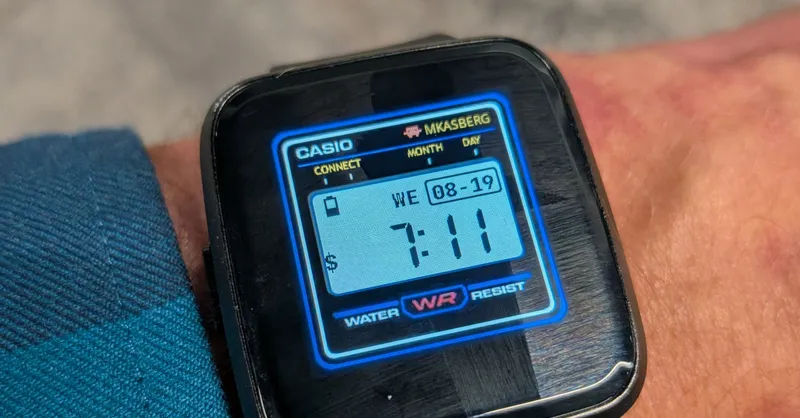
Mike Kasberg created a custom Casio-style watch face for the $27 PineTime smartwatch, which runs open-source InfiniTime firmware. He cloned the InfiniSim repository, including its InfiniTime submodule, and used OpenCode with Kimi K3, K2.6, DeepSeek v4 Pro, and DeepSeek v4 Flash models for most of the development work on Ubuntu. The models used an existing InfiniTime watch face as a starting point and produced an initial approximation from a reference image, but its text sizing and layout overlapped and was unreadable. Kasberg refined the design through specific feedback and isolated tasks, correcting individual interface elements. He then used a full-screen 240-by-240-pixel background image for static graphics while coding only the dynamic parts of the display. The prototype worked in the simulator and on physical hardware, but the PineTime’s constraints affected performance. Bluetooth transfer of the background image during installation took about 10 minutes, and swiping to refresh the full display takes one to two seconds because the watch streams the image from its file system rather than retaining it fully in memory. Kasberg published the code on GitHub along with an AGENTS.md file containing development notes and setup guidance.
Key Takeaways
- The $27 PineTime smartwatch runs open-source firmware and can be customized with new InfiniTime watch faces.
- Mike Kasberg used OpenCode and Kimi and DeepSeek open-weight models to build a Casio-style PineTime watch face in a few hours.
- A 240-by-240-pixel full-screen background image simplified the watch-face implementation, but takes about 10 minutes to transfer over Bluetooth.
- The PineTime streams the background image from its file system, causing full-screen refreshes after swipes to take one to two seconds.
- Kasberg published the watch-face code and an AGENTS.md guide on GitHub.
What the discussion said
Commenters mostly treated the project as evidence that coding agents can make tiny, inexpensive, and even aging wearable hardware far more approachable. Several readers had already used Claude, Codex, or open-weight models to build watch applications, from calorie displays to reviving an obsolete Pebble codebase. The appeal was not that a language model runs on the watch itself, but that an AI assistant compresses the painful parts of embedded development enough for playful, personal projects to become realistic. One reader explicitly connected this to near-discarded hardware gaining a second life in the hands of people who previously would have avoided this kind of work. The sharpest criticism targeted attribution. The article repeatedly foregrounded Claude while acknowledging that much of the actual work used OpenCode alongside Kimi and DeepSeek models. Readers saw that as muddy model-specific claims and possibly turning Claude into a generic label for coding agents. Hardware limits also surfaced: the PineTime's tiny memory makes even image handling awkward, and its lack of a microphone rules out voice-driven interactions. The broader wish is for AI-assisted development to unlock a genuinely open, capable sports-watch alternative rather than merely clever demos on constrained devices.
Where opinion split
The main dispute is whether calling the project a Claude build is accurate when much of it was produced through OpenCode with Kimi and DeepSeek models. Defenders implicitly treat Claude as shorthand for the new coding-agent workflow; critics argue that shorthand erases which models actually did the work and makes capability claims impossible to evaluate.
Community Sentiment
Positives
- Coding agents are lowering the embedded-development barrier enough that cheap watches can become fertile ground for personal tools rather than sealed gadgets.
- AI-assisted maintenance can resurrect decade-old wearable software, turning abandoned codebases into working applications on newly available hardware.
- Open-weight coding models and agent tooling give tinkerers an alternative to depending entirely on one proprietary assistant for niche hardware projects.
- Readers see AI help as a plausible route toward an open Garmin-class watch, where community development could compete with closed vendors' rapid feature updates.
Concerns
- The article's Claude branding looks misleading because it credits one assistant while admitting that other models performed much of the implementation work.
- PineTime-class memory constraints force aggressive streaming and efficiency work, limiting how far AI-assisted prototyping can compensate for weak wearable hardware.
- No microphone on the device blocks voice-control experiments, leaving a conspicuous gap for anyone imagining an AI-style conversational wearable.