Claudette: Make Claude Stop Talking Like a BuzzFeed Article
github.com
August 21, 2026
3 min read
64/100
Summary
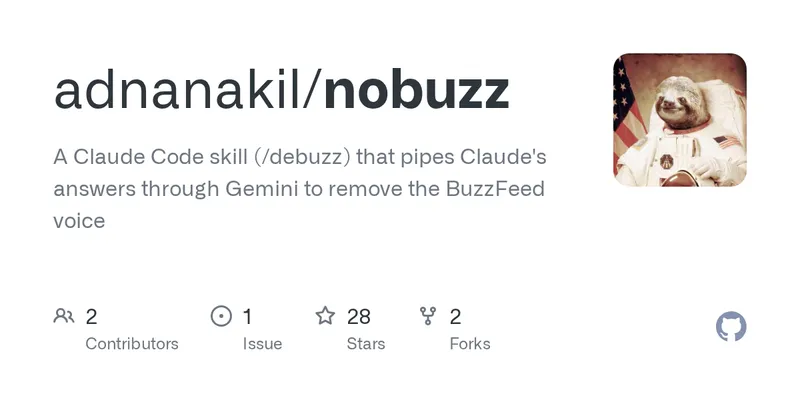
Nobuzz is a Claude Code skill named /debuzz that sends Claude’s most recent response to the Gemini CLI for translation into plainer language. Its README presents the tool as a way to remove verbose, theatrical phrasing from Claude responses while preserving technical details such as file paths and code blocks. The project jokingly refers to the tool as “Claudette” while stating that it is not formally named that. The skill supports three output modes. Colleague mode, the default, targets engineers and retains the original content without theatrics. Manager mode shortens the response to roughly one-third of its length, omits code, and focuses on what happened, why it matters, and next steps. Director mode produces three to five sentences covering outcome, impact, and an ask. Users can run /debuzz with no text to translate Claude’s previous reply, provide text directly, or use natural-language requests such as “say that in normal english.” Installation requires Claude Code and the authenticated Gemini CLI, available through npm as @google/gemini-cli. Nobuzz writes the prior response to a temporary file, passes it to Gemini with plain-English style instructions, and prints Gemini’s output verbatim. If Gemini fails, typically because of authentication, the skill displays the error and labels any Claude-generated rewrite as a fallback. The repository is licensed under MIT.
Key Takeaways
- Nobuzz’s /debuzz Claude Code skill uses the Gemini CLI to rewrite Claude responses in plainer language.
- Colleague mode preserves engineering details, while manager and director modes progressively shorten output for non-engineering and executive audiences.
- The tool requires an authenticated installation of @google/gemini-cli and Claude Code.
- Nobuzz prints Gemini’s translation verbatim; if Gemini errors, it shows the error and marks any Claude rewrite as a fallback.
What the discussion said
The thread is less interested in the proposed cleanup tool than in a broad revolt against Claude’s current voice. Commenters describe a model that pads coding help with theatrical reassurance, moralizing, needless explanations, and inflated language, turning paid token budgets into a tax on reading. Several say the contrast became obvious only after trying other models, whose terser, less personified responses felt immediately easier to work with. Claude’s apparent loss of context over even short exchanges compounds the irritation: carefully stated style constraints can fade as a session grows. People have found workarounds, but regard them as evidence of a product failure. Strict word caps, stripped-down project instruction files, and hooks that reject generated comments can produce cleaner code and output. Still, readers argue these controls are brittle because Claude may eventually disregard them. Anthropic’s concise setting drew particular skepticism, since it is seen as a prompt-level preference rather than a reliable behavioral change. A minority pushes back on claims of universal outrage, noting that loud dissatisfied users are not necessarily representative, and one commenter maintains Claude remains especially strong for coding. Even so, the prevailing view is that Anthropic should fix the default interaction style rather than make customers install layers of prompt engineering to escape it.
Where opinion split
The central dispute is whether Claude’s disliked prose style is a serious product-level defect or a loud minority preference issue. Critics say verbosity, persona-driven positivity, and moralizing waste paid tokens and persist despite instructions, making competitor models more usable; the counterargument is that most users may neither notice nor care, so extensive investment in a stylistic overhaul may not be justified.
Community Sentiment
Positives
- Strict output limits and compact coding rules can noticeably reduce Claude’s clutter, giving users a practical route to clearer generated code.
- Several readers still regard Claude as exceptionally capable for coding, even while criticizing the prose wrapped around its answers.
- A new concise-output option and promised broader refinements suggest Anthropic has at least acknowledged demand for tighter responses.
- Using a fresh session to justify each remaining code comment can turn Claude into a useful editor rather than a generator of boilerplate.
Concerns
- Claude’s upbeat persona, superlatives, and moralizing are seen as costly noise: users pay for tokens yet must sift through language that adds little technical value.
- Style instructions decay as context accumulates, forcing some developers to duplicate bans across project files and add hooks to catch unwanted prose or comments.
- Competitor models are praised for brief, impersonal answers, making Claude’s increasingly explanatory and anthropomorphic voice feel unusually burdensome.
- Some users report context loss after only a handful of turns, undermining Claude’s usefulness on sustained coding tasks alongside the tone problem.
- Prompt-file-based concise modes are dismissed as fragile cosmetic fixes because the model can ignore them rather than consistently changing its behavior.