
Muse Spark Open
Meta has released the weights for Muse Spark Open, an open-weight, natively multimodal AI model designed for coding, agentic workflows, complex software engineering, and multi-step reasoning. The model has 816 billion total parameters, with 42 billion active parameters, and supports a context window of up to 1 million tokens. Meta calls it the most capable US open-weight model to date. Muse Spark Open can run locally on two Apple M5 Ultra Mac Studio systems using Apple’s MLX framework. Each M5 Ultra can provide up to 512 GB of unified memory and 1.2 TB/s of memory bandwidth, allowing the two systems to hold the full model. Meta tested on-device workflows with Muse Code, including making bug fixes and adding features to the Ice Cubes Mastodon client, as well as reviewing and vertically cropping video in DaVinci Resolve. The weights are available through Amazon SageMaker AI, Google Cloud Model Garden, Hugging Face, and Microsoft Foundry Models, while hosted inference is offered through Baseten, Fireworks AI, Groq, Modal, Nebius, OpenRouter, and Together AI. The model supports engines including SGLang, vLLM, TensorRT-LLM, Transformers, MLX, llama.cpp, and Unsloth. Meta says its SGLang kernels deliver 1.03-3.95 times kernel-level speedups on NVIDIA and AMD GPUs. The model is released under the Muse Model License with limited commercial terms.
research.meta.ai
3 min
1d ago

GLM-5.3-Flash
Z.ai published a post titled “GLM-5.3-Flash.” The available source text provides no details about the model’s capabilities, release date, technical specifications, pricing, benchmarks, availability, or intended use. The post was submitted by Philpax and had received 529 points and 239 comments at the time represented by the source text.
z.ai
1 min
8/26/2026
Agent Lightning v1.0
Microsoft released Agent Lightning v1.0.1, the first official release of the Agent Lightning Skill for coding agents. The skill is designed to help coding agents optimize other AI agents by working from an editable agent and a benchmark. Agent Lightning guides measured, systematic iteration across prompts, tools, workflows, models, and reasoning settings. It balances accuracy, cost, latency, and reliability during those improvements. The skill can be installed for Claude Code, Codex, or GitHub Copilot with the command `gh skill install microsoft/agent-lightning agent-lightning --agent <agent>`. Version 1.0.1 also strengthens continuous integration, packaging, release automation, documentation, and benchmark reporting.
github.com
1 min
8/25/2026
Building an (almost) fully self-hosted, sandboxed, agentic software factory
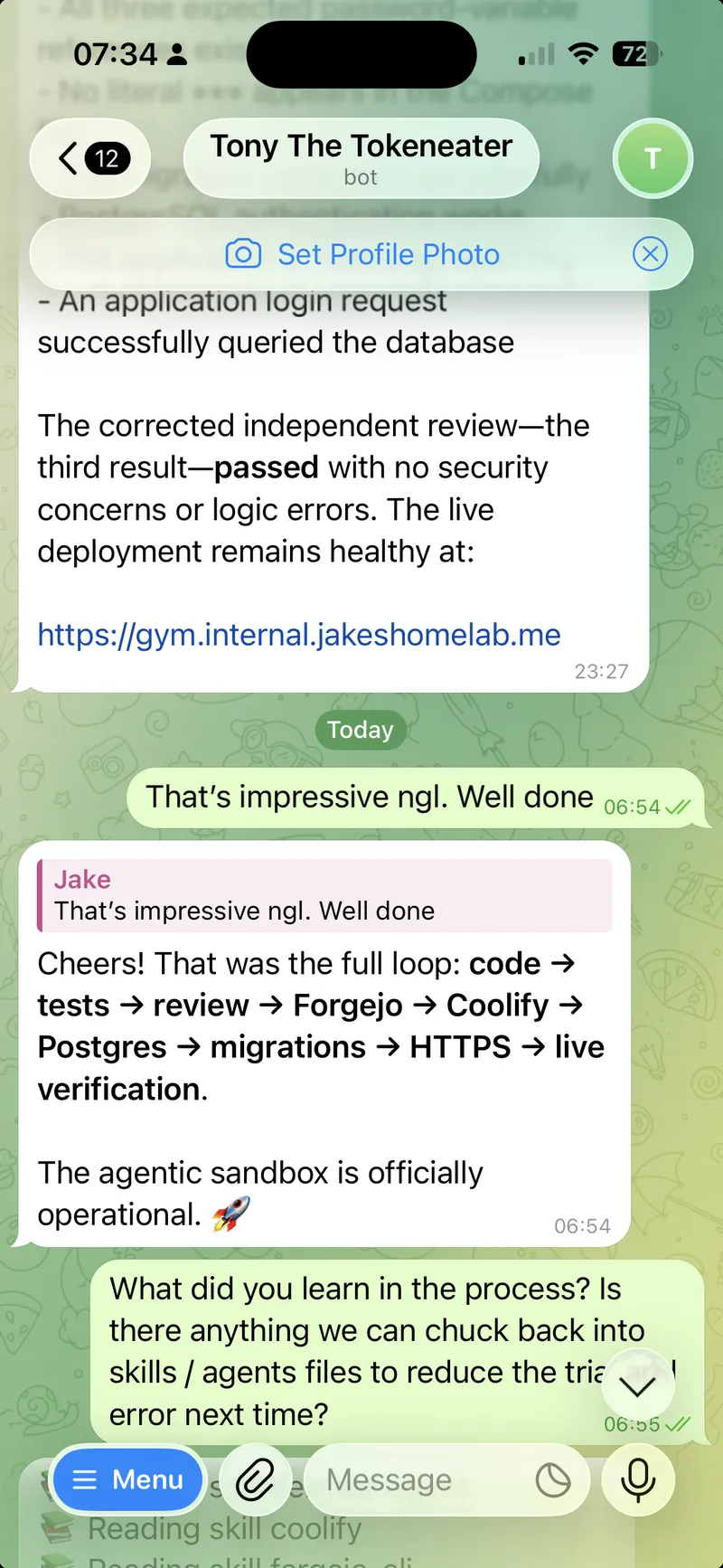
Jake Saunders built a mostly self-hosted agentic development environment that turned a single prompt into a deployed calorie-tracking application. Hermes, an OpenClaw-style assistant using OpenAI Codex for inference, created a Forgejo repository, generated a SvelteKit application with Drizzle, Postgres and Tailwind, wrote tests, configured CI, fixed failed tests, containerized the software, and deployed it through Coolify. After a later report of a CSRF bug, Hermes diagnosed the issue, added regression tests and redeployed the application. The environment runs on a separate 2021 10th-generation i7 machine with 32GB of RAM rather than the homelab server hosting other services. Coolify provides self-hosted Docker-based deployment, Forgejo supplies Git and CI runners, and Firecrawl provides web scraping and search access. Tailscale and Pi-hole make internal services reachable remotely, while DNS-01 validation through Porkbun and Let’s Encrypt issues HTTPS certificates without public A or AAAA records for the services. The setup still depends on external inference and integrations, including Codex, Tailscale, Telegram, Porkbun and Let’s Encrypt; the stated experiment-specific ongoing cost is a £20 Codex subscription. Saunders says the isolation limits the impact of agent mistakes but does not make the system safe: Hermes can still erase the dedicated machine, delete local resources, misuse supplied credentials, make outbound requests, and reach network resources permitted by firewall rules.
blog.jakesaunders.dev
11 min
8/21/2026
Seed: Minimal, self-modifying agent harness
Seed is an open-source agent starter that gives a language model a single exec tool for running shell commands. Its system prompt is loaded from self/SELF.md, and the agent can edit the self/ directory to preserve tools, notes, and behavior across otherwise ephemeral sessions. Rather than receiving a prebuilt framework’s memory, skills, tools, and conventions, each agent develops them over time by writing files into that directory. Running uvx --from git+https://github.com/vivekhaldar/seed.git seed in a new directory copies seed.py and run_seed.sh without overwriting existing files, creates self/SELF.md, initializes a Git repository, and opens a REPL. Each directory becomes a distinct agent whose retained files and Git history reflect its own interactions. The local runner can reopen an existing agent and optionally select a model, including gemini-2.5-pro. Seed records verbatim session transcripts in self/sessions/*.json after every turn, but does not automatically load those transcripts at startup. Model access is managed by Simon Willison’s llm library; the documented default is openai-codex/gpt-5.6-sol using a ChatGPT login through the Codex CLI. Supported providers include OpenAI, Anthropic, Gemini, and OpenRouter.
github.com
2 min
8/21/2026
Ox Alpha
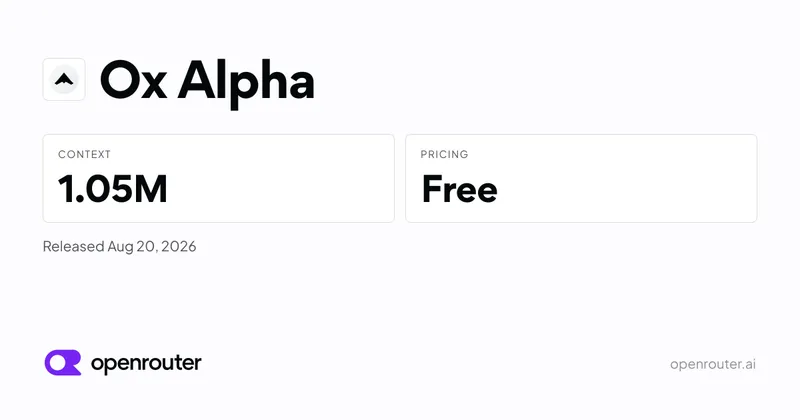
Ox Alpha is a free stealth reasoning model on OpenRouter for coding, sustained agentic work, production workloads, long-horizon software engineering, and complex reasoning. It accepts text, images, and video as input and returns text, supporting workflows that combine written and visual context. The model was released on August 20, 2026. An anonymous third-party provider develops and operates Ox Alpha during its preview period. OpenRouter routes requests directly to the model but is not its developer, owner, or provider. The provider retains prompts and completions, although it does not use them for training; other handling is governed by OpenRouter’s Stealth Model Terms. Ox Alpha is hosted by one provider, so OpenRouter has no alternative provider routing choices for requests. The model has a 1,048,576-token context window and can generate up to 131,072 completion tokens. It supports function calling through tools and tool_choice, plus JSON output through response_format without JSON Schema enforcement. OpenRouter lists prompt and completion token pricing at zero. Its reported median latency is 2.02 seconds and median throughput is 50 tokens per second. OpenRouter reports 99.99% uptime and 96.79% availability over the measured period.
openrouter.ai
3 min
8/20/2026
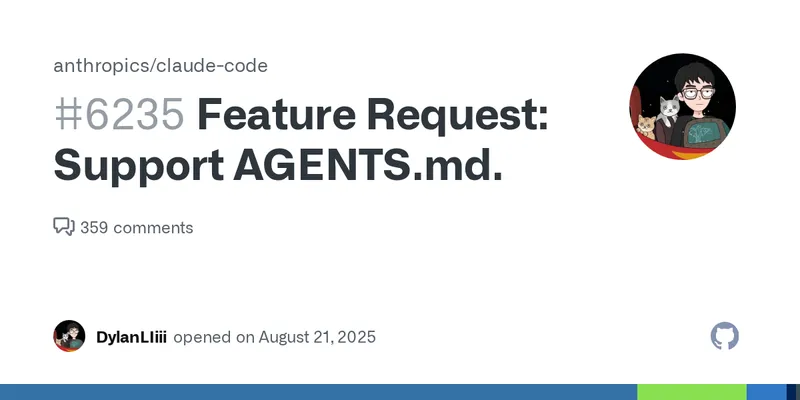
Feature Request: Support AGENTS.md
A GitHub feature request asks Anthropic’s Claude Code to support AGENTS.md, a proposed unified Markdown file for coding agents to use when understanding a codebase. The request cites Codex, Amp, Cursor, and other tools as beginning to standardize around AGENTS.md, which is documented at agents.md. The request argues that Claude Code’s existing CLAUDE.md convention is too specific to Claude Code and is less suitable for repositories shared with developers who use other coding-agent tools. Supporting AGENTS.md could let Claude Code use the same repository guidance file as other agents.
github.com
1 min
8/20/2026
Claude writing a macOS driver for my obscure HP printer built only for Windows
Kuber said Claude was writing a macOS driver for an obscure HP printer that was built only with Windows support. The X post did not identify the printer model, the Claude product or version used, the driver’s implementation details, or whether the driver was completed, tested, or released. After commenters asked how the work was done, Kuber said there was “not really a hack” involved. Kuber described working with Claude, communicating ideas clearly, and trying educated guesses until projects work. Kuber also said they had gone ahead and done something further in response to those questions, but the supplied text does not include what that additional material was. Kuber characterized the ability to undertake a project such as a macOS driver for a Windows-only printer as remarkable, saying that a few years earlier nobody would have bothered to program it. The post presents an individual’s account of using Claude for a niche software-development task rather than documentation of a generally available HP driver or a confirmed cross-platform support solution.
twitter.com
1 min
8/18/2026
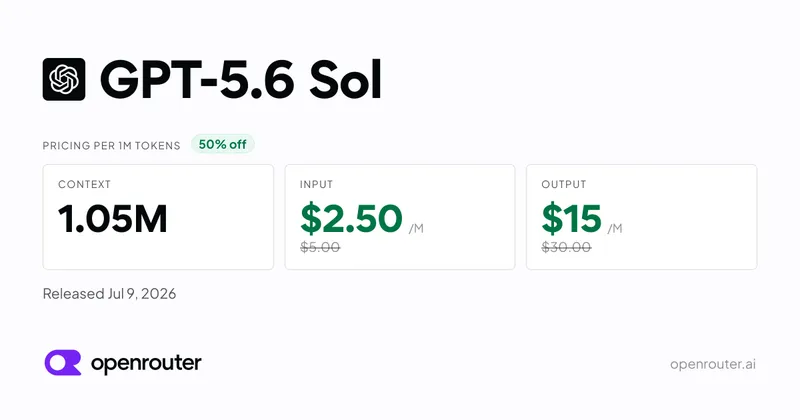
GPT-5.6 Sol Pricing Cut by 50%
GPT-5.6 Sol is OpenAI’s flagship model in the GPT-5.6 series, released on July 9, 2026. It is positioned for complex reasoning, coding, agentic workflows, command-line work, multi-step coding tasks, and long-horizon problem solving. The model has a 1 million-token context window and a February 2026 knowledge cutoff. OpenRouter lists pricing of $2.50 per million input tokens and $15 per million output tokens, reflecting a 50% discount from listed rates of $5 and $30. Provider listings shown on the platform include input prices from $5 to $5.50 per million tokens, output prices from $30 to $33, and cache pricing from $0.50 to $0.55. OpenRouter says actual customer prices can be lower because of caching and discounts. OpenRouter can route requests for GPT-5.6 Sol among multiple hosting providers through Balanced, Nitro, or Exacto modes, which prioritize price and speed, fastest response, or tool-calling accuracy, respectively. The platform reports a best-provider median latency of 3.07 seconds and a best-across-providers median throughput of 46 tokens per second. It reports 100.00% uptime over the prior three days and 99.76% availability, and says it can reroute requests after upstream-provider errors when request filters permit it. OpenRouter’s OpenAI-compatible API allows many SDKs to use the model by changing the base URL and model slug.
openrouter.ai
2 min
8/17/2026
Rhombus 1.1 is now available
Rhombus version 1.1 is now available for download at https://rhombus-lang.org/. This release introduces new features, including the ability to define annotations without writing meta-time code and a new binding form for improved readability.
blog.racket-lang.org
1 min
8/17/2026
Muse Spark Open
Meta has released the weights for Muse Spark Open, an open-weight, natively multimodal AI model designed for coding, agentic workflows, complex software engineering, and multi-step reasoning. The model has 816 billion total parameters, with 42 billion active parameters, and supports a context window of up to 1 million tokens. Meta calls it the most capable US open-weight model to date. Muse Spark Open can run locally on two Apple M5 Ultra Mac Studio systems using Apple’s MLX framework. Each M5 Ultra can provide up to 512 GB of unified memory and 1.2 TB/s of memory bandwidth, allowing the two systems to hold the full model. Meta tested on-device workflows with Muse Code, including making bug fixes and adding features to the Ice Cubes Mastodon client, as well as reviewing and vertically cropping video in DaVinci Resolve. The weights are available through Amazon SageMaker AI, Google Cloud Model Garden, Hugging Face, and Microsoft Foundry Models, while hosted inference is offered through Baseten, Fireworks AI, Groq, Modal, Nebius, OpenRouter, and Together AI. The model supports engines including SGLang, vLLM, TensorRT-LLM, Transformers, MLX, llama.cpp, and Unsloth. Meta says its SGLang kernels deliver 1.03-3.95 times kernel-level speedups on NVIDIA and AMD GPUs. The model is released under the Muse Model License with limited commercial terms.
research.meta.ai
3 min
1d ago
Agent Lightning v1.0
Microsoft released Agent Lightning v1.0.1, the first official release of the Agent Lightning Skill for coding agents. The skill is designed to help coding agents optimize other AI agents by working from an editable agent and a benchmark. Agent Lightning guides measured, systematic iteration across prompts, tools, workflows, models, and reasoning settings. It balances accuracy, cost, latency, and reliability during those improvements. The skill can be installed for Claude Code, Codex, or GitHub Copilot with the command `gh skill install microsoft/agent-lightning agent-lightning --agent <agent>`. Version 1.0.1 also strengthens continuous integration, packaging, release automation, documentation, and benchmark reporting.
github.com
1 min
8/25/2026
Seed: Minimal, self-modifying agent harness
Seed is an open-source agent starter that gives a language model a single exec tool for running shell commands. Its system prompt is loaded from self/SELF.md, and the agent can edit the self/ directory to preserve tools, notes, and behavior across otherwise ephemeral sessions. Rather than receiving a prebuilt framework’s memory, skills, tools, and conventions, each agent develops them over time by writing files into that directory. Running uvx --from git+https://github.com/vivekhaldar/seed.git seed in a new directory copies seed.py and run_seed.sh without overwriting existing files, creates self/SELF.md, initializes a Git repository, and opens a REPL. Each directory becomes a distinct agent whose retained files and Git history reflect its own interactions. The local runner can reopen an existing agent and optionally select a model, including gemini-2.5-pro. Seed records verbatim session transcripts in self/sessions/*.json after every turn, but does not automatically load those transcripts at startup. Model access is managed by Simon Willison’s llm library; the documented default is openai-codex/gpt-5.6-sol using a ChatGPT login through the Codex CLI. Supported providers include OpenAI, Anthropic, Gemini, and OpenRouter.
github.com
2 min
8/21/2026
Feature Request: Support AGENTS.md
A GitHub feature request asks Anthropic’s Claude Code to support AGENTS.md, a proposed unified Markdown file for coding agents to use when understanding a codebase. The request cites Codex, Amp, Cursor, and other tools as beginning to standardize around AGENTS.md, which is documented at agents.md. The request argues that Claude Code’s existing CLAUDE.md convention is too specific to Claude Code and is less suitable for repositories shared with developers who use other coding-agent tools. Supporting AGENTS.md could let Claude Code use the same repository guidance file as other agents.
github.com
1 min
8/20/2026
GPT-5.6 Sol Pricing Cut by 50%
GPT-5.6 Sol is OpenAI’s flagship model in the GPT-5.6 series, released on July 9, 2026. It is positioned for complex reasoning, coding, agentic workflows, command-line work, multi-step coding tasks, and long-horizon problem solving. The model has a 1 million-token context window and a February 2026 knowledge cutoff. OpenRouter lists pricing of $2.50 per million input tokens and $15 per million output tokens, reflecting a 50% discount from listed rates of $5 and $30. Provider listings shown on the platform include input prices from $5 to $5.50 per million tokens, output prices from $30 to $33, and cache pricing from $0.50 to $0.55. OpenRouter says actual customer prices can be lower because of caching and discounts. OpenRouter can route requests for GPT-5.6 Sol among multiple hosting providers through Balanced, Nitro, or Exacto modes, which prioritize price and speed, fastest response, or tool-calling accuracy, respectively. The platform reports a best-provider median latency of 3.07 seconds and a best-across-providers median throughput of 46 tokens per second. It reports 100.00% uptime over the prior three days and 99.76% availability, and says it can reroute requests after upstream-provider errors when request filters permit it. OpenRouter’s OpenAI-compatible API allows many SDKs to use the model by changing the base URL and model slug.
openrouter.ai
2 min
8/17/2026
GLM-5.3-Flash
Z.ai published a post titled “GLM-5.3-Flash.” The available source text provides no details about the model’s capabilities, release date, technical specifications, pricing, benchmarks, availability, or intended use. The post was submitted by Philpax and had received 529 points and 239 comments at the time represented by the source text.
z.ai
1 min
8/26/2026
Building an (almost) fully self-hosted, sandboxed, agentic software factory
Jake Saunders built a mostly self-hosted agentic development environment that turned a single prompt into a deployed calorie-tracking application. Hermes, an OpenClaw-style assistant using OpenAI Codex for inference, created a Forgejo repository, generated a SvelteKit application with Drizzle, Postgres and Tailwind, wrote tests, configured CI, fixed failed tests, containerized the software, and deployed it through Coolify. After a later report of a CSRF bug, Hermes diagnosed the issue, added regression tests and redeployed the application. The environment runs on a separate 2021 10th-generation i7 machine with 32GB of RAM rather than the homelab server hosting other services. Coolify provides self-hosted Docker-based deployment, Forgejo supplies Git and CI runners, and Firecrawl provides web scraping and search access. Tailscale and Pi-hole make internal services reachable remotely, while DNS-01 validation through Porkbun and Let’s Encrypt issues HTTPS certificates without public A or AAAA records for the services. The setup still depends on external inference and integrations, including Codex, Tailscale, Telegram, Porkbun and Let’s Encrypt; the stated experiment-specific ongoing cost is a £20 Codex subscription. Saunders says the isolation limits the impact of agent mistakes but does not make the system safe: Hermes can still erase the dedicated machine, delete local resources, misuse supplied credentials, make outbound requests, and reach network resources permitted by firewall rules.
blog.jakesaunders.dev
11 min
8/21/2026
Ox Alpha
Ox Alpha is a free stealth reasoning model on OpenRouter for coding, sustained agentic work, production workloads, long-horizon software engineering, and complex reasoning. It accepts text, images, and video as input and returns text, supporting workflows that combine written and visual context. The model was released on August 20, 2026. An anonymous third-party provider develops and operates Ox Alpha during its preview period. OpenRouter routes requests directly to the model but is not its developer, owner, or provider. The provider retains prompts and completions, although it does not use them for training; other handling is governed by OpenRouter’s Stealth Model Terms. Ox Alpha is hosted by one provider, so OpenRouter has no alternative provider routing choices for requests. The model has a 1,048,576-token context window and can generate up to 131,072 completion tokens. It supports function calling through tools and tool_choice, plus JSON output through response_format without JSON Schema enforcement. OpenRouter lists prompt and completion token pricing at zero. Its reported median latency is 2.02 seconds and median throughput is 50 tokens per second. OpenRouter reports 99.99% uptime and 96.79% availability over the measured period.
openrouter.ai
3 min
8/20/2026
Claude writing a macOS driver for my obscure HP printer built only for Windows
Kuber said Claude was writing a macOS driver for an obscure HP printer that was built only with Windows support. The X post did not identify the printer model, the Claude product or version used, the driver’s implementation details, or whether the driver was completed, tested, or released. After commenters asked how the work was done, Kuber said there was “not really a hack” involved. Kuber described working with Claude, communicating ideas clearly, and trying educated guesses until projects work. Kuber also said they had gone ahead and done something further in response to those questions, but the supplied text does not include what that additional material was. Kuber characterized the ability to undertake a project such as a macOS driver for a Windows-only printer as remarkable, saying that a few years earlier nobody would have bothered to program it. The post presents an individual’s account of using Claude for a niche software-development task rather than documentation of a generally available HP driver or a confirmed cross-platform support solution.
twitter.com
1 min
8/18/2026
Rhombus 1.1 is now available
Rhombus version 1.1 is now available for download at https://rhombus-lang.org/. This release introduces new features, including the ability to define annotations without writing meta-time code and a new binding form for improved readability.
blog.racket-lang.org
1 min
8/17/2026
Muse Spark Open
Meta has released the weights for Muse Spark Open, an open-weight, natively multimodal AI model designed for coding, agentic workflows, complex software engineering, and multi-step reasoning. The model has 816 billion total parameters, with 42 billion active parameters, and supports a context window of up to 1 million tokens. Meta calls it the most capable US open-weight model to date. Muse Spark Open can run locally on two Apple M5 Ultra Mac Studio systems using Apple’s MLX framework. Each M5 Ultra can provide up to 512 GB of unified memory and 1.2 TB/s of memory bandwidth, allowing the two systems to hold the full model. Meta tested on-device workflows with Muse Code, including making bug fixes and adding features to the Ice Cubes Mastodon client, as well as reviewing and vertically cropping video in DaVinci Resolve. The weights are available through Amazon SageMaker AI, Google Cloud Model Garden, Hugging Face, and Microsoft Foundry Models, while hosted inference is offered through Baseten, Fireworks AI, Groq, Modal, Nebius, OpenRouter, and Together AI. The model supports engines including SGLang, vLLM, TensorRT-LLM, Transformers, MLX, llama.cpp, and Unsloth. Meta says its SGLang kernels deliver 1.03-3.95 times kernel-level speedups on NVIDIA and AMD GPUs. The model is released under the Muse Model License with limited commercial terms.
research.meta.ai
3 min
1d ago
Building an (almost) fully self-hosted, sandboxed, agentic software factory
Jake Saunders built a mostly self-hosted agentic development environment that turned a single prompt into a deployed calorie-tracking application. Hermes, an OpenClaw-style assistant using OpenAI Codex for inference, created a Forgejo repository, generated a SvelteKit application with Drizzle, Postgres and Tailwind, wrote tests, configured CI, fixed failed tests, containerized the software, and deployed it through Coolify. After a later report of a CSRF bug, Hermes diagnosed the issue, added regression tests and redeployed the application. The environment runs on a separate 2021 10th-generation i7 machine with 32GB of RAM rather than the homelab server hosting other services. Coolify provides self-hosted Docker-based deployment, Forgejo supplies Git and CI runners, and Firecrawl provides web scraping and search access. Tailscale and Pi-hole make internal services reachable remotely, while DNS-01 validation through Porkbun and Let’s Encrypt issues HTTPS certificates without public A or AAAA records for the services. The setup still depends on external inference and integrations, including Codex, Tailscale, Telegram, Porkbun and Let’s Encrypt; the stated experiment-specific ongoing cost is a £20 Codex subscription. Saunders says the isolation limits the impact of agent mistakes but does not make the system safe: Hermes can still erase the dedicated machine, delete local resources, misuse supplied credentials, make outbound requests, and reach network resources permitted by firewall rules.
blog.jakesaunders.dev
11 min
8/21/2026
Feature Request: Support AGENTS.md
A GitHub feature request asks Anthropic’s Claude Code to support AGENTS.md, a proposed unified Markdown file for coding agents to use when understanding a codebase. The request cites Codex, Amp, Cursor, and other tools as beginning to standardize around AGENTS.md, which is documented at agents.md. The request argues that Claude Code’s existing CLAUDE.md convention is too specific to Claude Code and is less suitable for repositories shared with developers who use other coding-agent tools. Supporting AGENTS.md could let Claude Code use the same repository guidance file as other agents.
github.com
1 min
8/20/2026
Rhombus 1.1 is now available
Rhombus version 1.1 is now available for download at https://rhombus-lang.org/. This release introduces new features, including the ability to define annotations without writing meta-time code and a new binding form for improved readability.
blog.racket-lang.org
1 min
8/17/2026
GLM-5.3-Flash
Z.ai published a post titled “GLM-5.3-Flash.” The available source text provides no details about the model’s capabilities, release date, technical specifications, pricing, benchmarks, availability, or intended use. The post was submitted by Philpax and had received 529 points and 239 comments at the time represented by the source text.
z.ai
1 min
8/26/2026
Seed: Minimal, self-modifying agent harness
Seed is an open-source agent starter that gives a language model a single exec tool for running shell commands. Its system prompt is loaded from self/SELF.md, and the agent can edit the self/ directory to preserve tools, notes, and behavior across otherwise ephemeral sessions. Rather than receiving a prebuilt framework’s memory, skills, tools, and conventions, each agent develops them over time by writing files into that directory. Running uvx --from git+https://github.com/vivekhaldar/seed.git seed in a new directory copies seed.py and run_seed.sh without overwriting existing files, creates self/SELF.md, initializes a Git repository, and opens a REPL. Each directory becomes a distinct agent whose retained files and Git history reflect its own interactions. The local runner can reopen an existing agent and optionally select a model, including gemini-2.5-pro. Seed records verbatim session transcripts in self/sessions/*.json after every turn, but does not automatically load those transcripts at startup. Model access is managed by Simon Willison’s llm library; the documented default is openai-codex/gpt-5.6-sol using a ChatGPT login through the Codex CLI. Supported providers include OpenAI, Anthropic, Gemini, and OpenRouter.
github.com
2 min
8/21/2026
Claude writing a macOS driver for my obscure HP printer built only for Windows
Kuber said Claude was writing a macOS driver for an obscure HP printer that was built only with Windows support. The X post did not identify the printer model, the Claude product or version used, the driver’s implementation details, or whether the driver was completed, tested, or released. After commenters asked how the work was done, Kuber said there was “not really a hack” involved. Kuber described working with Claude, communicating ideas clearly, and trying educated guesses until projects work. Kuber also said they had gone ahead and done something further in response to those questions, but the supplied text does not include what that additional material was. Kuber characterized the ability to undertake a project such as a macOS driver for a Windows-only printer as remarkable, saying that a few years earlier nobody would have bothered to program it. The post presents an individual’s account of using Claude for a niche software-development task rather than documentation of a generally available HP driver or a confirmed cross-platform support solution.
twitter.com
1 min
8/18/2026
Agent Lightning v1.0
Microsoft released Agent Lightning v1.0.1, the first official release of the Agent Lightning Skill for coding agents. The skill is designed to help coding agents optimize other AI agents by working from an editable agent and a benchmark. Agent Lightning guides measured, systematic iteration across prompts, tools, workflows, models, and reasoning settings. It balances accuracy, cost, latency, and reliability during those improvements. The skill can be installed for Claude Code, Codex, or GitHub Copilot with the command `gh skill install microsoft/agent-lightning agent-lightning --agent <agent>`. Version 1.0.1 also strengthens continuous integration, packaging, release automation, documentation, and benchmark reporting.
github.com
1 min
8/25/2026
Ox Alpha
Ox Alpha is a free stealth reasoning model on OpenRouter for coding, sustained agentic work, production workloads, long-horizon software engineering, and complex reasoning. It accepts text, images, and video as input and returns text, supporting workflows that combine written and visual context. The model was released on August 20, 2026. An anonymous third-party provider develops and operates Ox Alpha during its preview period. OpenRouter routes requests directly to the model but is not its developer, owner, or provider. The provider retains prompts and completions, although it does not use them for training; other handling is governed by OpenRouter’s Stealth Model Terms. Ox Alpha is hosted by one provider, so OpenRouter has no alternative provider routing choices for requests. The model has a 1,048,576-token context window and can generate up to 131,072 completion tokens. It supports function calling through tools and tool_choice, plus JSON output through response_format without JSON Schema enforcement. OpenRouter lists prompt and completion token pricing at zero. Its reported median latency is 2.02 seconds and median throughput is 50 tokens per second. OpenRouter reports 99.99% uptime and 96.79% availability over the measured period.
openrouter.ai
3 min
8/20/2026
GPT-5.6 Sol Pricing Cut by 50%
GPT-5.6 Sol is OpenAI’s flagship model in the GPT-5.6 series, released on July 9, 2026. It is positioned for complex reasoning, coding, agentic workflows, command-line work, multi-step coding tasks, and long-horizon problem solving. The model has a 1 million-token context window and a February 2026 knowledge cutoff. OpenRouter lists pricing of $2.50 per million input tokens and $15 per million output tokens, reflecting a 50% discount from listed rates of $5 and $30. Provider listings shown on the platform include input prices from $5 to $5.50 per million tokens, output prices from $30 to $33, and cache pricing from $0.50 to $0.55. OpenRouter says actual customer prices can be lower because of caching and discounts. OpenRouter can route requests for GPT-5.6 Sol among multiple hosting providers through Balanced, Nitro, or Exacto modes, which prioritize price and speed, fastest response, or tool-calling accuracy, respectively. The platform reports a best-provider median latency of 3.07 seconds and a best-across-providers median throughput of 46 tokens per second. It reports 100.00% uptime over the prior three days and 99.76% availability, and says it can reroute requests after upstream-provider errors when request filters permit it. OpenRouter’s OpenAI-compatible API allows many SDKs to use the model by changing the base URL and model slug.
openrouter.ai
2 min
8/17/2026