Latest stories
Story · 1 report
It wasn't AI that flipped Proton's charge
Proton CEO Andy Yen reportedly told an engineer that requesting several days to penetration-test new code before release was “bullshit and loser thinking,” while urging staff to stop “lovingly handcrafting code” and use AI more. The reported exchange occurred in Proton’s security Slack channel and followed leadership’s push to expand AI use inside the privacy-focused company. The criticism centers on Proton’s leadership and software-release practices rather than on AI-generated code itself. AI coding tools can be used with review, testing, and clear accountability for production releases. Proton’s products depend on user confidence that security-sensitive software, including email services, is developed and tested carefully; a flaw exposing user mail could seriously damage that trust. Staff were reportedly told that their AI use could affect whether they retained their jobs. After that plan was dropped following a leak, Yen reportedly said it had already served its purpose. A Proton employee writing on Reddit said Yen supported penetration testing provided it did not slow the release pipeline. The reported events have raised questions about whether Proton can maintain security testing standards while leadership prioritizes release speed and AI adoption.
blog.raed.dev
🔥🔥🔥🔥🔥1 min summary
11/1/2026
Story · 1 report
I Am the Reason OpenAI Is Killing Unlimited Chats
OpenAI has announced changes that, according to the developer, will end unlimited ChatGPT chats and combine their usage with Codex limits. The developer had used regular ChatGPT conversations as coding agents by connecting them to tools running on a Windows laptop and a VPS through custom Model Context Protocol servers and OpenAI’s Secure MCP Tunnel. The setup combined Desktop Commander, which provided file access, code editing, terminal execution, testing, and process management, with a Computer Use Agent integration for screenshots, mouse input, visual inspection, and browser or desktop testing. The developer modified the integration so captured screenshots could render in ChatGPT through a custom MCP App viewer, and built a dashboard to manage the MCP connection, monitor system resources, and view tool calls and failures. For larger projects, the developer used Astra in Codex or ChatGPT’s limited Pro model to produce implementation plans and GitHub issues, then assigned separate issues to multiple ChatGPT conversations running Sol 6 High. Those conversations could edit code, run tests, and debug against the shared environment. The developer says the workflow relied on effectively unlimited Sol High usage while reserving premium-model limits for planning, architecture, and reviews, and plans to switch to Claude after the changes.
chaosmanage.github.io
🔥🔥🔥🔥🔥2 min summary
11/1/2026
Story · 1 report
GPT-5.6 Sol can beat Factorio on peaceful mode
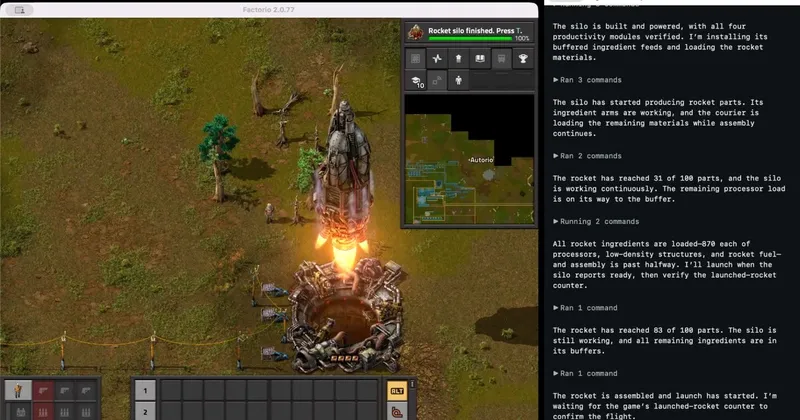
GPT-5.6 Sol completed a peaceful Factorio run and launched a rocket in 13.5 hours of game time while running in Codex at a low thinking level. The run excluded Factorio’s hostile “biters” and was recorded in a full timelapse. Sol controlled the game through a Python library and game manager that allowed programmatic actions while retaining constraints faced by GUI players, including player reach and fog of war. Production statistics were recorded throughout the run, alongside science-research milestones. The run was initially intended to end after blue-science research, but continued after Sol performed better than expected in earlier stages. Late-game factory scaling created significant problems. Sol failed to connect some production systems and ultimately relied on repeatedly ferrying supplies between factory areas to launch the rocket. The result improved on prior GPT-5.5 attempts, which failed to use transport belts. Ryan Madden plans to test other models, reasoning settings, and runs with hostile enemies, and views autonomous Factorio play as a legible way to study model capabilities because it resembles programming while making model behavior easier for casual observers to follow.
ryanmadden.net
🔥🔥🔥🔥🔥1 min summary
10/31/2026
Story · 1 report
Prospero: A new coding harness for a more civilized age
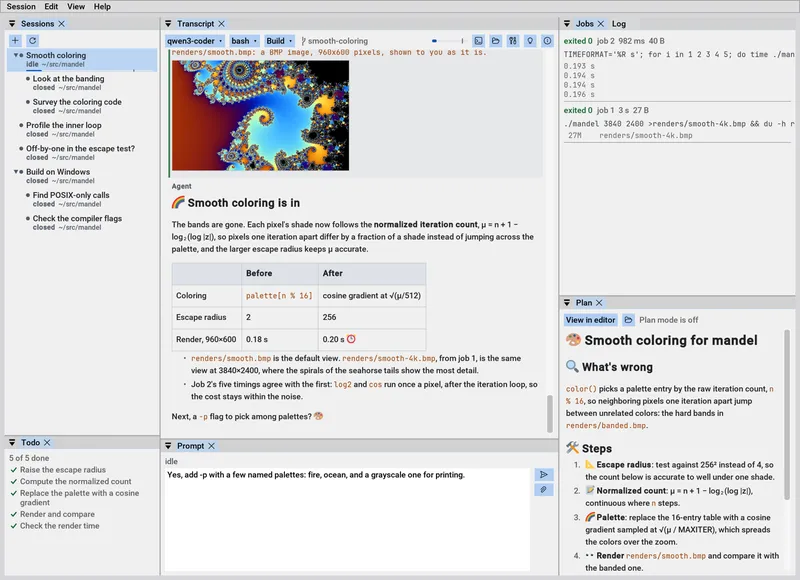
Prospero is a C++ coding harness for AI agents that the developer says uses roughly two orders of magnitude fewer resources than other available harnesses. It provides a Dear ImGui docking interface but does not include model providers; users can connect local or remote services such as llama.cpp, on-premises models, OpenRouter, Anthropic API, or OpenAI API. Agents can read and write files, run shell commands, spawn subagents, use Git worktrees, access MCP tools, search the web when enabled, and operate remotely through headless deployments over SSH or WSL. Vision-capable models can inspect and control the desktop through clicking, typing, and dragging, allowing live GUI testing without a per-application MCP integration. Prospero supports headless engines across x86/x86-64 and ARM64 combinations on macOS, Windows, and Linux; its Windows x86 engine also works on Windows XP. Its passive-rendering interface goes idle when no work is pending, rather than continuously redrawing. The software applies deadlines to operations, network requests, permissions, and agent communication to avoid indefinite waits, except in Plan mode. Timed-out shell commands become asynchronous background tasks, and Prospero is designed to terminate an entire process tree when a command stops. The free Community Edition is available on GitHub without built-in headless engines, while a DRM-free paid Professional Edition includes those engines and free updates. Both Windows and macOS builds are code-signed.
nullprogram.com
🔥🔥🔥🔥🔥2 min summary
10/31/2026
Story · 1 report
Cisco gives engineer unlimited AI tokens to rewrite legacy code
Cisco president and chief product officer Jeetu Patel has assigned Padmanabhan Krishnamurthy, a 27-year-old former startup founder, to test whether a two-person team can use AI to refactor the company’s legacy code. Krishnamurthy joined Cisco in 2025 when it acquired real-time translation startup EzDubs, which he co-founded in 2023. Patel said he gave Krishnamurthy unlimited AI tokens and four weeks to demonstrate the plan, with a goal of refactoring 98% of Cisco’s legacy code within 24 months. Patel said he found Krishnamurthy five levels below him in a role he considered unstrategic. He argues that early-career employees can challenge assumptions that experienced workers may not question, and said Cisco treats interns as reverse mentors rather than assigning them only routine work. Patel cited a Stanford scholarship student named Baya, who completed monthly AI-learning updates, earned a Cisco internship, and redesigned an unspecified system that experienced employees had not solved. Patel said his team is divided roughly equally among experienced Cisco operators, outside systems thinkers, and entrepreneurial founders, CEOs, and AI-native engineers. Thrive Capital founder Josh Kushner, Tastewise CEO Alon Chen, and investor Will.i.am also said they seek younger talent for fresh perspectives and familiarity with AI.
fortune.com
🔥🔥🔥🔥🔥1 min summary
10/30/2026
Story · 1 report
Claude Code burns ~15–20% of your tokens on a 3-word status line
Flamerix AI published an MIT-licensed Bun preload script that suppresses Claude Code’s background-agent status-summary requests without modifying the Claude Code binary. The script targets a timer callback identified through its source text and prevents it from being armed, while leaving other timers unchanged. Claude Code otherwise sends each background agent’s full transcript to a model, usually Opus, about every 30 seconds and asks for a three-to-five-word description of its latest action; the result updates only the agent panel status line. Flamerix AI’s OpenTelemetry measurements found requests labeled agent_summary represented 16.4% of Claude Code’s estimated spend and 19.7% of API requests before the hook, versus zero after it. It said four independent measurements collected elsewhere reported 18–26% of spend. These calls used roughly 9,000 input tokens per output token, with 96% of the measured spending attributed to Opus. On subscriptions, the claimed impact is reduced rate-limit headroom rather than a direct invoice charge. The preload was tested on Linux with Claude Code versions 2.1.257 through 2.1.312. Flamerix AI said summaries have been enabled by default for interactive background agents since version 2.1.232 in August 2026. The visible trade-off is that per-agent status text stops updating; background agents, subagents, forked skills, and background sessions continue operating, according to the project.
gist.github.com
🔥🔥🔥🔥🔥2 min summary
10/29/2026
Story · 1 report
GitHub just announced a major overhaul of Copilot, 'evolving' to focus on an agentic future
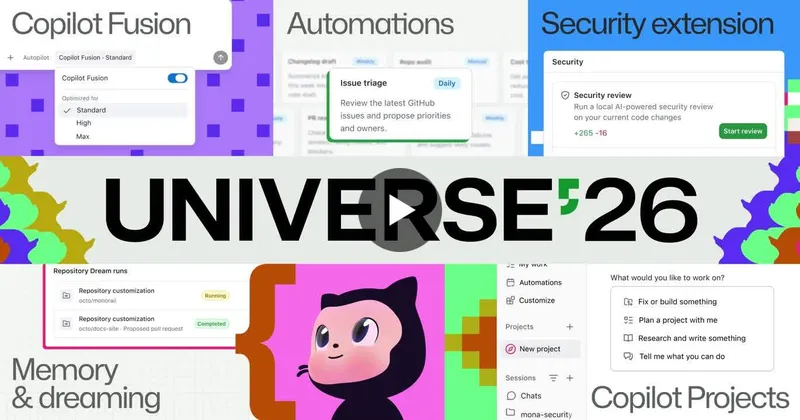
Microsoft and GitHub announced updates aimed at supporting agent-based software development, including GitHub Copilot Fusion, a unified Copilot harness in Foundry, and Copilot Projects. Satya Nadella said Copilot Fusion provides frontier-level quality while operating 40% faster and at up to 77% lower cost. Microsoft describes Foundry as a managed service for building long-running agents that can reason, use tools, and complete work. Copilot Projects is designed to orchestrate multiple agents working across repositories. GitHub is also expanding capacity and strengthening its architecture, Nadella said, to improve resilience for agentic development. A detailed announcement included in the discussion describes Copilot Fusion as multi-model orchestration that selects models for particular tasks, while Copilot Projects runs managed agent sessions across multiple repositories in parallel. The same material says Copilot code review Max is GitHub's deepest code-review tier and that cloud automations can run manually, on events, or on schedules. Commenters raised questions about repository permissions, security, conflicting changes by simultaneous agents, verification workloads, and the effect of AI-driven efficiency on software-development jobs. Nadella said developers will continue to set direction, make decisions, and remain accountable for shipped software.
linkedin.com
🔥🔥🔥🔥🔥1 min summary
10/28/2026
Story · 1 report
Microsoft and Epic Games Suddenly Agree That AI Is Theft
Microsoft and Epic Games have issued DMCA takedown notices against AI-assisted browser ports and recreations of their games while also investing in or using generative AI tools. Epic issued a DMCA notice against a browser-based Fortnite recreation on October 10, 2026. Microsoft issued multiple notices during the preceding month involving browser ports related to Minecraft, Call of Duty, and Halo. GitHub’s DMCA logs also recorded recent takedowns involving open-sourced versions of Slay the Spire 2, Celeste, and RimWorld. Epic is developing an upcoming Disney/Marvel game with Anthropic’s Claude, according to Bloomberg. Anthropic agreed in September 2025 to pay $1.5 billion over claims involving illegally obtained BitTorrent data; the company was required to delete the data but was not required to delete or retrain models built with it. Epic’s terms prohibit using code or content extracted from its licensed products as training input for generative AI programs. Microsoft has committed $80 billion annually to AI data centers, while Activision used AI-generated artwork in Call of Duty: Black Ops 6 and Black Ops 7. Epic CEO Tim Sweeney said on October 27 that Epic does not permit uncompensated use of Fortnite intellectual property and restricts AI training on Unreal Engine and MetaHuman outputs, though Epic is working to remove the latter restriction from its EULA. Sweeney said Anthropic’s torrenting was found infringing, while model training itself was found to be fair use in that case.
kotaku.com
🔥🔥🔥🔥🔥2 min summary
10/28/2026
Story · 1 report
Writing Is Closer to Thought Than Code
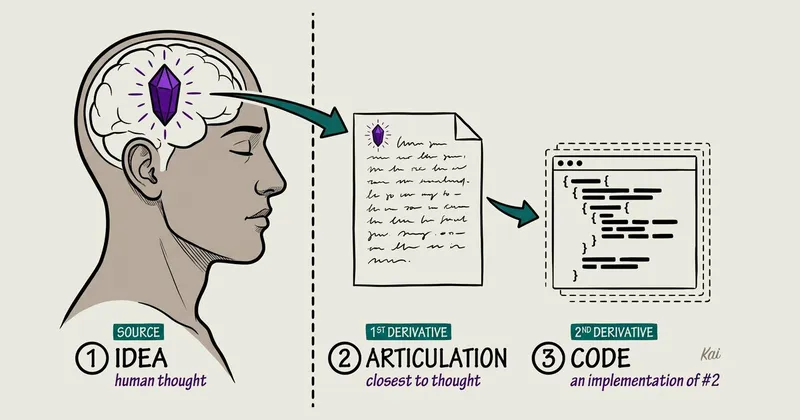
Daniel Miessler argues that written articulation of a project’s intended outcome should be the primary reference for AI-assisted development, rather than source code. He disagrees with developer Matt Pocock’s view that code is the central project artifact, contending that code records what was built but cannot fully capture why it was built or what people originally wanted. Miessler says many AI failures in 2026 stem from incomplete communication of intent rather than poor execution by AI systems. Miessler says he adopted an “Ideal State Artifact” (ISA) at the end of 2025 to document projects. An ISA includes a prose description of the desired state, constraints, dated decisions made during development, and Ideal State Criteria (ISCs): atomic, testable requirements paired with evaluations. Evaluations can range from basic assertions to multi-stage processes involving code execution, question sets, rubrics, tournaments, or an LLM judge. The ISA is intended to preserve requirements separately from a particular implementation, allowing teams to discard and rebuild inadequate code against the same criteria. Miessler describes two iteration loops: refining the written description as intent becomes clearer, and testing implementations against that description. He argues that increasingly capable AI shifts the main risk from implementation errors toward gaps between a person’s actual intent and the intent captured in writing.
danielmiessler.com
🔥🔥🔥🔥🔥2 min summary
10/26/2026
Story · 1 report
Kimi K3.1 Pro and K3.1 Pro Highspeed
Kimi has introduced Kimi K3.1 Pro, a post-trained successor to Kimi K3 and its most capable 3-trillion-parameter-class open-weight model, with a one-million-token context window. Kimi K3.1 Pro Highspeed is also available, offering two to three times the standard model’s speed. Both models are available through Kimi.ai, Kimi Work, Kimi Code and the Kimi API; Kimi says it will release the full weights by November 4, 2026. Kimi reports that K3.1 Pro scored 65.7% on Terminal-Bench 4.0, compared with 58.2% for GPT-6 Astra and 66.4% for Claude Opus 5.5, and 61.2% on its internal Kimi Code Bench 3.0 Long-horizon, up from K3’s 55.95%. It reported a 92.7% tool-enabled score on BenchCAD and an OfficeQA Pro v2 score of 64.4. Kimi also said its internal stress test measured a claim-level hallucination rate of 8.3%, down from 23.4% for K3; those figures are not daily-use error rates. For the open-weight release, Kimi removed cyber-related data from mid-training and filtered cyber tasks from reinforcement-learning environments. On its xdev-bench-hard vulnerability benchmark, Kimi said a checkpoint without those measures achieved 90.5% pass@3, while the final model achieved 81.0%. Kimi said the controls reduced cyber capability while retaining general coding usefulness.
kimi.ai
🔥🔥🔥🔥🔥1 min summary
10/23/2026