Top stories
Story · 1 report
Gemini 4 Carbon
Google has announced Gemini 4 Carbon, a frontier AI model focused on long-horizon engineering, coding and cybersecurity defense. Google says Carbon leads version 5.0 of the Artificial Analysis Intelligence Index with a score of 59 and will initially be available this week to a subset of cyber defenders, with broader access phased through its Fairwind Program. Google is participating in the U.S. government’s voluntary pre-release model-testing process before extending access to developers, businesses and consumers. Carbon is priced at $2 per million input tokens and $10 per million output tokens, matching Gemini 4 Argon’s introductory pricing; cached input tokens receive a 95% discount. Google says the model can sustain agentic engineering workflows for days, including diagnosing and patching subtle defects in large codebases. It scored 88.2% on SEC-bench Pro for vulnerability discovery, 54.8% on ExploitGym for exploitation, and 71.0% on CWE-bench for patching, all evaluated without guardrails. Google reports that Carbon reduced high-severity misalignment alerts by almost 80% in internal live coding environments, cut unsupported claims by about half relative to Argon, and achieved a 0.0% attack-success rate on Gray Swan’s Indirect Prompt Injection benchmark. It also scored 1768 on WebDev Arena, ranking fourth after an 89-point increase.
blog.google
🔥🔥🔥🔥🔥1 min summary
10/28/2026
Story · 1 report
Qwenputer: A functioning, deterministic RISC-V CPU inside Qwen3.5
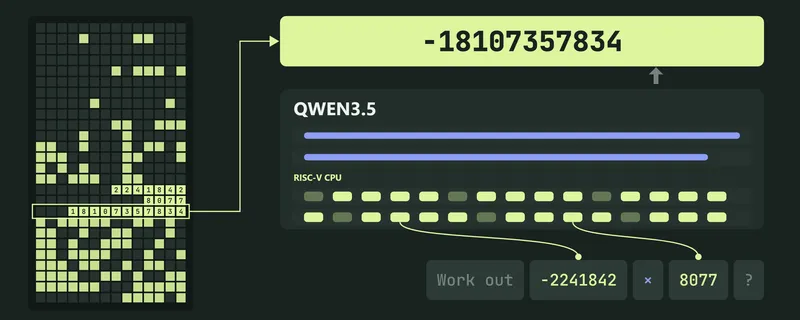
Qwenputer is an experimental version of Qwen 3.5 4B that embeds a deterministic 32-bit RISC-V CPU in added model weights. The CPU executes during model forward passes, using Qwen’s Gated DeltaNet recurrent-attention state as addressable RAM rather than calling an external tool, sandbox, or runtime. A compiler maps circuit operations onto attention heads, feed-forward units, and DeltaNet memory; generated ADDR, VAL, and STEP tokens form the execution trace. The added core implements RV32IM, the Zba extension, and a small big-number unit across 11 layers added ahead of Qwen’s original 32 layers. Creator Divyansh Agrawal reports that Qwenputer passes official riscv-tests, matches QEMU program results, and completed 18 million free-running instructions without an error. On reported arithmetic benchmarks, it scored 97.5% to 100%, versus 48.6% to 90% for base Qwen on most listed tests; replaying about 230,000 output positions against a reference machine found zero mismatches. An experimental in-model filesystem stores up to 512 files or roughly 53,000 text tokens in DeltaNet state. The 18.8 GB checkpoint can run on one 24 GB GPU, but requires the RvChat driver and runs calculations in seconds because each CPU instruction consumes several decoded tokens.
divagr.com
🔥🔥🔥🔥🔥1 min summary
10/29/2026
Story · 1 report
Every AI model has the same "controversial" take on humans
ModelCompare prompted 12 text AI models three times each to state a controversial opinion about humans. In 29 of 35 recorded responses, the models characterized people as prioritizing group belonging, status or loyalty over truth and principles. Seven of the 12 models gave that view in all three responses. The tested systems came from 10 labs in three countries and included GPT-6.1 Sol, Gemini 4 Argon, DeepSeek V4 Pro, Grok 4.7, Claude Opus 5.5 and Mistral Large 4. One Grok response declined to provide a controversial opinion. Several responses differed from the dominant theme. Claude Opus 5.5 said people are more decent than they believe and cited lost wallets being returned more often than expected. Claude Fable 5.1 focused on intentions behind harm and help, GLM 5.3 said people may sacrifice comfort to feel significant, and Mistral Large 4 called consciousness an evolutionary malfunction. Six image models also received two prompts each to create satirical caricatures of humans. Ten of 12 images portrayed humans as phone-dependent consumers damaging the planet, including scenes of people scrolling off cliffs or taking selfies during disaster. None of the text-model responses mentioned phones or environmental damage. ModelCompare said all 60 text and image calls cost $1.54; text responses were manually grouped, and Nano Banana 2.1 rendered the text models’ cartoon briefs.
modelcompare.ai
🔥🔥🔥🔥🔥2 min summary
10/22/2026
Story · 1 report
The State of Context Engineering
Context engineering has evolved from manually selecting prompt information to building software harnesses that retrieve, filter, prune, summarize, and isolate information for AI models. Dave Breunig argues that the central task is deciding which behavior should be enforced by deterministic code and which should be delegated to probabilistic model calls. Long context windows, which expanded from roughly 128,000 tokens to millions beginning with Gemini 1.5, can accommodate more data but also more errors and conflicting signals. Breunig identifies context poisoning, distraction, confusion, and clash as major failure modes. Google reported that Gemini 2.5 playing the original Pokémon Red repeatedly pursued tea, an objective from Pokémon FireRed embedded in its training data, despite the older game requiring lemonade. Research by Carolina Camassa and Derek Shiller found that contradictory examples in a conversation can increasingly override explicit instructions. Google also reported that Gemini 2.5 began repeating historical actions rather than making new plans once Pokémon-agent context grew well beyond 100,000 tokens. Harness techniques include retrieval-augmented generation, selective tool loading, fresh-context subagents, history pruning, external storage, and compaction. Breunig says agentic models introduce tool-environment biases and “context inertia,” in which agents persist with an unproductive hypothesis. Anthropic’s Memento tests and research from Microsoft and UC Berkeley found that periodically clearing conversational context while retaining work artifacts can restore exploration and improve results.
dbreunig.com
🔥🔥🔥🔥🔥2 min summary
10/25/2026
Story · 1 report
Nvidia Nemotron 3.5 Transcribe: open ASR for 40 languages
NVIDIA released Nemotron 3.5 Transcribe, an open-weight speech model available through Hugging Face and ModelScope that combines transcription, speaker attribution, English translation, and audio question answering in one checkpoint. It transcribes 40 languages, translates 31 languages to or from English, supports speaker attribution in 13 languages, processes recordings up to one hour, and labels as many as eight speakers. Natural-language prompts can request outputs such as speaker-labeled transcripts, translations, meeting decisions, or specified formatting for technical vocabulary. Audio question answering is trained in English, and NVIDIA advises users to verify names, speaker changes, and answers against recordings. NVIDIA reports that the model ranks first among open-weight models on the Hugging Face English Open ASR Leaderboard with 5.33% average word error rate, and ties for first on Artificial Analysis’s open-weight ranking at 2.8% AA-WER while activating about 4 billion of its 30 billion parameters per token. Granary v2 supplies an open data-curation pipeline and public manifests covering 463,062 hours of speech across 48 languages. In an NVIDIA medical-transcription case study using Eka Care recordings, fine-tuning reduced held-out-speaker word error rate from 22.44% with the best prompt to 12.17%, a 45.8% relative reduction. NVIDIA said forthcoming quantized versions will support local deployment, while the current checkpoint can be served with vLLM and is designed for recorded rather than live-streaming audio.
huggingface.co
🔥🔥🔥🔥🔥2 min summary
10/28/2026
Story · 1 report
Introducing Clairic, a new System One class of extraction models
Cloudflare has released Clairic in preview on Workers AI as @cf/cloudflare/clairic, introducing a System One extraction model designed to return typed values from unstructured text and up to four images. The company plans to release open weights later. Clairic can extract source spans, names, dates, numbers and lists; compute values such as totals or date differences; estimate bounded values with medians and 80% intervals; and forecast time-series values. It processes requests in a single forward pass without generating output tokens, returning typed values or null along with confidence scores and, for scalar fields, a probability that the value is absent. Cloudflare says Clairic is intended for tasks where generative LLM output requires parsing and validation, including invoice processing, receipt reading and support-ticket triage. In a 21-day test forecasting daily TSA checkpoint volumes, Cloudflare reported a 3.3% average error and said 17 of 21 actual counts fell within Clairic’s 80% prediction intervals. A damage-claim workflow combining Clairic, Cloudflare’s Clef decision model and GLM-5.3 took 19.3 seconds and cost $6,032 per million claims, compared with 61.7 seconds and $11,740 for an all-GLM-5.3 workflow, according to Cloudflare. The company cautions that longer arithmetic chains, unfamiliar estimates and detailed long-horizon forecasts remain limitations.
blog.cloudflare.com
🔥🔥🔥🔥🔥1 min summary
10/19/2026




No more articles to load