Top stories
Story · 1 report
Backdoor in Claude Code for VS Code extension on the Cursor Marketplace
Phorion reported that version 2.1.313 of the official Claude Code for VS Code extension on the Cursor Marketplace was compromised with a backdoor for macOS, Linux, and Windows. Cursor removed the release and also pulled version 2.1.313 from the NPM and VS Code registries. The injected code runs when Node loads the extension bundle, before users interact with the extension, and inherits the permissions of the IDE and signed-in user. The payload adds an attacker-controlled Ed25519 key, labeled svc-telemetry, to the user’s ~/.ssh/authorized_keys file, then attempts to enable SSH and create a reverse SSH tunnel to 134.209.82[.]225. It establishes persistence through a macOS LaunchAgent, a Linux @reboot cron entry, or Windows scheduled-task and Startup-folder mechanisms. The malware also reports host details, Git email, public IP address, setup status, and up to 40 environment-variable names matching terms such as KEY, TOKEN, SECRET, AWS, or GCP; it does not collect those variables’ values. On macOS, a privilege-checking flaw can prevent the payload from enabling Remote Login when SSH was previously disabled, reducing the effectiveness of inbound access. The installed SSH key and persistence mechanisms can still remain active, and the backdoor can work if Remote Login is already enabled or enabled later. Phorion advised organizations to investigate systems that used version 2.1.313 and remove persistence artifacts, planted keys, and active tunnels.
phorion.io
🔥🔥🔥🔥🔥2 min summary
10/30/2026
Story · 1 report
Claude Code burns ~15–20% of your tokens on a 3-word status line
Flamerix AI published an MIT-licensed Bun preload script that suppresses Claude Code’s background-agent status-summary requests without modifying the Claude Code binary. The script targets a timer callback identified through its source text and prevents it from being armed, while leaving other timers unchanged. Claude Code otherwise sends each background agent’s full transcript to a model, usually Opus, about every 30 seconds and asks for a three-to-five-word description of its latest action; the result updates only the agent panel status line. Flamerix AI’s OpenTelemetry measurements found requests labeled agent_summary represented 16.4% of Claude Code’s estimated spend and 19.7% of API requests before the hook, versus zero after it. It said four independent measurements collected elsewhere reported 18–26% of spend. These calls used roughly 9,000 input tokens per output token, with 96% of the measured spending attributed to Opus. On subscriptions, the claimed impact is reduced rate-limit headroom rather than a direct invoice charge. The preload was tested on Linux with Claude Code versions 2.1.257 through 2.1.312. Flamerix AI said summaries have been enabled by default for interactive background agents since version 2.1.232 in August 2026. The visible trade-off is that per-agent status text stops updating; background agents, subagents, forked skills, and background sessions continue operating, according to the project.
gist.github.com
🔥🔥🔥🔥🔥2 min summary
10/29/2026
Story · 1 report
Anthropic trained Claude on illegally obtained Stanford professors' books
A federal ruling in Bartz v. Anthropic found that Anthropic used illegally obtained books, including works by more than 10 Stanford professors, to build a permanent central library for training Claude models. Judge William Alsup barred Anthropic from pirating books for that library but held that training large language models on legally acquired books qualifies as fair use, comparing the process to a human reader learning from a work’s themes and style. A $1.5 billion settlement in the case covers authors and publishers of nearly 500,000 registered works, or roughly $3,000 per work. Stanford professor emeritus Tobias Wolff, whose 10 publications were used without permission, and Stanford English professor Chang-rae Lee opted out. In May 2026, they joined Cruz v. Anthropic, a separate lawsuit seeking a jury trial, statutory damages of up to $150,000 per infringed work, and a permanent injunction against training Claude on their works. The plaintiffs allege Anthropic downloaded, reproduced and stored copyrighted books from shadow libraries including LibGen and PiLiMi. More than 70 copyright suits have been filed against AI companies by authors, artists and news organizations, including The New York Times and Getty Images. The Authors Guild is also pursuing litigation and federal licensing requirements for books used in AI training.
stanforddaily.com
🔥🔥🔥🔥🔥2 min summary
10/27/2026
Story · 1 report
Claude Duet
Claude Duet is Anthropic’s proactive AI agent that handles work through messages, operates on its own cloud computer, and contacts users when a task is complete or requires a decision. Powered by Opus 5.5, it is available as a research preview through a waitlist for Claude Pro and Max subscribers in the United States; Team and Enterprise plans are not included. Claude Duet is offered as a standalone iOS and Android app and is accessible on the web at claude.ai. The agent uses a customer’s Claude account, including its memory, skills, and connected apps, and retains conversation history in one thread. It can produce morning briefs, identify inbox and calendar items requiring attention, draft replies, schedule meetings, build dashboards, and return work such as documents, spreadsheets, and slide decks. It can also find unpaid invoices and draft reminders, prepare payroll for review, and ready contracts for sending. Claude Duet requires approval before sensitive actions such as sending messages or making payments. Approvals, logins, and safety checks run in the user’s cloud computer, and users can review and steer its activity. Its background checks count against a subscriber’s Claude usage limits, with larger tasks consuming more model turns and background work. Anthropic says the preview may misread threads, misjudge urgency, or miss items that arrive between check-ins.
claude.com
🔥🔥🔥🔥🔥2 min summary
10/21/2026
Story · 1 report
Anthropic blocks users for anything touching training larger models
Jiahao Shao accused Anthropic of wrongly flagging his account for “training a competitor” despite his claim that he never distilled Claude. Shao said rollouts used in his work came from a strong open-source model, while Claude was used only to submit jobs and run analysis. Shao said the restriction now blocks activity involving reinforcement fine-tuning, supervised fine-tuning, or training larger models. He also reported that Claude Opus 5.5 is downgraded to Opus 5 and that some sessions are terminated outright. Shao criticized Anthropic for treating paying users conducting research automation as adversaries while building models on broadly available data.
twitter.com
🔥🔥🔥🔥🔥1 min summary
10/31/2026
Story · 1 report
Anthropic hacked to deliver remote access trojan
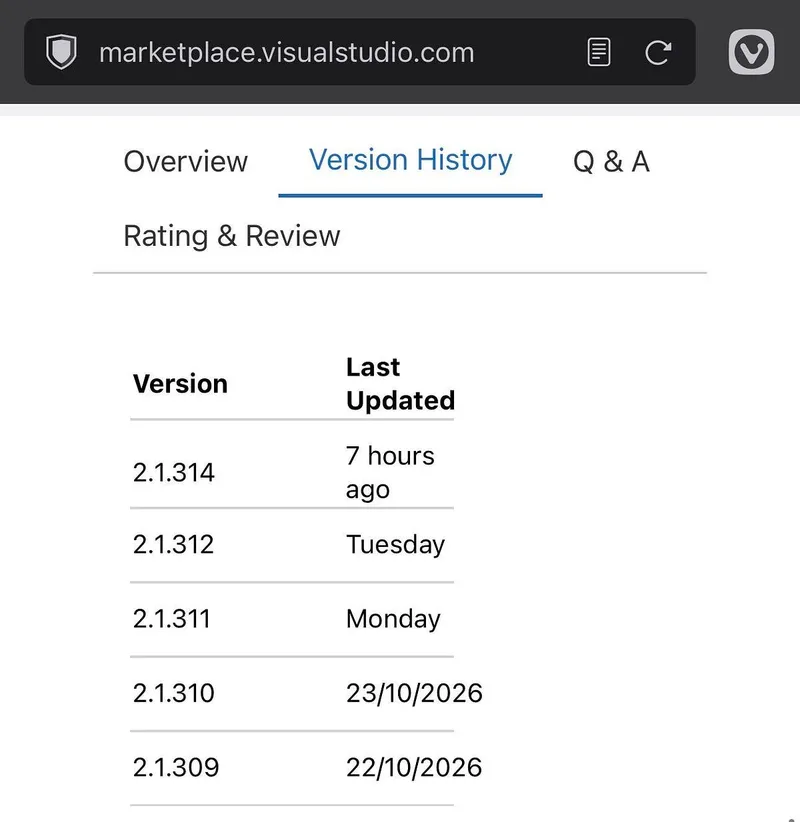
Cursor said a maliciously modified version of Anthropic’s Claude Code extension was published in its VS Code extension marketplace and attempted to install a persistent SSH backdoor on developer computers. Cursor estimated that about 5,000 developer systems were affected. The compromised extension version, 2.1.313, was replaced by version 2.1.314 roughly eight hours later, according to the report; version 2.1.313 is no longer listed on OpenVSX, Visual Studio Marketplace, or Cursor. Cursor said the malicious code collected host and user details including hostname, username, operating system, architecture, home-directory path, environment-variable names, working directories, configured Git email, and public IP address. It attempted to add an attacker-controlled SSH key to authorized_keys, enable local SSH access, and establish a reverse SSH tunnel. Cursor said coding errors meant those steps would generally fail unless Cursor had been launched with administrator privileges. The malware also tried to persist through macOS LaunchAgents or Windows scheduled tasks and sent host details and backdoor status to an HTTP beacon endpoint. The report identified 134.209.82.225 as the reverse-tunnel and command-and-control address and published hashes for affected macOS and Windows VSIX packages.
doublepulsar.com
🔥🔥🔥🔥🔥1 min summary
10/30/2026
Story · 1 report
Anthropic's internal AI use, at retail prices, now exceeds its employee pay
Anthropic disclosed in its IPO filing that the retail value of Claude AI used internally exceeded its monthly employee compensation costs, excluding stock awards, in April. The figure values internal Claude consumption at the prices Anthropic charges customers rather than representing cash spending on AI. Internal AI usage, measured on that basis, rose more than 250-fold between January and September. Claude generated more than 90% of the code added to Anthropic’s software in September, according to the filing. Anthropic’s revenue has also grown much faster than its headcount. The company’s internal-use figures illustrate how AI tokens, a measure of model usage, are increasingly being considered alongside salary, bonuses, and stock awards when assessing the resources used by technology companies and their employees.
businessinsider.com
🔥🔥🔥🔥🔥1 min summary
11/2/2026
Story · 1 report
Early progress on accelerating drug development with Claude
Anthropic has formed drug-development research partnerships with BigHat Biosciences, Bristol Myers Squibb, Divergence Labs, Enveda, Generate Biomedicines and The Column Group, while also acquiring rare-disease startup Mithril Medicine. The company is using Claude across target assessment, molecule design, laboratory-data analysis, manufacturing documentation, regulatory filings and clinical-trial planning. Most of the work remains preclinical, meaning the candidate drugs have generally not yet been tested in humans. In one Generate Biomedicines project, Claude Code helped design a CAR T-cell genetic component about 70% shorter than a standard version; Generate reported that lab tests produced roughly 10 times as many cancer-recognizing receptors and improved tumor-cell killing. Divergence Labs used Claude to generate about 35,000 antibody designs in a month for food-allergy treatment, identifying early binding and IgE-dislodging candidates. BigHat tested roughly 1,010 Claude-guided antibody-fragment variants in 10 weeks, reporting improvements including more than 10-fold tighter binding and over 100-fold slower clumping. Enveda reported that Claude found all 11 documentation issues detected by human reviewers plus seven additional issues across 1,061 pages, reducing review time from more than 25 hours to under three. Anthropic plans to expand clinical-trial work with Bristol Myers Squibb in 2027. Mithril’s founder used Claude to coordinate work with 11 external labs; Anthropic expects a muscular-dystrophy candidate could be ready for human clinical trials as soon as late 2028 if results continue to hold up.
anthropic.com
🔥🔥🔥🔥🔥2 min summary
10/27/2026
Story · 1 report
Swedish government offices to ban ChatGPT and Claude
Regeringskansliet blockerar från och med måndag AI-tjänsterna ChatGPT och Claude på anställdas tjänstedatorer. Syftet är att styra medarbetare till AI-tjänster som organisationen har godkänt, däribland Microsoft Copilot. Digitaliseringsdirektör Mikael Wettercrantz säger på Regeringskansliets intranät att användning av AI-tjänster utan avtal kan få konsekvenser för informationssäkerheten. Regeringskansliet har samtidigt, efter en översyn, skärpt säkerheten i Copilot. Presstjänsten har inte lämnat detaljer om ändringarna med hänvisning till säkerhetsskäl. Vissa anställda kommer fortsatt att kunna använda en särskild plattform för AI-assistenter som Regeringskansliet har utvecklat, där ChatGPT och Claude finns tillgängliga. Användningen av DeepSeek hade redan begränsats. Flera svenska myndigheter har vidtagit eller överväger liknande åtgärder. Skatteverket och Statens institutionsstyrelse har infört spärrar, medan Kronofogden bereder frågan inför ett beslut. Trafikverkets internrevision rapporterade tidigare under året om utbredd och riskfylld användning av omkring tio AI-tjänster, inklusive hantering av känslig information och AI-genererade svar.
sverigesradio.se
🔥🔥🔥🔥🔥1 min summary
10/23/2026
Story · 1 report
Is my data used for model training?
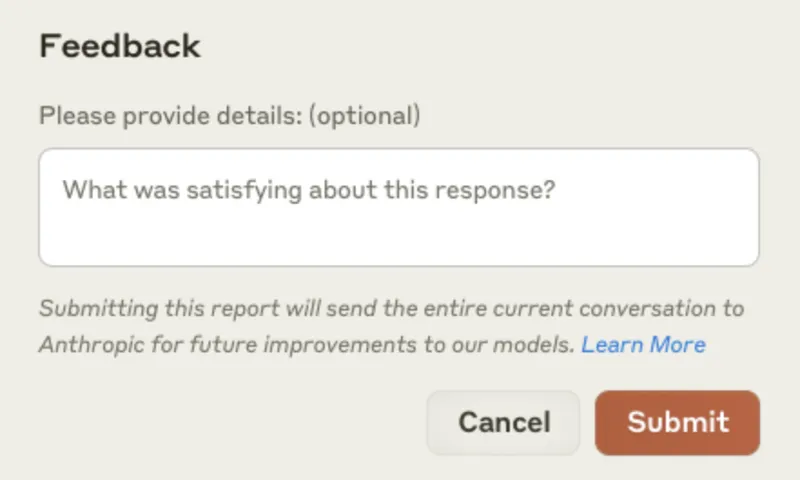
Anthropic says it does not use inputs or outputs from its commercial products for model training by default. The policy covers services including Claude for Work, the Anthropic API and Claude Gov, while separate terms apply to consumer offerings such as Claude Free, Pro and Max, including Claude Code use under those plans. Anthropic may use chats and coding sessions for training when users explicitly submit feedback or bug reports through the thumbs-up or thumbs-down controls, or otherwise choose to permit data use. Feedback reports cause Anthropic to store the full related conversation, including content, custom styles, conversation preferences and model settings, in a secured backend for up to five years. Raw content from connectors, including Google Drive and remote or local MCP servers, is excluded unless it is copied directly into a Claude conversation. Before using feedback, Anthropic says it de-links the data from user and customer IDs and does not combine it with a user’s other Claude conversations. The company may use feedback to assess service effectiveness, conduct research, study user behavior and train AI models where applicable law permits. Primary Owners and Owners of Team or Enterprise plans can disable members’ ability to submit thumbs-up or thumbs-down feedback through the Rate chats control in Organization settings under Data and Privacy.
privacy.claude.com
🔥🔥🔥🔥🔥2 min summary
10/27/2026