Latest stories
Story · 1 report
Award-winning AI literature
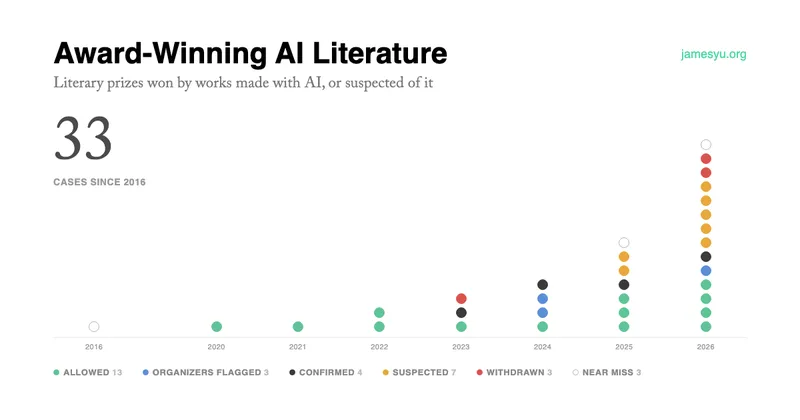
Literary prizes in multiple countries have recognized works made with generative AI, while other awards have revoked, reviewed, or disputed entries over alleged AI use. Japan’s Nikkei Hoshi Shinichi Literary Award explicitly permitted AI use and gave prizes to AI-assisted stories from 2022 through 2026. Its 2026 competition received 2,107 entries, counted 491 as partly AI-created, and said three of four general-division winners used AI somewhere in their process. Rie Kudan’s Akutagawa Prize-winning novel Sympathy Tower Tokyo used ChatGPT for roughly one page of its 143 pages, according to Kudan. Awards have also honored AI-centered poetry, fiction, and book projects when disclosure was permitted. Zuzana Husárová and Ľubomír Panák trained GPT-2 on 2,108 Slovak works for the 2021 Zlatá vlna-winning poetry collection Výsledky vzniku, while Sasha Stiles’s 2025 Lumen Prize-winning WORDS BEYOND WORDS generates a new poem whenever it is refreshed. Some allegations remain unresolved or were rejected after review. The Commonwealth Foundation retained 2026 prizes for Jamir Nazir, John Edward DeMicoli, and Sharon Aruparayil after reviewing evidence supporting their denials of AI use. In contrast, publishers and contest organizers have withdrawn or changed results in several cases, including the removal of Thélyson Orélien’s novel from the Goncourt longlist and Poetry.com’s reassignment of two 2024 monthly first prizes.
jamesyu.org
🔥🔥🔥🔥🔥2 min summary
4d ago
No more articles to load