Latest stories
Story · 1 report
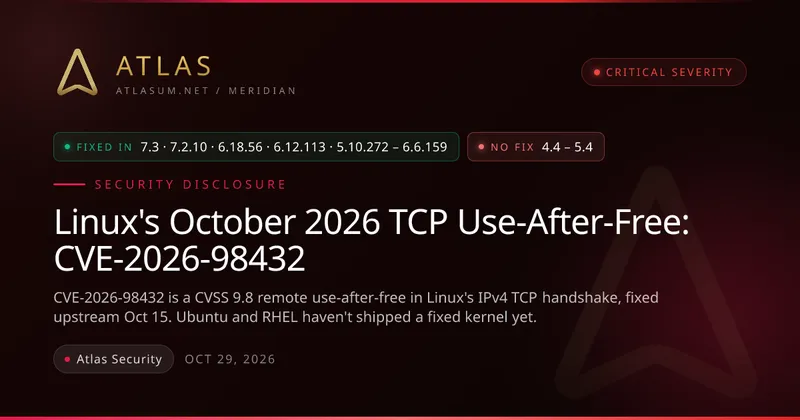
TCP Use-After-Free: CVE-2026-98432 / CVSS 9.8
Linux stable kernels released fixes in October 2026 for CVE-2026-98432, a critical use-after-free vulnerability in IPv4 TCP connection handling. The flaw affects kernels from Linux 4.4 onward that lack a distributor backport or an upstream fix, and can be reached remotely without authentication during the TCP handshake, before an application processes the connection. The Linux kernel CNA assigned a CVSS 3.1 score of 9.8; potential consequences include kernel-memory disclosure, memory corruption, crashes, and possible remote code execution. Fixed upstream versions include 5.10.272, 5.15.223, 6.1.190, 6.6.159, 6.12.113, 6.18.56, 7.2.10, and 7.3. The patch replaces immediate memory freeing with RCU-delayed freeing so concurrent kernel readers cannot access released IPv4 option data. As of October 31, Ubuntu listed all releases as vulnerable and RHEL 8, 9, and 10 had no fix, while Debian, specified SUSE releases, Oracle UEK, and Amazon Linux had released fixes. Anthropic says its Claude model produced an unpublished proof-of-concept that executes commands as root on Linux servers with MPTCP listeners. Go programs running on Linux enable MPTCP by default for listen sockets from Go 1.24 where the kernel permits it. Administrators can reduce exposure by installing a vendor-fixed kernel and rebooting; temporary mitigations include filtering IPv4 TCP packets with IP options and disabling unused MPTCP listeners.
atlasum.net
🔥🔥🔥🔥🔥2 min summary
14h ago
Story · 1 report
Putting Linux on my RTX Spark laptop because I don't have a Microsoft account
An Arch Linux ARM installation now runs on the ASUS ProArt P16 H7607BA-SE033W, an Nvidia RTX Spark laptop configuration with 128 GB of RAM, 6,144 CUDA cores and a 2 TB SSD. The bootable setup incorporates Nvidia’s Ubuntu kernel work plus patches for ACPI overrides, framebuffer mapping, the ASUS keyboard and audio support. It uses kernel 7.0.0-1022-nvidia and Nvidia driver 615.78.08; build inputs are hash-pinned, and the packages are signed by an Arch Linux Package Maintainer key. In 7-Zip tests on October 19, the Linux system reached 165.754 GIPS for 20-thread compression and 148.471 GIPS for 20-thread decompression. Those results were 5.0% and 2.7% above published Windows results from an HP OmniBook Ultra 16 using the same 20-core Nvidia N1X processor, while single-thread results were within 1.2%. Linux reported a unified 116.0 GiB memory pool to both the operating system and CUDA, compared with a 109.7 GiB CUDA total reported for a Windows ProArt setup using a 91 GiB dedicated-GPU reservation. The system ran Nvidia’s Qwen3.8-Flash-Next-FP4-Local model through vLLM in a native ARM64 container, allocating 68.2 GiB for the model and 21.1 GiB for KV cache. It delivered 30.9 tokens per second in a code-review test and passed all checks across 171 deterministic responses.
josie.lol
🔥🔥🔥🔥🔥2 min summary
10/19/2026
No more articles to load