Latest stories
Story · 1 report
AI isn't replacing SREs, it's deskilling them
AI is automating an increasing share of site reliability engineering work, including alert grouping, runbook execution, log-pattern detection, anomaly flagging, root-cause suggestions, and remediation of known failures such as restarting crashed pods or scaling overloaded services. PagerDuty describes a tiered model in which known incidents are fully automated, partially understood incidents receive AI recommendations subject to human validation, and novel or cascading failures remain human-led. SigNoz argues that this division of work could deskill SREs by removing the repeated hands-on practice that builds incident-response intuition. The argument draws on Lisanne Bainbridge’s 1983 paper, “Ironies of Automation,” which found that automation can leave operators responsible for rare, high-stakes failures while reducing their ability to handle them. The source cites a study in which AI-assisted endoscopists’ unassisted polyp-detection rates fell from 28% to 22%, and says aviation research has linked heavy autopilot use with reduced situational awareness and manual flying ability. The risk extends to junior SREs who may never acquire foundational troubleshooting skills if AI handles routine incidents. SigNoz recommends deliberate human practice on some automatable incidents and systems that keep operators actively engaged alongside AI. It plans to begin with an assistant that keeps humans in control and later add autonomy within guardrails.
newsletter.signoz.io
🔥🔥🔥🔥🔥2 min summary
10/30/2026
Story · 1 report
Ontology-Driven Observability: Building an End-to-End Knowledge Graph at Netflix
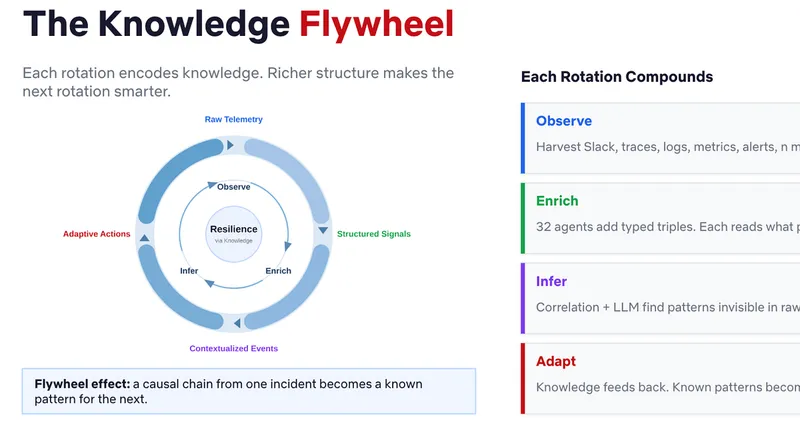
Netflix has built an Observability Ontology, a machine-readable knowledge graph intended to connect operational data that is otherwise split across telemetry, alerting, incident, deployment, on-call and discussion systems. The system targets investigations across infrastructure that processes more than 2 billion daily requests and over 38 million real-time logging events per second; Netflix delivered the November 2024 Jake Paul–Mike Tyson fight to roughly 65 million concurrent streams. Netflix says a home-screen rendering regression can take four hours to diagnose and fix, largely because engineers must reconstruct relationships among disconnected systems. The ontology defines typed entities and relationships for applications, incidents, deployments and other operational domains using RDF, OWL, SHACL and SPARQL. Its knowledge graph is stored in Netflix’s QuipuDB, a distributed RDF quad store built on the Rust-based redb key-value database. Applications are validated against a software catalog with roughly 49,000 entries, and the model uses twelve namespaces for operational domains. Dozens of sequential enrichers convert noisy telemetry and incident Slack discussions into constrained triples. A correlation engine evaluates 13 signal types, scores event chains by timing and severity within a 10-minute window, and discards chains below 0.6 confidence. Netflix’s AutoRCA agent uses graph-backed hypotheses and associated evidence to help engineers investigate incidents, while humans retain responsibility for evaluating diagnoses and implementing fixes.
netflixtechblog.com
🔥🔥🔥🔥🔥2 min summary
10/19/2026
No more articles to load