Microgpt
karpathy.github.io
March 1, 2026
28 min read
Summary
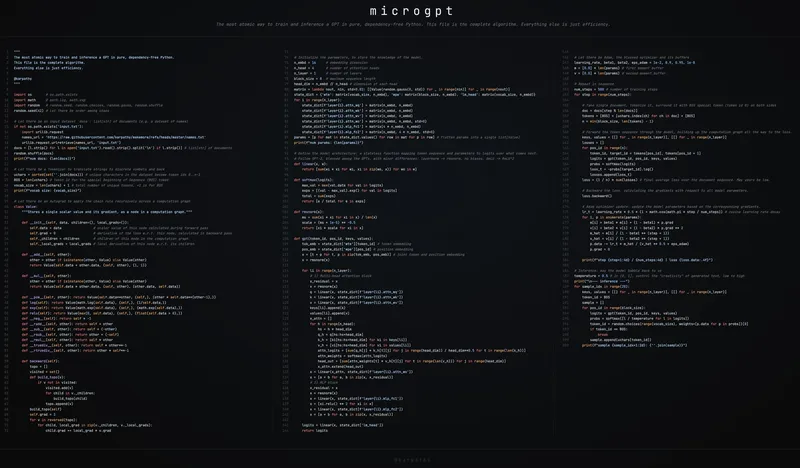
microgpt is a single-file Python script consisting of 200 lines that implements a GPT-like model with no dependencies. It includes components such as a dataset, tokenizer, autograd engine, neural network architecture, Adam optimizer, and both training and inference loops.
Key Takeaways
- microgpt is a single-file Python project that implements a GPT-like neural network with no dependencies, consisting of 200 lines of code.
- The model is trained on a dataset of 32,000 names to learn patterns and generate new, plausible-sounding names.
- A simple tokenizer is used to convert text into integer token IDs, assigning unique IDs to each character in the dataset.
- The project is available as a GitHub gist, a web page, and a Google Colab notebook for users to explore the code.
Community Sentiment
MixedPositives
- The project encourages a deep understanding of the AI pipeline, revealing the mechanics behind matrix multiplications and gradient computations, which is crucial for developing effective models.
- Implementing a simplified model allows for clearer insights into the attention mechanism, enhancing comprehension of its functionality beyond theoretical knowledge.
Concerns
- There is a desire for more detailed explanations of the code, indicating that the current documentation may not fully support users in understanding the implementation.
Source
karpathy.github.io
Published
March 1, 2026
Reading Time
28 minutes
Relevance Score
82/100
🔥🔥🔥🔥🔥
Why It Matters
This page is optimized for focused reading: quick context up top, a clean summary block, and a direct path to the original source when you want the full story.