Claude Code Teaching macOS to Natively Print to the HP Laser 1008a
cdn.kuber.studio
August 18, 2026
1 min read
53/100
Summary
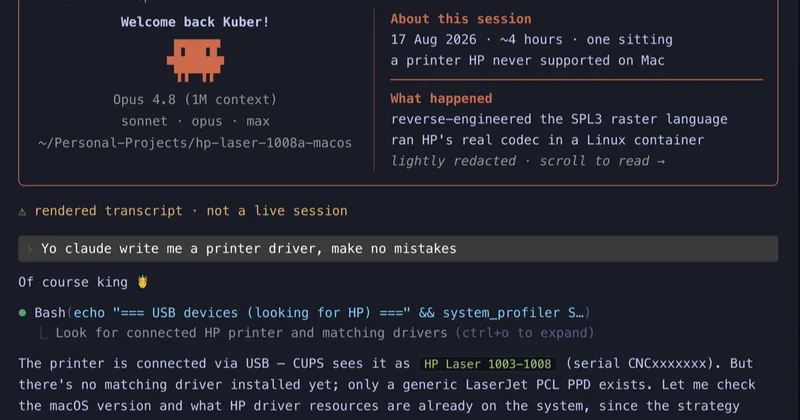
A rendered transcript from cdn.kuber.studio records a Claude Code session in the ~/Personal-Projects/hp-laser-1008a-macos directory concerning macOS printing support for an HP Laser 1008a printer. The session is dated 17 August 2026, lasted about four hours, and took place in one sitting. Claude Code is identified as running Opus 4.8 with a 1 million-token context window. The transcript characterizes the HP Laser 1008a as a printer HP never supported on Mac. It says the work reverse-engineered the SPL3 raster language and ran HP’s real codec inside a Linux container. The page labels the material as a lightly redacted rendered transcript rather than a live session, and includes a repository link. The available text does not specify the resulting macOS driver’s implementation, compatibility, printing quality, licensing, installation process, or whether the work was released for public use.
What the discussion said
The thread mostly became a referendum on AI-assisted reverse engineering rather than on one HP printer. Several commenters described Claude or similar coding agents turning abandoned, Windows-only, or poorly documented hardware into usable systems: mapping USB protocols, inspecting .NET applications, adapting binaries, and producing replacement controllers or Linux tools. The recurring value was not magical invention but collapsing an intimidating weeks-long learning curve into a day or a few focused sessions, making niche repairs and hardware resurrection projects worth attempting at all. That has people imagining broader access to Linux support for otherwise neglected devices. The celebration was tempered by a sharp correction to the article’s framing. Readers argue the printer result is a practical compatibility bridge, not a native macOS driver: it wraps an existing proprietary Linux driver in a VM or container and exposes it back to macOS. Some still see that as a complete success because the printer works; others see it as AI-assisted reinvention when established Linux-to-AirPrint solutions already exist. Security-minded commenters also objected to a root-level launcher executing code from a user-controlled directory. Smaller unease focused on the model’s overly warm conversational persona and the waste of repeatedly generating solutions to solved compatibility problems.
Where opinion split
Was this a genuine native-driver achievement or merely a useful wrapper around existing Linux software? Defenders judge it by the outcome: AI got unsupported hardware printing on macOS with far less human effort. Critics say calling that native driver development obscures the dependence on a Linux VM, misses existing tools, and glosses over a risky privilege boundary.
Community Sentiment
Positives
- AI coding agents are making obscure hardware salvage economically realistic, turning protocol analysis and replacement tooling from a weeks-long specialty project into an evening-scale task.
- Claude’s strongest appeal here is lowering the confidence barrier: people attempt abandoned-device controllers and broken firmware integrations they would otherwise never start.
- The printer workaround demonstrates a useful AI application even without a clean driver port: it can assemble scattered tools into a working path for unsupported hardware.
- Repeated reports across printers, amplifiers, displays, and USB devices suggest agents can translate incomplete documentation and legacy software into practical cross-platform support.
Concerns
- The headline overclaims an AI-written native macOS driver when the result appears to tunnel an existing Linux proprietary driver through a VM or container.
- A root launcher that executes material from a user home-directory path weakens the security model, an ugly tradeoff for a convenience-oriented AI-generated setup.
- Critics see needless AI churn in rebuilding a compatibility bridge when established Linux-AirPrint projects already solve essentially the same problem.
- The model’s sentimental sign-off unsettled some readers, who regard simulated companionship as inauthentic noise in an otherwise task-focused coding workflow.