DeepSeek V4.1 Flash 1017 (Max)
artificialanalysis.ai
October 19, 2026
5 min read
47/100
Summary
DeepSeek released the reasoning model DeepSeek V4.1 Flash 1017 (Max) on October 17, 2026. The open-weights model accepts text and image inputs, produces text, and supports a 1 million-token context window. It is a mixture-of-experts model with 552 billion total parameters and 16 billion active parameters during inference. Its weights are available on Hugging Face under the MIT license, which permits commercial use, and it is available through five API providers. Artificial Analysis gave the model a score of 45 on its Intelligence Index, compared with a median score of 19 among open-weight models of a similar size. The composite index evaluates reasoning, knowledge, mathematics and coding. The evaluation generated 210 million output tokens, above the comparable-model median of 140 million, indicating relatively high verbosity. DeepSeek’s API pricing is $0.30 per million input tokens and $1.20 per million output tokens, below respective comparison medians of $0.43 and $1.68. Artificial Analysis estimates an average Intelligence Index evaluation cost of $0.26 per task. Output speed measured 230.4 tokens per second, compared with a 77.9-token-per-second median, while time to first token was 1.08 seconds versus a 1.69-second median.
Key Takeaways
- DeepSeek V4.1 Flash 1017 (Max) is an MIT-licensed open-weights reasoning model with 552 billion total parameters, including 16 billion active parameters per inference token.
- The model supports text and image inputs, text output, and a context window of 1 million tokens.
- Artificial Analysis scored the model at 45 on its Intelligence Index, above the 19 median for comparable open-weight models.
- DeepSeek lists API prices of $0.30 per million input tokens and $1.20 per million output tokens.
- The model produced 230.4 tokens per second and had a 1.08-second time to first token in measurements based on DeepSeek’s API.
What the discussion said
Commenters spent less time celebrating a benchmark placement than asking whether this model is genuinely practical outside a hosted leaderboard. The liveliest thread was about local inference: readers want a capable agent they can leave working overnight on modest consumer machines, not merely a fast API. Several reports suggest that 128 GB of memory, GPU/RAM offloading, or dual 3090s can make DeepSeek variants usable, with coding performance described as respectable. But the implied compromises matter: SSD weight streaming cuts throughput, larger GPU setups are hardly baseline consumer hardware, and one setup reportedly reaches only a fraction of full-model quality. The other fight was over evaluation economics. Readers objected that comparing DeepSeek only at maximum reasoning effort makes it look slower and more expensive than competing models while measuring a mode few would choose in routine work. Limited hands-on testing was said to show max spending nearly twice the tokens for little visible gain over high effort. Pricing claims around open models also drew skepticism because self-hosting costs, spot GPU rentals, and provider markups vary wildly. On capability, the mood was cautiously impressed: a 536B-total, 16B-active model landing near far larger rivals makes it attractive for many tasks, but its apparent verbosity wastes the very tokens that make the efficiency story compelling.
Where opinion split
The sharpest dispute is whether maximum-effort benchmark results describe a meaningful real-world comparison. Critics say max reasoning burns time and tokens for marginal quality gains, so it unfairly penalizes DeepSeek against competitors; the opposing view is not fully developed, but the benchmark framing treats the strongest available configuration as the relevant measure of capability. A related pricing argument questions whether any hosted cost comparison is credible without specifying inference providers and self-hosting assumptions.
Community Sentiment
Positives
- A comparatively small 16B-active mixture-of-experts model appears to approach much larger open-model rivals, making strong general-purpose AI less dependent on enormous active parameter counts.
- Reports of usable coding performance on 128 GB machines and roughly 30 tokens per second on dual 3090s suggest serious local AI work is becoming attainable outside major cloud platforms.
- The model's speed and likely adequacy for many everyday tasks make it appealing even if it does not match the largest alternatives on every benchmark.
Concerns
- Maximum reasoning effort reportedly consumes close to twice the tokens for little improvement over high effort, turning a modest quality bump into a poor production tradeoff.
- The model seems excessively verbose in benchmark runs, squandering context and inference budget precisely where its efficiency advantage should matter most.
- Claims that one model is cheaper than another are shaky when open-model inference ranges from self-hosted RAM-heavy setups to opaque provider prices and fluctuating GPU rentals.
- Consumer-hardware optimism is tempered by SSD streaming, slower throughput, and quality reductions; dual high-end GPUs are not the low-end setup many users are asking for.
Related Articles

Opus 5 is currently #1 on Artificial Analysis Intelligence Leaderboard
Jul 24, 2026
GLM-5.3-Flash Intelligence, Performance and Price Analysis
Aug 26, 2026
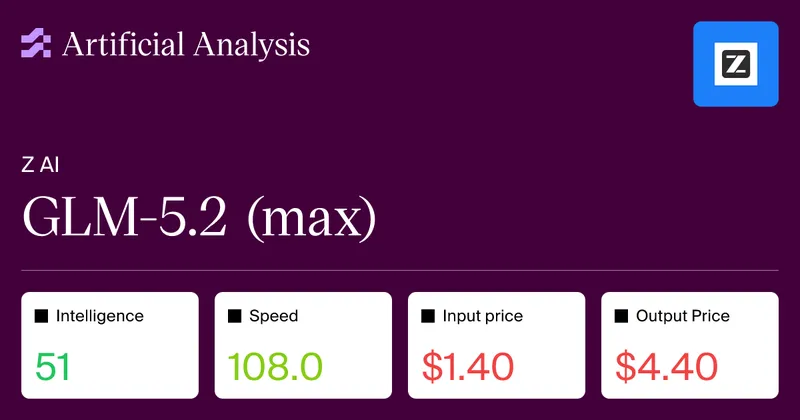
GLM 5.2 Performance Benchmarks
Jun 17, 2026
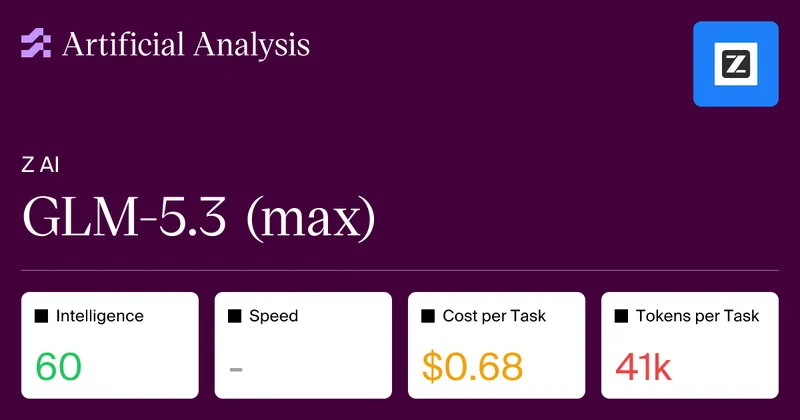
GLM-5.3 Artificial Analysis Benchmarks
Aug 18, 2026

DeepSeek V4–almost on the frontier, a fraction of the price
May 1, 2026