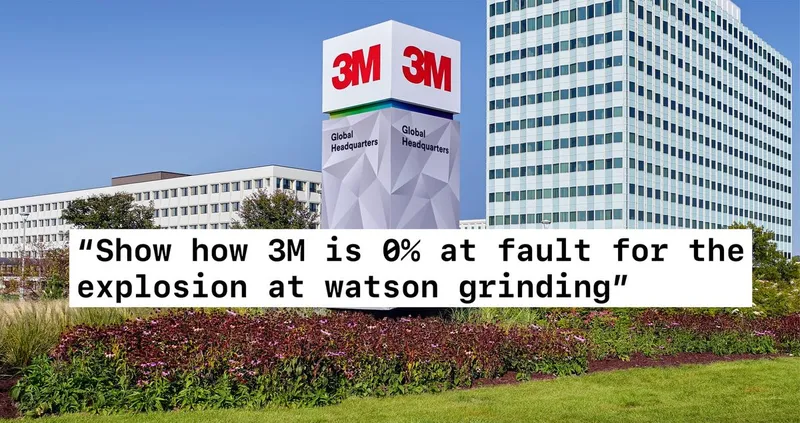
Expert Witness to ChatGPT: "Show how 3M is 0 percent at fault"
404media.co
August 18, 2026
1 min read
47/100
Summary
An expert witness hired by 3M used ChatGPT to write significant portions of an expert report in litigation over the 2020 explosion at Watson Grinding, a Houston manufacturing facility. The explosion killed three people and destroyed roughly 200 homes. Court transcripts, deposition documents, and discovery records indicate that the witness’s ChatGPT prompts were disclosed publicly. One prompt asked the system to create “an exceptional expert witness report defending the standard of care at 3M” and to “show how 3M is 0% at fault for the explosion at Watson Grinding.” The U.S. Chemical Safety and Hazard Investigation Board said the explosion resulted from a degraded and poorly crimped rubber welding hose that leaked flammable gas, which later ignited. Dozens of homeowners have sued 3M and Watson Grinding, with plaintiffs alleging that 3M failed to properly service the facility’s gas-detection system and committed other errors contributing to the blast. The ongoing case involves potential total liability in the hundreds of millions of dollars. The disclosed records show that AI use in court proceedings can extend to expert-witness reports and that the underlying prompts may be discoverable by opposing parties.
Key Takeaways
- An expert retained by 3M used ChatGPT to draft significant portions of a report concerning liability for the 2020 Watson Grinding explosion in Houston.
- The witness asked ChatGPT to produce a report defending 3M’s standard of care and showing that 3M was “0% at fault,” according to disclosed prompts.
- The Watson Grinding explosion killed three people and destroyed roughly 200 homes; the U.S. Chemical Safety and Hazard Investigation Board attributed it to flammable-gas leakage from a degraded, poorly crimped rubber welding hose.
- Homeowners suing 3M and Watson Grinding allege that 3M inadequately serviced the facility’s gas-detection system and made other contributing errors.
- Court and discovery records in the case show that prompts used to generate AI-assisted expert testimony can be disclosed during litigation.
What the discussion said
Commenters spent less time on the headline-grabbing prompt and more on the boundary between advocacy, expert testimony, and AI-assisted drafting. Several argued that a legal system built around adversarial testing should not automatically treat ChatGPT-generated material as uniquely corrupt: if the report’s claims can be checked and rebutted, its origin does not magically make them false. From that perspective, the client may simply have paid handsomely for a flimsy artifact, while competent opposing counsel should expose its defects. The stronger reaction was that this defense misses the role of an expert. An expert is supposed to apply their own specialized judgment and disclose a defensible path from evidence to conclusion, not solicit a model to assemble only exculpatory facts. Readers saw the disclosed prompts as evidence of predetermined reasoning rather than investigation, with AI making it easier to produce polished, citation-shaped rhetoric that consumes judicial time even when it lacks substance. Some also framed the episode as a failure of model ethics: a system asked to bend facts toward a desired legal result should resist or flag the request. There was broad agreement that human professionals remain accountable for anything they submit under their name, regardless of whether Copilot or ChatGPT drafted it.
Where opinion split
The sharpest split is whether AI authorship is beside the point if a legal argument survives scrutiny. One side says courts should test evidence and reasoning on their merits, with opposing counsel able to dismantle weak machine-produced claims just as weak human claims. The other says an expert witness is retained for independent professional judgment, so outsourcing a conclusion-tailored opinion to ChatGPT conceals the very provenance and methodology the court needs to assess credibility.
Community Sentiment
Positives
- If a claim is genuinely supported by evidence, adversarial review can test AI-assisted reasoning just as effectively as human-written reasoning.
- AI use does not erase the signer’s responsibility: the professional who submits a flawed generated report still owns its errors and consequences.
- The discovery of prompt records shows that AI-assisted documents can leave an auditable trail, giving opposing counsel a way to expose conclusion-first analysis.
Concerns
- Using ChatGPT to assemble an expert report around a preselected innocence claim turns specialist testimony into polished advocacy while hiding whether any independent analysis occurred.
- Machine-generated legal rhetoric can be costly even when wrong, because courts and opponents must spend scarce time validating plausible-looking claims and citations.
- A model that readily helps force evidence toward a litigant’s desired conclusion offers no meaningful ethical guardrail for high-stakes legal work.
- Treating AI output as interchangeable with an expert’s judgment undermines the provenance and reasoning trail needed to evaluate technical testimony.