I ran Photoshop on a £0.60 computer chip

pointinthecloud.com
August 21, 2026
8 min read
54/100
Summary
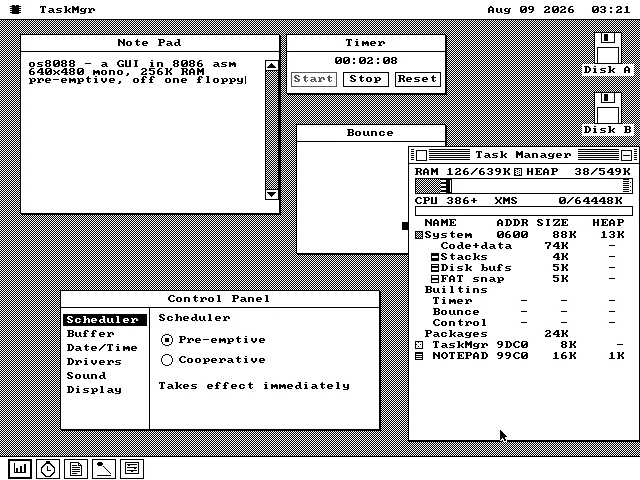
An Adafruit Fruit Jam board built around Raspberry Pi’s RP2350 chip emulated an old Apple Macintosh and ran early Macintosh versions of Adobe Photoshop and WordPerfect. The RP2350 chip costs about £0.60, although a usable computer also requires components including memory, storage, display output, and input hardware. The emulated system approximates a mid-1990s computer; the chip has two 150 MHz processors and can add 4 MB of RAM and gigabytes of storage. A Macintosh SE comparable to the emulated machine sold for £3,495 in 1989, or about £9,554 in current money using the Bank of England inflation calculator. The Fruit Jam includes Wi-Fi, infrared remote support, HDMI and keyboard terminal capabilities, and a ready-made Mac emulator, but its GPIO and USB design differs from several related RP2350 boards. Photoshop and WordPerfect required an emulator image with additional PSRAM. The author found WordPerfect’s uncluttered interface easier to concentrate with than a modern laptop environment. They suggest that low-power, understandable hardware could support less distracting devices for writing, web reading, messaging, maps, and music, while acknowledging that modern web pages, 4G and 5G networking, high-quality photography, and video present significant limitations. Possible software targets include FUZIX, BBC Micro emulators, Oberon, Smalltalk, Plan 9, and terminal software.
Key Takeaways
- A Raspberry Pi RP2350-based board emulated a classic Apple Macintosh capable of running Photoshop and WordPerfect, with the chip itself costing roughly £0.60.
- The RP2350 has two 150 MHz processors and can be paired with 4 MB of RAM and gigabytes of storage, giving it capabilities comparable to a mid-1990s computer.
- Adafruit’s Fruit Jam provides Wi-Fi, infrared support, HDMI and keyboard connectivity, plus a ready-made Macintosh emulator, but its hardware layout limits compatibility with software built for other RP2350 boards.
- The author says modern web complexity, cellular networking, video, and high-quality images would be difficult on such hardware, while simpler writing, music, messaging, and map functions may be feasible.
What the discussion said
The thread barely engaged with AI at all. Most commenters treated the project as a retrocomputing and hardware-efficiency stunt: a cheap microcontroller emulating an old Macintosh well enough to demonstrate how much work earlier machines supported. That produced admiration for clever memory expansion, flash-based execution, and the broader idea that constrained hardware can still be useful. Others punctured the headline by noting that the full setup needs a much pricier board and added RAM, while a used conventional PC would run a modern Photoshop far more practically. The sole explicit AI angle came from a reader imagining GPT-3-scale text generation on a Raspberry Pi. It was presented as an appealing extension of the same constraint-driven ethos: making capable AI run on modest, accessible hardware rather than assuming datacenter-class resources. But nobody supplied a model size, quantization strategy, inference speed, memory calculation, or evidence that such a deployment is feasible. Consequently, the conversation offers enthusiasm for tiny-device experimentation, not a substantive assessment of local AI capability, cost, or model performance. There was no meaningful discussion of training, safety, benchmarks, APIs, or actual AI applications beyond that speculative wish.
Community Sentiment
Positives
- The dream of running a GPT-3-class generator on a Raspberry Pi captures real excitement about pushing useful AI onto cheap, power-efficient personal hardware.
Concerns
- The proposed Raspberry Pi GPT-3 use case is pure aspiration here: commenters offered no evidence that a model of that scale could fit or perform acceptably on such constrained hardware.