MacKenzie Scott's giving, in quality-adjusted life years
maxghenis.com
July 13, 2026
6 min read
🔥🔥🔥🔥🔥
46/100
Summary
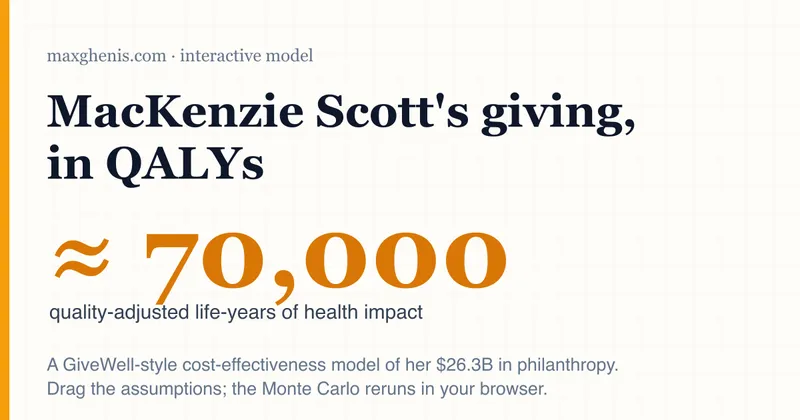
A Monte Carlo cost-effectiveness model estimates the health impact of MacKenzie Scott's $26.3 billion in philanthropy using Quality-Adjusted Life Years (QALYs). The model allows users to adjust assumptions, with results influenced by varying levels of trust in the cited effects of each study.
Key Takeaways
- MacKenzie Scott's Yield Giving network has made over $26 billion in more than 2,700 gifts since 2019, projected to reach $26.3 billion by 2025.
- The cost-effectiveness model estimates that Scott's philanthropy could deliver between 70,000 to 200,000 quality-adjusted life-years (QALYs) depending on the credibility of the causal evidence used.
- The model incorporates a Monte Carlo simulation to assess the impact of donations across various intervention archetypes, adjusting for the causal credibility of each effect.
- The average cost per QALY for global health interventions is estimated to range from approximately $150 to $260 under the model's conventions.
Community Sentiment
Positives
- MacKenzie Scott is a beacon of humanity amid extreme inequality, showing that billionaires can do good and inspire hope.
- Every avoided pregnancy and child death through her philanthropy could lead to significant economic productivity and quality of life improvements.
Concerns
- Many feel her charitable efforts are just a drop in the ocean compared to the vast wealth disparity, revealing a lack of creativity in her approach.
- The calculations around quality-adjusted life years (QALY) seem overly optimistic and simplistic, raising doubts about their validity.
- Some commenters argue that the premise of evaluating economic value from avoided births is flawed and dismissive of potential human contributions.
Related Articles
New Withings Users Must Pay $99/Year for Apple Health Syncing
Oct 15, 2026

The brain may be about to have its Ozempic moment
Aug 26, 2026

The Sloppification of Peptides
Aug 23, 2026

Seeing beyond BMI: Estimating cardiometabolic risk with smartphone imagery
Aug 20, 2026

Moderna reports first positive Phase 3 for mRNA neoantigen therapy in melanoma
Aug 19, 2026