Mojo 1.0 Beta
mojolang.org
May 8, 2026
2 min read
🔥🔥🔥🔥🔥
64/100
Summary
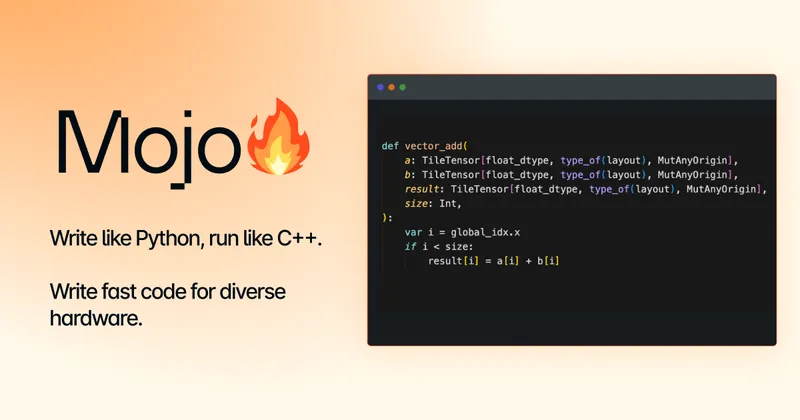
Mojo is a programming language designed to combine the user-friendliness of Python with the performance of C++. It allows developers to write fast code for various hardware, including CPUs and GPUs, while ensuring memory safety and avoiding vendor lock-in.
Key Takeaways
- Mojo is a programming language designed for high performance on diverse hardware, combining Python's syntax with Rust's memory safety and Zig's compile-time metaprogramming capabilities.
- Mojo enables GPU programming without vendor-specific libraries, allowing developers to write high-performance GPU kernels using the same language as for CPUs.
- Mojo natively interoperates with Python, allowing developers to optimize performance-critical code without needing to rewrite existing Python code.
- The development roadmap for Mojo includes phases for enhancing CPU and GPU coding capabilities, expanding application-level programming, and implementing a guaranteed memory-safety model.
Community Sentiment
Positives
- The potential for Mojo to mix GPU and CPU code in a single language could significantly enhance performance for machine learning applications, making it an exciting prospect for developers.
- The MLIR approach utilized by Mojo has proven valuable in creating efficient Python JIT DSLs, which could benefit the broader AI ecosystem.
- The promise of a 36,000x speedup over Python in certain scenarios highlights Mojo's ambitious goals for performance improvement in computational tasks.
Concerns
- Mojo's lack of compatibility with existing Python codebase raises concerns about its adoption, as many developers rely heavily on Python's ecosystem.
- The claim of a 36,000x speedup appears misleading, as it may only apply in extreme edge cases, undermining trust in Mojo's performance promises.
- The proprietary nature of Mojo's compiler, combined with its not fully open-source development model, alienates many developers who prefer open-source solutions.