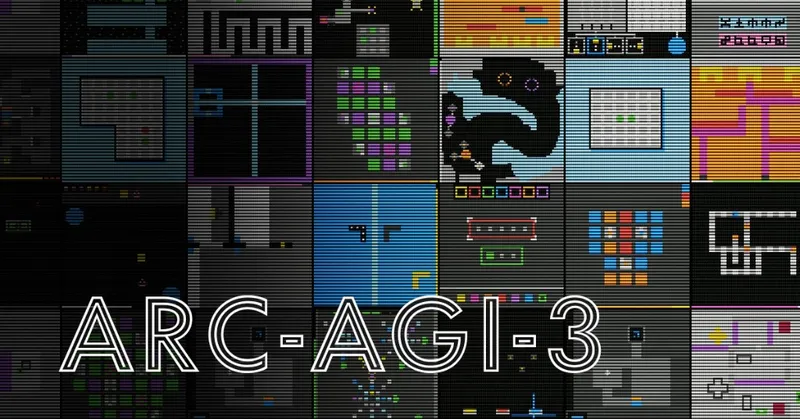
Nvidia AVO scores 100% on the ARC-AGI-3 interactive reasoning benchmark
twitter.com
August 21, 2026
1 min read
46/100
Summary
NVIDIA said its general-purpose coding agent, NVIDIA AVO, scored 100% on the ARC-AGI-3 interactive reasoning benchmark. The company said AVO completed all 183 levels across 25 public environments. NVIDIA said the agent determined what actions to take without instructions, explicit rules, or stated goals. The result concerns ARC-AGI-3’s interactive reasoning benchmark and NVIDIA’s reported performance on its public environments.
What the discussion said
Commenters quickly stripped away the headline's AGI bait and focused on what the result actually measures. A 100% figure here is not a declaration that a system has mastered every task; it reflects performance relative to a median human encountering these games for the first time. Several readers also argued that the puzzles reward relentless trial, memory, and persistence as much as broad intelligence, giving tireless agents a built-in edge over bored humans. The sharper technical debate was over attribution. Nvidia's result is an agentic search harness wrapped around Claude Opus 5, scored on just 25 public tasks, rather than a verified private-set score or evidence of a new Nvidia base model. That makes it an impressive demonstration of scaffolding, but not clean proof of raw-model reasoning or generalization; readers flagged overfitting risk and noted the public leaderboard's much lower verified result concerns a different evaluation. Some pushed back on dismissing harnesses altogether: real deployed models are already mediated by server-side orchestration, memory, tools, and control loops, and modern model progress has materially improved game-playing agents. The thread wanted missing operational details too, especially end-to-end time and compute, since fewer environment actions may simply mean much more deliberation per action. Enthusiasm remained, but it was conditional on private-set validation and transparent cost-speed reporting.
Where opinion split
The core dispute is whether AVO's public-set perfect score demonstrates a major reasoning breakthrough or mostly a powerful benchmark-specific wrapper. Supporters argue that capable agents should be evaluated as full systems with memory, search, and tools, and that current frontier models are far stronger than older examples suggest. Skeptics argue that a custom harness atop Opus 5 on known public games cannot establish raw intelligence or generalization until it succeeds on hidden tasks with disclosed runtime and compute.
Community Sentiment
Positives
- An agent that solves every public ARC-AGI-3 game while using 12% fewer actions than bare Opus points to scaffolding that can turn frontier models into more deliberate, efficient interactive reasoners.
- The comparison between Opus and GPT-5.6 Sol hints that agent frameworks can exploit distinct model strengths: one may move faster in elapsed time while another wastes fewer environment actions.
- Several readers see the result as a genuinely exciting sign that persistence, memory, and iterative search are making agents viable for longer interactive tasks once beyond a model's single response.
Concerns
- The headline's perfect score rests on 25 public tasks, not the semi-private or private evaluation, so memorization and benchmark-specific tuning remain the obvious alternative explanation.
- AVO is a sophisticated harness around Claude Opus 5 rather than evidence that Nvidia trained a new model with unprecedented native reasoning ability.
- Without end-to-end latency, compute, and cost figures, fewer game actions is an incomplete efficiency claim: each action may be preceded by expensive internal search.
- A benchmark score calibrated to median first-pass human performance cannot by itself settle whether a system is AGI, especially when machines can outlast humans on tedious puzzles.