Slack Code
salesforce.com
August 20, 2026
10 min read
48/100
Summary
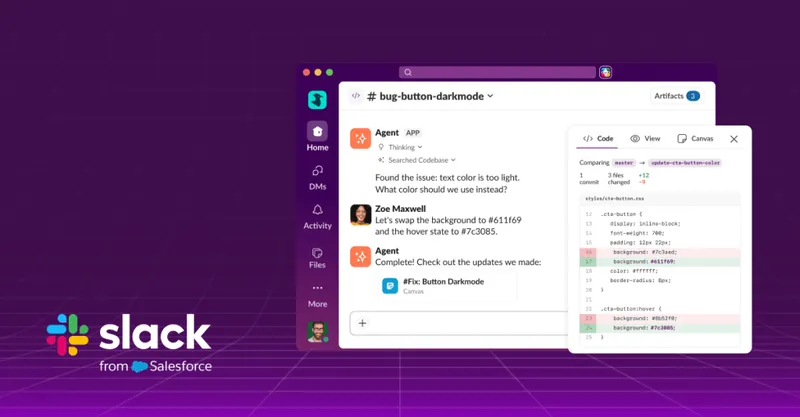
Salesforce has introduced Slack Code, a Slack feature that creates dedicated code channels for teams and AI coding agents to plan, write, review and ship software together. A user can tag an agent for tasks such as fixing a bug, updating a webpage or building a feature; the agent creates a code channel where participants can view its conversation, inspect code diffs and live previews, provide feedback, and approve work before deployment. Completed channels archive automatically while remaining searchable. Slack Code initially supports agents from founding partners Anthropic, Cognition, GitHub, OpenAI’s ChatGPT and Vercel. The feature is available on any Slack plan, although customers need access to each partner’s agent. Slack says the agents inherit its existing security model, permissions and administrative controls, while production changes require expert sign-off in the channel. Slack plans to open the code-channel APIs to the wider developer community so custom agents, including non-engineering agents for work such as marketing campaigns or legal document review, can participate. Slack also added labeled agent direct messages, titled threads, an Agents tab for managing agent sessions and statuses, and an Add to Slack setup flow for agents from services including Lovable, n8n, LangChain and Vercel. Slack says this flow automates OAuth, manifest setup and environment configuration.
Key Takeaways
- Slack Code creates dedicated Slack code channels where teams and AI agents can collaborate on software tasks, review diffs and previews, and approve work before it ships.
- Slack Code initially integrates with Anthropic Claude, Cognition Devin, GitHub Copilot, ChatGPT and Vercel agents, and is available on any Slack plan with separate access to each agent required.
- Agents in code channels use Slack’s existing permissions, security model and admin controls; Slack says production deployments require expert sign-off.
- Slack added an Agents tab and an Add to Slack flow that automates OAuth, manifest setup and environment configuration for supported third-party agents.
What the discussion said
The thread treated Slack Code less as a breakthrough than as another vendor racing to claim the agentic-coding control plane. Many commenters are already using models to draft features, generate tests, review changes, and handle repetitive CRUD work; for that audience, putting an agent where product, operations, and engineering already talk is not irrational. They see a real opening for non-engineers to prototype, triage bugs, and turn discussions into concrete starting points. But the dominant mood was exhaustion. Readers argued that every SaaS company is shipping the same coding-agent pitch, wrapped in inflated language about reinventing software development. Slack itself was viewed as a poor place for the hard parts: code review belongs in GitHub, serious work still needs terminals and editors, and Slack-based conversations can burn tokens rapidly. Several also feared another costly enterprise AI add-on rather than meaningful new capability. The practical consensus was that AI coding assistance is useful for bounded tasks, but no one has found a clean, collaborative workflow for managing agents at team scale. Existing GitHub tagging, chat integrations, and cloud-hosted agents feel awkward, while the alternative of granting broadly connected agents access to infrastructure raises obvious operational unease.
Where opinion split
The sharpest dispute is whether Slack is a sensible home for coding agents. Supporters say work already begins in Slack, so turning product conversations and operational reports into prototypes can remove handoffs and broaden who can contribute. Skeptics argue that chat is the wrong interface for reviewing and shipping code, while Slack primarily adds vendor lock-in, token expense, and agent hype to workflows better served by editors, terminals, and GitHub.
Community Sentiment
Positives
- AI assistants are already pulling their weight on repetitive CRUD work by drafting implementations, generating tests, and supplying an additional review pass before deployment.
- Embedding agents in the team’s communication hub could let product and operations staff prototype ideas and triage defects instead of routing every rough request straight to engineers.
- Lower development costs from capable AI agents could make self-hosted alternatives to entrenched SaaS suites more realistic, weakening dependence on expensive proprietary tools.
- Several readers see chat-based coding as a plausible extension of existing Slack bot workflows, since teams already coordinate work and invoke internal AI systems there.
Concerns
- Slack Code landed as another interchangeable agentic-coding pitch, with commenters tired of SaaS firms copying one another instead of solving a distinct developer problem.
- The promotional framing was ridiculed as AI-generated corporate sludge, promising a revolution in software creation while offering little evidence of a novel capability.
- For real development, Slack looks like a weak control surface: reviewers need GitHub’s diff and pull-request tooling, while developers still rely on editors and terminals.
- Chat-driven agents can consume tokens aggressively, making an always-on Slack interface an especially expensive path for routine coding tasks.
- Readers expect the feature to become another forced enterprise AI upsell, compounding already painful Slack licensing costs without proving equivalent value.
- Giving agents broad access to infrastructure, databases, DNS, and telemetry was portrayed as an alarming version of offloading work rather than a trustworthy engineering workflow.