Stop Making TUIs
sockpuppet.org
August 21, 2026
15 min read
65/100
Summary
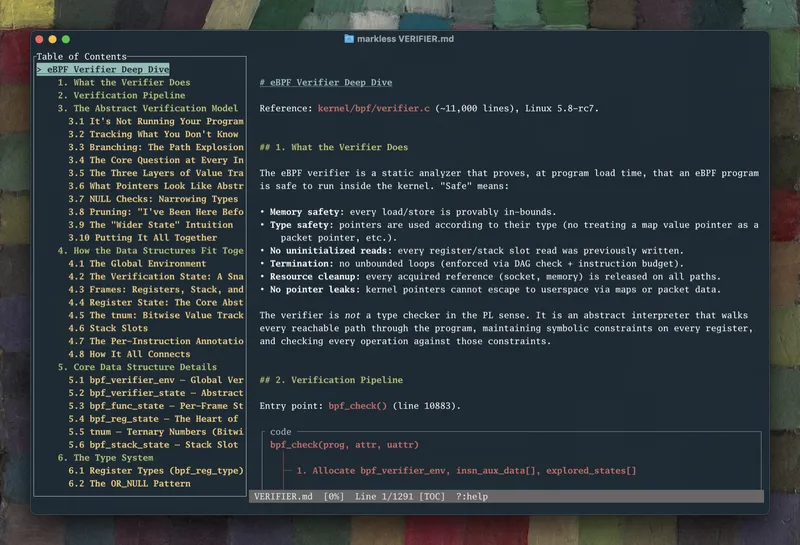
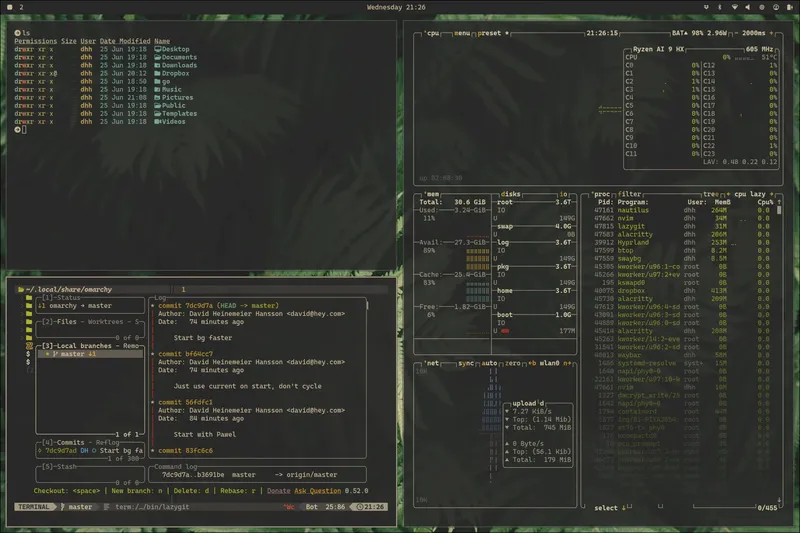
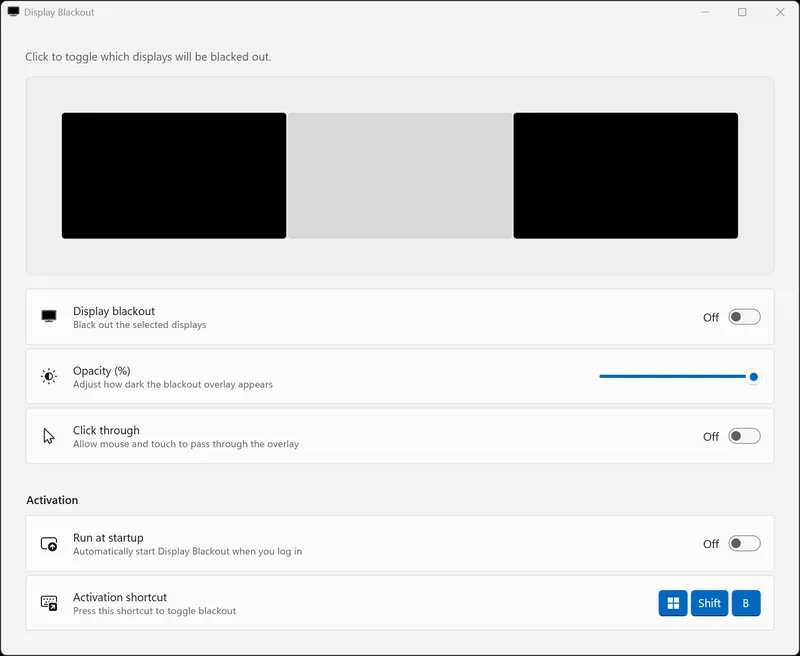
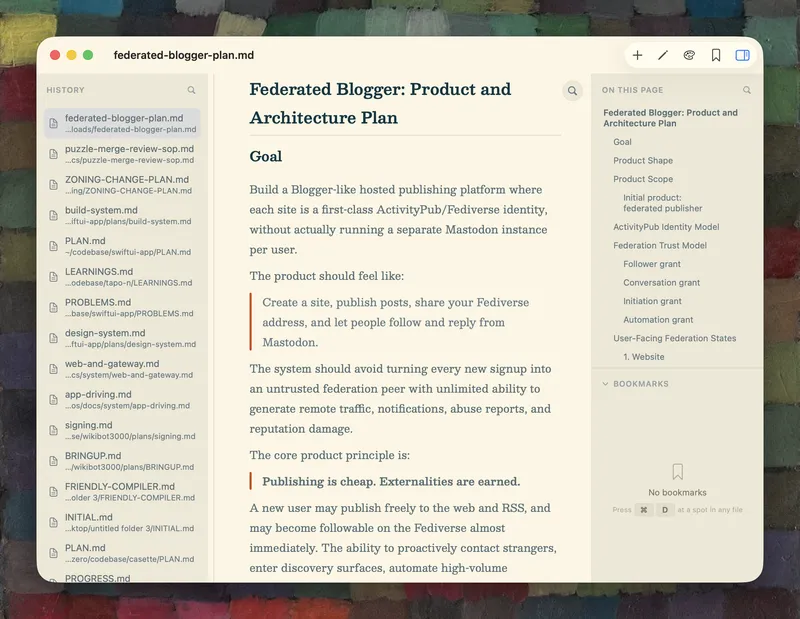
A macOS developer used AI coding agents to generate several private SwiftUI applications, including MDV.app, a Markdown viewer; a SageMath frontend that renders output in LaTeX and exposes mathematical operations through point-and-click controls; DJ Roomba, an Apple Music player with an LLM playlist agent; a self-driving wiki; a GPT-5-backed food macro tracker; a TP-Link sensor monitor; and a menu-bar universal remote for Apple TV, Roku TV, and a Denon receiver. The developer says these programs were built by copying a template directory, describing the desired software to Claude or Codex, and letting agents build and test it with computer-use capabilities. The developer argues that AI agents have made native macOS interfaces practical for people who previously avoided UI work, and urges programmers to favor native graphical interfaces over new terminal user interfaces. They distinguish command-line interfaces, which they consider useful for automation and remote operations, from TUIs, which they characterize as constrained by terminal capabilities. They say SwiftUI supplies standard behavior for scrolling, drag and drop, text selection, windows, images, and accessibility that TUI frameworks must recreate imperfectly. Cross-platform consistency remains, in their view, the strongest case for TUIs. The developer’s macOS workflow uses SwiftUI, a Makefile-driven build process, and skills covering macOS design, typography, SwiftUI, and Swift style.
Key Takeaways
- AI coding agents generated private native macOS tools for Markdown viewing, mathematics, music playback, knowledge management, food tracking, sensor monitoring, and remote control.
- The SageMath frontend renders output in LaTeX, provides point-and-click access to methods on mathematical objects, and accepts shorthand inputs such as matrix notation.
- DJ Roomba includes an embedded LLM agent that can read an Apple Music library, recently played tracks, and upcoming tracks to create playlists from natural-language requests.
- The developer argues that native UI frameworks such as SwiftUI provide system-level controls and accessibility support that terminal UI frameworks must reproduce with additional work.
- The developer considers cross-platform consistency the strongest argument for TUIs, while recommending CLIs rather than TUIs for many remote production tasks.
What the discussion said
The discussion was overwhelmingly about terminal interfaces rather than the article’s AI angle, so most praise for SSH, keyboard control, low resource use, and remote persistence does not bear on AI/ML directly. The AI-specific thread focused on whether frontier models change the economics of interface development. Several readers argued that code-generating models make native GUI work unusually approachable for personal tools: they can help produce platform-specific menus, charts, Bluetooth integrations, and visual polish that previously demanded more specialized UI expertise. That makes disposable, narrowly tailored software more plausible, even for people who would never volunteer to maintain an AI-generated application for others. The sharper objection concerned agentic systems. One reader described an internal development agent that outgrew its initial TUI because the interface became too stateful and cramped for complex planning, task decomposition, dependency management, execution, and review. From that perspective, the meaningful design boundary is no longer terminal versus graphical UI, but whether an interface serves a human or can be reliably driven and inspected by an agent. Commenters also suggested that automated computer-use systems may eventually ease GUI-framework migration by providing a verification loop, though this was framed as a near-future expectation rather than demonstrated capability.
Where opinion split
Do AI coding agents make TUIs more defensible, or do they expose their limits? The optimistic view is that models now make polished native GUIs cheap enough for personal, disposable tools and may automate future UI migrations. The opposing view is that complex agentic workflows need explicit, inspectable, less state-bound interfaces, where a dense TUI quickly becomes a liability for both agents and humans.
Community Sentiment
Positives
- Frontier coding models are making polished native personal tools feel attainable, lowering the barrier to custom menus, charts, device integrations, and platform-specific UX.
- AI-assisted interface work supports a disposable-software model: people can build narrowly useful apps for themselves without committing to the maintenance burden of a public product.
- Robust computer-use agents could eventually turn GUI migrations into a testable automation problem, reducing the long-term cost of changing UI frameworks.
Concerns
- Vibe-coded applications may be acceptable as private experiments, but commenters distrust shipping or maintaining AI-generated software for other people without stronger engineering discipline.
- A TUI proved too state-bound and visually cramped for a large agentic development harness, obstructing reliable agent control across planning, decomposition, execution, and review loops.