The Citizen Developer
massdriver.cloud
August 20, 2026
11 min read
44/100
Summary
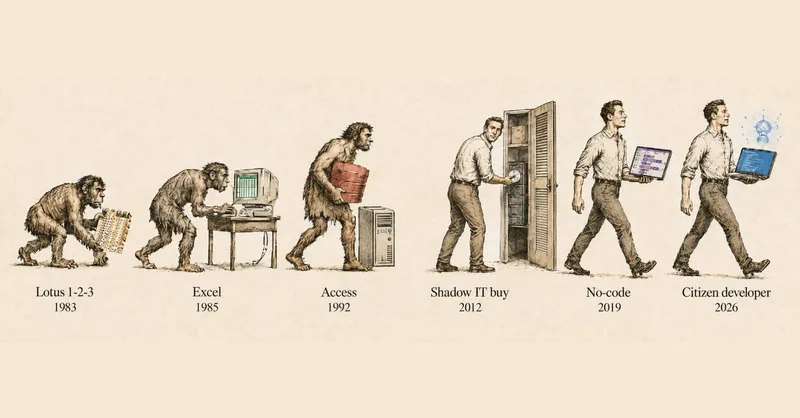
Citizen developers—employees who create software outside traditional engineering teams—are increasingly using AI coding tools to build and deploy applications, often without IT oversight. The term covers business users such as sales representatives and operations managers as well as professional developers working outside their usual specialties. Gartner found in 2021 that 41% of employees created technology or analytics capabilities outside IT departments, before ChatGPT’s release. The growth of AI-assisted development can accelerate shadow IT, including applications that handle personal data or connect to company systems without established security, compliance, cost, or operational controls. The post argues that operations and platform teams should provide AI agents with company-specific deployment paths rather than attempting to block citizen development. Suggested controls include a supported application runtime, deployment workflow, identity and secret-management process, and defined points where an agent must request human review. It cites an October research scan of 5,600 production “vibe-coded” apps that reportedly found more than 2,000 vulnerabilities, 400 leaked secrets, and 175 exposures of personal data. It also cites Moltbook’s leak of 1.5 million API tokens through a Supabase key in client-side JavaScript three days after launch. The Cloud Security Alliance says major AI security frameworks, including NIST AI RMF and the OWASP LLM Top 10, lack dedicated guidance for citizen developers operating without professional security oversight.
Key Takeaways
- AI coding tools allow employees outside engineering teams to create applications, increasing the scale and speed of shadow IT.
- Gartner found that 41% of employees were creating technology or analytics capabilities outside IT departments in 2021, before ChatGPT launched.
- An October scan of 5,600 production vibe-coded apps reportedly identified more than 2,000 vulnerabilities, 400 leaked secrets, and 175 instances of exposed personal data.
- Company-provided coding agents can be configured with supported deployment, identity, secrets, and human-review workflows to direct users toward approved infrastructure.
- The Cloud Security Alliance says major AI security frameworks do not provide dedicated guidance for citizen developers shipping software without professional security oversight.
What the discussion said
The thread mostly rejected the article's implied equation of AI-assisted building with engineering. Commenters argued that producing code is only the visible first step: real engineering means understanding the problem, making sound tradeoffs, validating behavior, handling security and operations, and owning the result after its creator moves on. Several used the bridge or carpentry analogy to stress that a powerful tool does not confer professional judgment, particularly where failures carry serious consequences. Still, there was meaningful recognition that AI changes who can make useful software. Readers described non-developers now being able to create internal tools quickly, bypassing development teams whose queues and process overhead can turn modest needs into permanent non-projects. One formerly hostile reader saw AI as the missing capability that makes citizen development materially different from earlier no-code hype. The more constructive position was not unrestricted deployment, but a managed path: let AI-assisted builders deploy into internal, engineering-controlled environments with guardrails. Skeptics focused on the gap between a polished demo and a maintainable system. Personal use of Claude was said to reveal contradictory decisions, forgotten context, and needless complexity, making close technical supervision essential. The discussion therefore treats AI as a strong accelerator for capable people, not a substitute for the expertise and accountability behind production engineering.
Where opinion split
The sharp dispute is whether AI turns ordinary business users into engineers or merely gives them better ways to prototype. Supporters argue that competent domain experts can finally ship small, valuable internal tools without being trapped behind overloaded engineering organizations. Critics answer that AI-generated code still needs someone who can define requirements, catch model errors, secure and maintain the system, and accept responsibility when the prototype becomes infrastructure.
Community Sentiment
Positives
- AI can let technically capable domain experts build narrowly scoped internal tools in hours or days, escaping development backlogs that routinely smother small business needs.
- Citizen development looks more credible than past low-code waves because modern models can create artifacts that previously required a software specialist.
- A guarded deployment model can preserve the speed of AI-assisted building while keeping tools private, operated on managed infrastructure, and upgraded as their creators gain skill.
- AI-assisted prototyping can force engineering teams to confront how often bureaucracy and oversized architecture make modest software requests economically impossible.
Concerns
- Generating an app through prompts does not supply the systems judgment, validation discipline, and long-term ownership that distinguish production engineering from a demo.
- Models can appear astonishingly capable at first, then lose context, contradict prior design choices, and inflate simple tasks into needlessly complicated systems.
- The dangerous handoff is the launch-and-leave mindset: a nontechnical creator may treat an AI-built tool as finished while engineers inherit its security, reliability, and maintenance burden.
- Calling every AI user an engineer risks erasing the accountability required when software affects consequential operations, even if most applications are not literally life-critical.