What Emily Bender meant by "stochastic parrots"

spectrum.ieee.org
July 6, 2026
10 min read
🔥🔥🔥🔥🔥
56/100
Summary
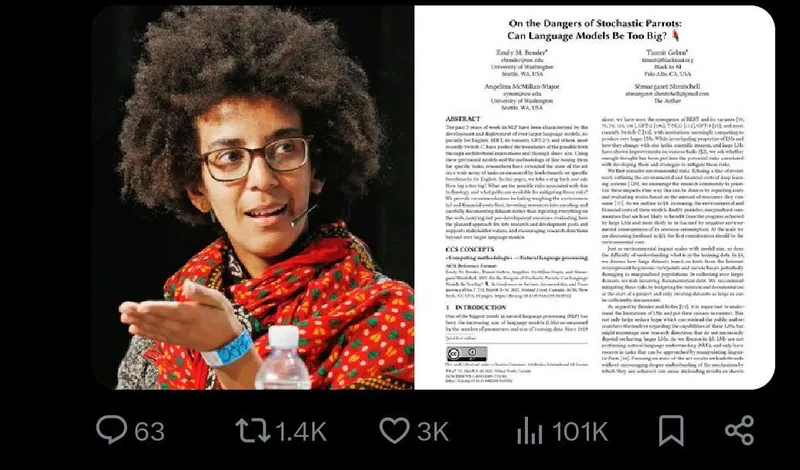
The paper "On the Dangers of Stochastic Parrots: Can Language Models Be Too Big?" argues that large language models generate text by statistically predicting likely sequences of words. The publication gained significant attention following the firing of two authors, Timnit Gebru and Margaret Mitchell, by Google.
Key Takeaways
- The paper "On the Dangers of Stochastic Parrots" argues that large language models generate text by statistically predicting word sequences rather than understanding language.
- Emily M. Bender states that the term "artificial intelligence" obscures the distinct technologies involved and oversells their capabilities, complicating discussions and decision-making.
- Bender highlights that many people conflate "AI" with chatbots or large language models, failing to recognize the differences between various technologies like AlphaFold and statistical modeling.
- The term "artificial intelligence" primarily benefits tech companies seeking to enhance their valuations rather than providing clarity about the technologies being discussed.
Community Sentiment
Positives
- The criticisms about financial and environmental costs in the 'stochastic parrots' paper are crucial — we can't ignore the impact of AI on the planet.
- There's a valid point in advocating for careful evaluation of datasets, rather than just dumping the entire internet into models — quality over quantity matters!
- Some commenters appreciate the nuanced discussion around AI and its limitations, highlighting that LLMs can behave methodically, challenging the notion of them being merely 'haphazard'.
Concerns
- Many commenters feel the paper has been unfairly criticized without substantial argument — it's frustrating when people dismiss important work without engaging with its content.
- The debate over the ethical implications of LLMs seems muddled, with some asserting that calling them 'intelligent' is misleading — they may mimic understanding but lack true cognition.
- There's a strong sentiment that the term 'artificial intelligence' oversells the capabilities of these models, leading to misunderstandings about what they can truly do.
Related Articles

The Future of Everything Is Lies, I Guess
Apr 8, 2026
The LLM warnings Google fired Timnit Gebru over have all come true
Jun 4, 2026

OpenAI says its new model GPT-2 is too dangerous to release (2019)
Apr 8, 2026

You Do Not, in Fact, Have to Hand It to Them
Mar 28, 2026

Two different tricks for fast LLM inference
Feb 15, 2026