15 years of FP64 segmentation, and why the Blackwell Ultra breaks the pattern
nicolasdickenmann.com
February 19, 2026
7 min read
Summary
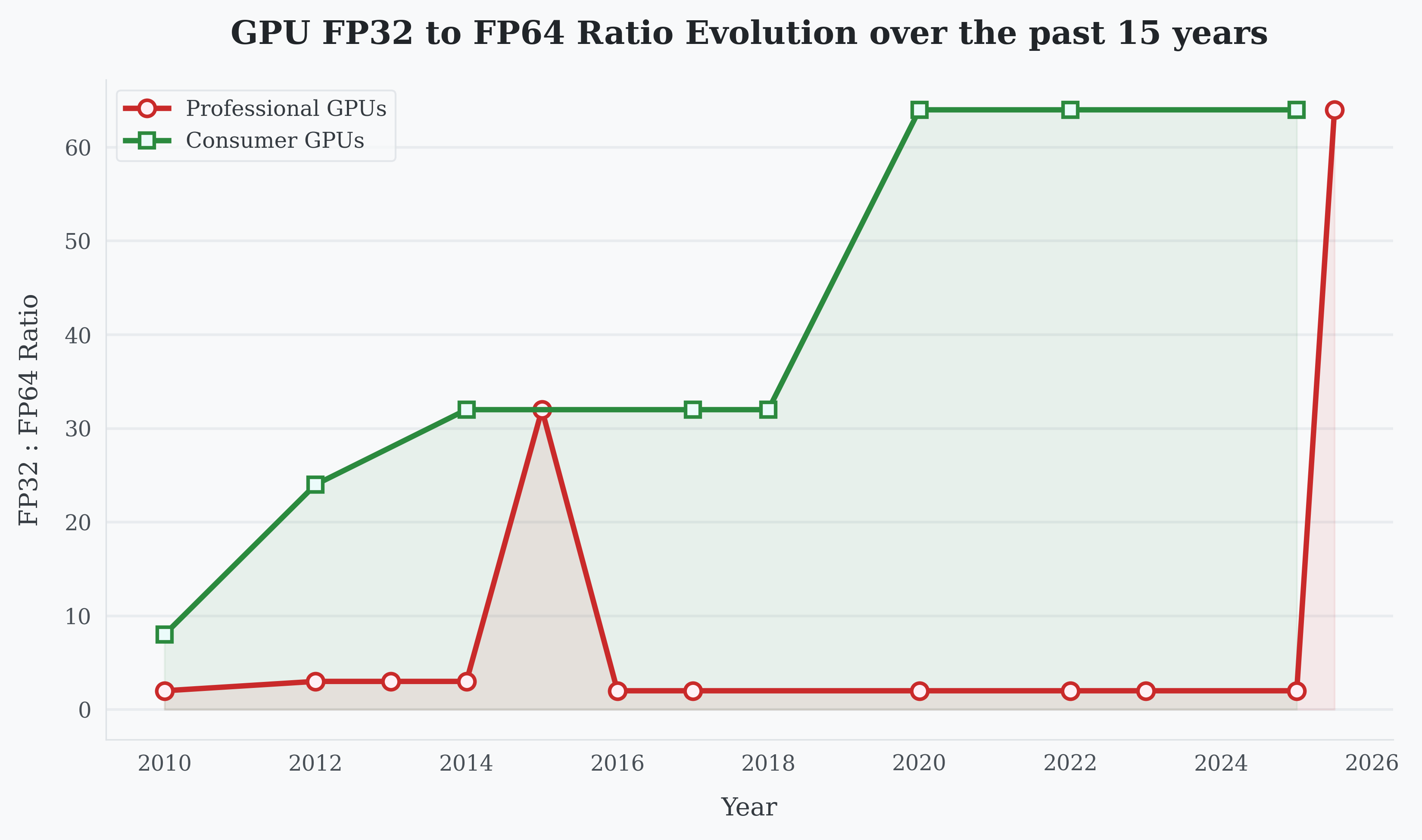
The RTX 5090 delivers 104.8 TFLOPS of FP32 compute and only 1.64 TFLOPS of FP64 compute, resulting in a 64:1 FP64 to FP32 ratio. Over the past fifteen years, this ratio has widened on consumer GPUs, reflecting a growing divide between consumer and enterprise silicon, which is now being challenged by advancements in AI.
Key Takeaways
- The FP64:FP32 performance ratio on Nvidia consumer GPUs has deteriorated from 1:2 in 2010 to 1:64 by 2020, reflecting a deliberate market segmentation strategy by Nvidia.
- Over the past fifteen years, FP64 performance on consumer GPUs increased only 9.65x, while FP32 performance improved 77.63x.
- Modern AI training primarily utilizes FP32 and lower precision formats, making consumer GPUs increasingly viable for serious compute workloads.
- Nvidia updated its GeForce End User License Agreement in 2017 to prohibit the use of consumer GPUs in datacenters, marking a shift from implicit to explicit market segmentation.
Community Sentiment
MixedPositives
- NVIDIA's evolution from graphics chips to GPGPU illustrates their adaptability, showcasing how innovations in one area can lead to breakthroughs in another, like CUDA.
- The historical context of FP64 capabilities highlights the importance of HPC workloads, which underscores the significance of NVIDIA's strategic decisions in the AI landscape.
Concerns
- The article overlooks the cost implications of FP64 units, which could significantly increase GPU prices, raising concerns about market viability for gamers.
- Regulatory constraints on FP64 performance for consumer GPUs limit their applicability, indicating a significant barrier for developers in high-performance computing sectors.
- The potential overflow and underflow issues with double-precision implementations could severely impact scientific computing, raising doubts about the proposed solutions.
Source
nicolasdickenmann.com
Published
February 19, 2026
Reading Time
7 minutes
Relevance Score
58/100
🔥🔥🔥🔥🔥
Why It Matters
This page is optimized for focused reading: quick context up top, a clean summary block, and a direct path to the original source when you want the full story.