Top stories
Story · 1 report
We're releasing the weights of Mistral Large 4
Mistral has released the weights for Mistral Large 4, also called Le Chonk, a 1-trillion-parameter natively multimodal mixture-of-experts model that had entered public preview earlier in the month. The open-weight model is designed for coding, agentic workflows, defensive cybersecurity and enterprise tasks, and offers low, medium and high reasoning modes to balance cost and performance. Mistral says the model was trained from scratch on European infrastructure and can be inspected, customized and self-hosted. Mistral reports that three additional weeks of reinforcement learning raised its FrontierCode 2.0 score to 19.7% and its Terminal-Bench 4.0 result by 13 percentage points to 41%. On the Artificial Analysis Coding Agent Index, it scored 48% while using 47% fewer tokens per task on average than GLM-5.3, according to Mistral. The company also reports a 51% score on the Artificial Analysis Cyber Index and a 96.6% average refusal rate for malicious cybersecurity requests. A specialized cybersecurity version is being previewed with vetted enterprise partners for authorized testing. Mistral Large 4 is available through Mistral Studio, the Mistral API, OpenRouter, Hugging Face, Microsoft Foundry and NVIDIA-hosted endpoints. API pricing starts at $0.70 per million input tokens and $2.10 per million output tokens. Its modified MIT-style license permits use, modification, fine-tuning and commercialization, except Model-as-a-Service providers require a separate commercial license.
mistral.ai
🔥🔥🔥🔥🔥2 min summary
10/29/2026
Story · 1 report
Anthropic S-1
An SEC filing link identifies Anthropic, PBC and an S-1 document labeled “Q2.” The source provides no filing details, financial figures, dates, business information, or statements from Anthropic. The link was posted by SiNTEx and had a score of 1,064 points and 989 comments at the time reflected in the source.
sec.gov
🔥🔥🔥🔥🔥1 min summary
10/26/2026
Story · 1 report
Sebastian Raschka's from-scratch video course on building reasoning models
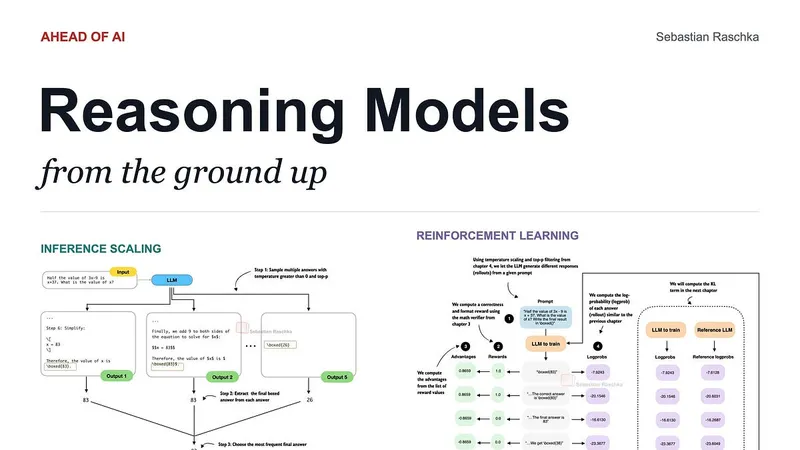
An eight-video, 11-hour coding course teaches developers to build and improve a small reasoning model in Python and PyTorch, beginning with a pre-trained Qwen3 0.6B model. The materials cover model loading, streaming text generation, KV caching, model compilation, evaluation, inference-time scaling, reinforcement learning, and distillation. Python and PyTorch familiarity are recommended; early generation and evaluation exercises can run on a CPU, while later training experiments are more practical on a GPU. The course builds a math-answer verifier and uses the MATH-500 benchmark to evaluate models. It implements temperature scaling, multinomial sampling, top-p filtering, self-consistency voting, scoring based on token and sequence log probabilities, and self-refinement. Later lessons implement a simplified Group Relative Policy Optimization method for reinforcement learning with verifiable rewards, including response groups scored by the verifier, training metrics, clipped policy ratios, and KL-loss terms. The final lesson distills reasoning behavior from DeepSeek R1-generated answers through supervised training and compares distilled-model results on MATH-500. The videos accompany the book Build a Reasoning Model (From Scratch), and a separate 90-minute LinkedIn Learning course provides a conceptual overview of inference-time scaling, reinforcement learning, and distillation.
magazine.sebastianraschka.com
🔥🔥🔥🔥🔥1 min summary
10/26/2026
Story · 1 report
A 10-year-old CNN outperforms frontier LLMs for skin cancer diagnosis
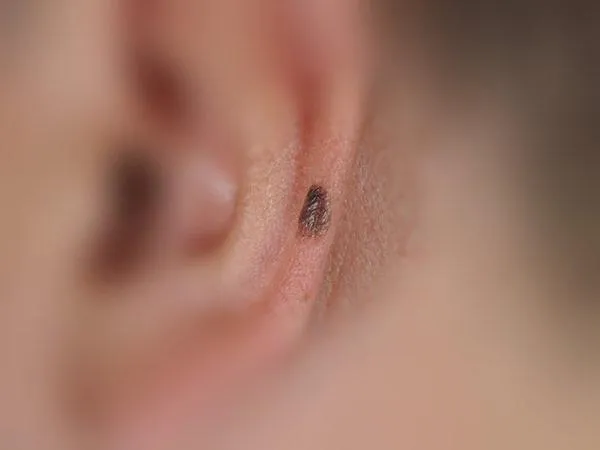
A dermatologist tested GPT-6 Astra, Claude Fable 5.1 and a fine-tuned Inception v3 convolutional neural network on 200 randomly selected, biopsy-confirmed skin lesions from the public MILK10k dataset. The CNN correctly identified 125 of 200 lesions across six diagnoses, or 62%, while GPT-6 Astra and Claude Fable 5.1 identified 84 and 85, or 42% each. Inception v3 was introduced by Google in 2015 and was fine-tuned on 68,011 ISIC Archive clinical and dermoscopic images for about 20 minutes on one H100 GPU. The test set contained 100 lesions requiring further care, including 30 melanomas, and 100 benign lesions considered safe to discharge. The CNN identified 13 melanomas as its first choice, versus eight for GPT-6 Astra and 11 for Claude Fable 5.1. With a second diagnostic choice allowed, the CNN reached 173 correct cases, compared with 134 and 138 for the LLMs. Both LLMs incorrectly labeled a pictured melanoma as a benign seborrhoeic keratosis and said the patient could be discharged. The sample size was small, each LLM response was generated once, and all lesions had been biopsied, making the cases unusually difficult. At its preset discharge threshold, the CNN discharged 18 melanomas, though matching its unsafe-lesion retention rate to the LLMs reduced that figure to two or one. The browser-based CNN runs locally with WebGPU and does not upload images.
lynchlab.net
🔥🔥🔥🔥🔥2 min summary
10/25/2026
Story · 1 report
LLM Voice
Martin Fowler argues that prose with an identifiable “LLM voice” can create an uncanny-valley reaction that reduces readers’ willingness to continue, even when they cannot definitively establish whether a model generated it. He is skeptical of AI-writing detectors because of questions about their accuracy and because readers’ reactions often occur before any detector is consulted. He also cautions that linguistic preferences can reflect generational or regional differences rather than a reliable distinction between human and machine writing. Fowler urges writers not to use LLMs to draft prose or to accept extensive rephrasing suggestions, arguing that human editing often cannot fully remove the model’s voice. He considers AI assistance with outlines potentially acceptable, but says writers should compose the prose themselves and disclose AI writing assistance. Fowler says he uses AI only as a search tool and verifies information against original sources. He views writing as an important mechanism for thinking and comprehension, warning that delegating writing may also delegate parts of those processes. He identifies exceptions, including Jim Highsmith’s use of LLMs to write while living with Parkinson’s disease, translation for non-native English speakers, form letters, and reports intended for automated processes. Fowler says human communication benefits from prose that retains the writer’s humanity.
martinfowler.com
🔥🔥🔥🔥🔥2 min summary
10/29/2026
Story · 1 report
GPT-6.1 Terra
OpenAI has introduced GPT-6.1 Terra, a model for visual reasoning, computer-use tasks, writing, and coding. It is available immediately to ChatGPT Work and Codex users on Plus, Pro, Enterprise, and Edu plans, and through the OpenAI API as gpt-6.1-terra. OpenAI lists standard API prices of $1 per million input tokens, $0.05 per million cached input tokens, and $5 per million output tokens; it says these prices are 50% below GPT-5.6 Terra and GPT-6.1 Sol. OpenAI says GPT-6.1 Terra can handle tasks including interpreting technical drawings, entering invoice data into accounting software, completing forms, and editing video. On the Agents’ Last Exam computer-use benchmark at medium reasoning effort, OpenAI reports that Terra scored 15 percentage points above GPT-5.6 Terra at about one-third the cost, while matching GPT-6 Astra’s performance at one-tenth its token price. It says Terra completed tasks more than three times faster than GPT-6 Astra and GPT-6.1 Sol. OpenAI reports a lower error rate on its internal error-inducing-prompt benchmark: 16.7% at low reasoning effort, versus 53.6% for GPT-5.6 Terra, and 4.3% at maximum effort. On Terminal-Bench 4.0, Terra solved 50.3% of tasks at maximum reasoning effort, compared with GPT-5.6 Terra’s published 21.5%. OpenAI says the model meets its Critical cybersecurity threshold and retains GPT-6 Astra’s safeguards.
openai.com
🔥🔥🔥🔥🔥2 min summary
10/26/2026
Story · 1 report
Every AI model has the same "controversial" take on humans
ModelCompare prompted 12 text AI models three times each to state a controversial opinion about humans. In 29 of 35 recorded responses, the models characterized people as prioritizing group belonging, status or loyalty over truth and principles. Seven of the 12 models gave that view in all three responses. The tested systems came from 10 labs in three countries and included GPT-6.1 Sol, Gemini 4 Argon, DeepSeek V4 Pro, Grok 4.7, Claude Opus 5.5 and Mistral Large 4. One Grok response declined to provide a controversial opinion. Several responses differed from the dominant theme. Claude Opus 5.5 said people are more decent than they believe and cited lost wallets being returned more often than expected. Claude Fable 5.1 focused on intentions behind harm and help, GLM 5.3 said people may sacrifice comfort to feel significant, and Mistral Large 4 called consciousness an evolutionary malfunction. Six image models also received two prompts each to create satirical caricatures of humans. Ten of 12 images portrayed humans as phone-dependent consumers damaging the planet, including scenes of people scrolling off cliffs or taking selfies during disaster. None of the text-model responses mentioned phones or environmental damage. ModelCompare said all 60 text and image calls cost $1.54; text responses were manually grouped, and Nano Banana 2.1 rendered the text models’ cartoon briefs.
modelcompare.ai
🔥🔥🔥🔥🔥2 min summary
10/22/2026
Story · 1 report
Survival LLM: AI assistant and emergency library that runs on your own computer
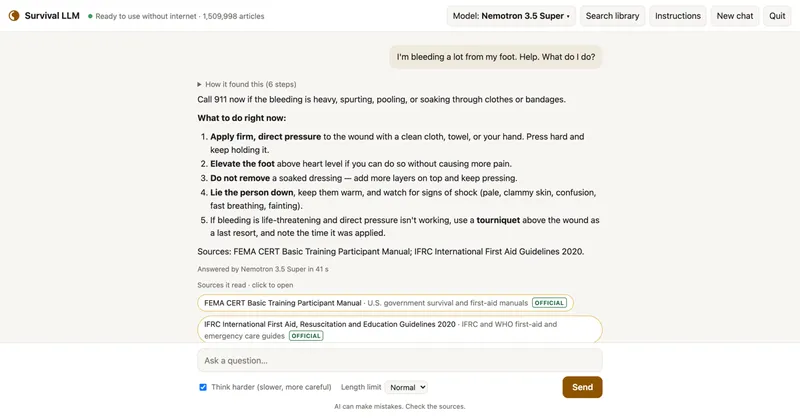
Survival LLM is a free AI assistant and survival library designed to run locally on a computer without an internet connection. It includes 1.5 million offline articles and displays the source for every answer it provides. The software is available for Mac and Windows, allowing users to access its AI assistance and stored survival information on their own devices when internet access is unavailable.
brangus.io
🔥🔥🔥🔥🔥1 min summary
10/27/2026
Story · 1 report
Hybrid Reasoning Agents: LLM agents that think in latent space, act through text
Hybrid Reasoning Agents, submitted to arXiv on October 13, 2026, combine latent reasoning with text-based interaction in a single language-model agent. The system is designed to let an agent use latent representations for internal reasoning while continuing to use text to call tools and interact with external environments. Its latent thoughts are intended to remain directly inspectable. The architecture uses a lightweight component called HybridLink to switch between text and latent modes during generation. A continuous working-memory mechanism retains hybrid context across multiple turns. The researchers also describe two post-training methods: HybridSFT, which trains a backbone model to coordinate with HybridLink during tool-integrated generation, and HybridRL, which learns when to reason in latent space and when to act through text. Across three model scales and 11 benchmarks in mathematics, science, medicine, search, and agentic reasoning, the authors report that HybridAgent improved performance by 10.4% relative to frontier LLM agents and agentic frameworks using text-based or latent methods. They also report 35.5% to 54.7% lower token use, 1.8× to 2.6× faster inference, and 2.7× to 3.7× cost savings. The authors state that the project’s code and data are available online.
arxiv.org
🔥🔥🔥🔥🔥1 min summary
10/18/2026
Story · 1 report
LLMs are making formal software verification feasible at a much larger scale
Anthropic and formal-verification company Theorem used Claude to generate machine-checkable proofs for security properties in open-source software at the RISC-V assembly level. Over several weeks, Claude patched bugs and proved that 239 OSS-Fuzz entry points across 123 libraries would not crash for any input below 64 MB, under assumptions including a single-threaded static RISC-V binary, Linux, and a fixed memory budget. The proofs cover normal exits without assertion failures or modeled memory-safety errors, rather than proving that the libraries are entirely bug-free. The effort produced roughly 180 million lines of Rocq proof code, with a typical proof about 600,000 lines for a binary containing a median 18,000 RISC-V instructions. Claude found hundreds of bugs while attempting the proofs, including out-of-bounds reads and writes requiring unusual or large inputs, a rediscovery of CVE-2026-56132 in libexpat, and a logic flaw in a file-loading restriction feature. Anthropic is publishing a subset of the proofs, relevant RISC-V and Linux semantics, and specifications that it could not prove; Theorem plans to offer the pipeline for other open-source projects. The guarantees depend on the correctness and scope of the formal specification, processor and operating-system models, and the Rocq proof checker. The current proofs do not model common deployments such as x86 or ARM systems with dynamically linked glibc, and AddressSanitizer-based fuzz targets do not capture every possible vulnerability.
anthropic.com
🔥🔥🔥🔥🔥2 min summary
10/22/2026