Latest stories
Story · 1 report
Just saw a google ad for a course that charges $49 a month to teach you how to use AI. I screnshot the ad, fed it into Gemini and Muse and heres a full course for free! Have at it!
A Reddit user says they saw a Google advertisement for an AI-use course priced at $49 per month. The user says they captured a screenshot of the advertisement and supplied it to Gemini and Muse, then shared what they describe as a complete AI course available for free through a Muse link. The post does not provide the advertised course’s name, curriculum, provider, or any details about the material generated by Gemini and Muse. The shared Muse URL is https://muse.ai/s/how-to-use-ai-xyg6dxexr5xpxh9xu/QALF6v_VqhqFcgpqMi74UmMJhc8uenJJ7UqvSQu03Ho. The Reddit discussion had 8 upvotes and no comments when the source text was recorded. No independent confirmation is provided for the Google ad, its $49 monthly price, or the completeness and quality of the free course the user says was created.
muse.ai
🔥🔥🔥🔥🔥1 min summary
10/30/2026
Story · 1 report
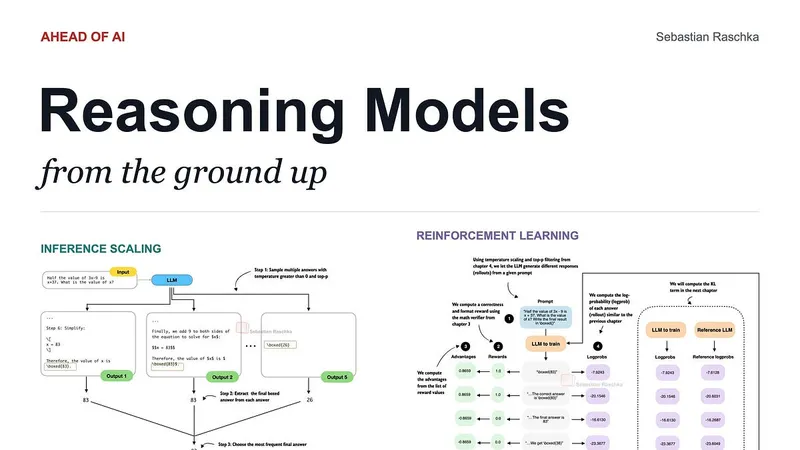
Sebastian Raschka's from-scratch video course on building reasoning models
An eight-video, 11-hour coding course teaches developers to build and improve a small reasoning model in Python and PyTorch, beginning with a pre-trained Qwen3 0.6B model. The materials cover model loading, streaming text generation, KV caching, model compilation, evaluation, inference-time scaling, reinforcement learning, and distillation. Python and PyTorch familiarity are recommended; early generation and evaluation exercises can run on a CPU, while later training experiments are more practical on a GPU. The course builds a math-answer verifier and uses the MATH-500 benchmark to evaluate models. It implements temperature scaling, multinomial sampling, top-p filtering, self-consistency voting, scoring based on token and sequence log probabilities, and self-refinement. Later lessons implement a simplified Group Relative Policy Optimization method for reinforcement learning with verifiable rewards, including response groups scored by the verifier, training metrics, clipped policy ratios, and KL-loss terms. The final lesson distills reasoning behavior from DeepSeek R1-generated answers through supervised training and compares distilled-model results on MATH-500. The videos accompany the book Build a Reasoning Model (From Scratch), and a separate 90-minute LinkedIn Learning course provides a conceptual overview of inference-time scaling, reinforcement learning, and distillation.
magazine.sebastianraschka.com
🔥🔥🔥🔥🔥1 min summary
10/26/2026

No more articles to load