HelloAssembly The smallest possible complete Windows application
PlummersSoftwareLLC’s HelloAssembly repository contains x86 assembly implementations of a minimal complete Windows application. The project targets an uncompressed executable that runs a Windows message loop; provides a title bar with functional minimize, maximize, and close controls; includes the corresponding system menu; and paints a background plus centered text at least as large as “Dave’s Tiny App.” The repository includes several variants: TinyOriginal, an optimized original implementation; Lasse, which uses shell-coding tactics; and Theron, which uses a manually written Portable Executable header. As of March 11, 2023, the listed smallest working builds were 1,104 bytes for Lasse built with MASM32, 818 bytes for Lasse built with Crinkler, 540 bytes for TinyOriginal built with Crinkler, and 383 bytes for Theron built with Yasm. Lasse can be built with MASM32 11.0, while Theron requires Yasm. Crinkler, a linker designed for executables of a few kilobytes, requires the Windows SDK; version 10.0.20348.0 produced the smallest stated results. The repository warns that aggressive size optimizations in Lasse and Crinkler may resemble malware techniques and trigger antivirus detections. The maintainers say the repository contains no malicious code, while warning they cannot verify binaries or code obtained from other sources.
github.com
4 min
8/25/2026
JIT Compiling Code in 5μs
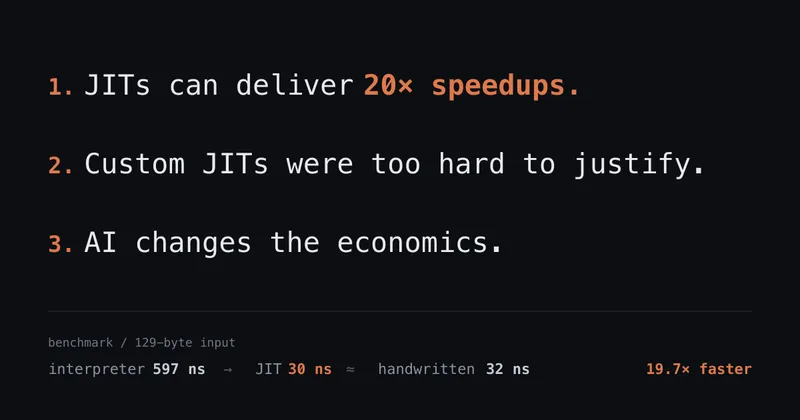
Pgrust’s JIT compiler reportedly compiles code in about 5 microseconds, allowing the PostgreSQL-compatible database project to JIT-compile every SQL query rather than only selected queries. The implementation directly generates ARM64 machine code instead of relying on LLVM or generated C/C++, options the developer says impose higher compilation overhead. A demonstration regular-expression engine supports literal strings, concatenation, and repetition, then uses copy-and-patch compilation to turn its parsed expression tree into executable code at runtime. Reusable ARM64 instruction templates, or stencils, perform character comparisons, branching, backtracking-stack operations, success checks, and failure handling. The runtime allocates executable memory with mmap, copies generated instructions into it, invalidates the instruction cache, and calls the memory as a Rust-compatible function on macOS ARM64. For the regex b(an)*, benchmark results put the JIT implementation near handwritten code and substantially ahead of an interpreter. Across inputs from 9 to 2,049 bytes, the JIT took 3.8 to 470 nanoseconds and delivered 11.7x to 19.7x speedups over the interpreter; handwritten code took 3.8 to 393 nanoseconds. The developer says AI assistance reduced the difficulty of producing and modifying assembly-level code, which historically limited adoption of custom JIT compilers.
malisper.me
12 min
8/23/2026

SectorC: A C Compiler in 512 bytes
SectorC is a C compiler written in x86-16 assembly that occupies 512 bytes in the boot sector of an x86 machine. It supports a subset of C sufficient for writing functional programs, making it potentially the smallest C compiler ever created.
xorvoid.com
10 min
2/7/2026
HelloAssembly The smallest possible complete Windows application
PlummersSoftwareLLC’s HelloAssembly repository contains x86 assembly implementations of a minimal complete Windows application. The project targets an uncompressed executable that runs a Windows message loop; provides a title bar with functional minimize, maximize, and close controls; includes the corresponding system menu; and paints a background plus centered text at least as large as “Dave’s Tiny App.” The repository includes several variants: TinyOriginal, an optimized original implementation; Lasse, which uses shell-coding tactics; and Theron, which uses a manually written Portable Executable header. As of March 11, 2023, the listed smallest working builds were 1,104 bytes for Lasse built with MASM32, 818 bytes for Lasse built with Crinkler, 540 bytes for TinyOriginal built with Crinkler, and 383 bytes for Theron built with Yasm. Lasse can be built with MASM32 11.0, while Theron requires Yasm. Crinkler, a linker designed for executables of a few kilobytes, requires the Windows SDK; version 10.0.20348.0 produced the smallest stated results. The repository warns that aggressive size optimizations in Lasse and Crinkler may resemble malware techniques and trigger antivirus detections. The maintainers say the repository contains no malicious code, while warning they cannot verify binaries or code obtained from other sources.
github.com
4 min
8/25/2026
JIT Compiling Code in 5μs
Pgrust’s JIT compiler reportedly compiles code in about 5 microseconds, allowing the PostgreSQL-compatible database project to JIT-compile every SQL query rather than only selected queries. The implementation directly generates ARM64 machine code instead of relying on LLVM or generated C/C++, options the developer says impose higher compilation overhead. A demonstration regular-expression engine supports literal strings, concatenation, and repetition, then uses copy-and-patch compilation to turn its parsed expression tree into executable code at runtime. Reusable ARM64 instruction templates, or stencils, perform character comparisons, branching, backtracking-stack operations, success checks, and failure handling. The runtime allocates executable memory with mmap, copies generated instructions into it, invalidates the instruction cache, and calls the memory as a Rust-compatible function on macOS ARM64. For the regex b(an)*, benchmark results put the JIT implementation near handwritten code and substantially ahead of an interpreter. Across inputs from 9 to 2,049 bytes, the JIT took 3.8 to 470 nanoseconds and delivered 11.7x to 19.7x speedups over the interpreter; handwritten code took 3.8 to 393 nanoseconds. The developer says AI assistance reduced the difficulty of producing and modifying assembly-level code, which historically limited adoption of custom JIT compilers.
malisper.me
12 min
8/23/2026
SectorC: A C Compiler in 512 bytes
SectorC is a C compiler written in x86-16 assembly that occupies 512 bytes in the boot sector of an x86 machine. It supports a subset of C sufficient for writing functional programs, making it potentially the smallest C compiler ever created.
xorvoid.com
10 min
2/7/2026
HelloAssembly The smallest possible complete Windows application
PlummersSoftwareLLC’s HelloAssembly repository contains x86 assembly implementations of a minimal complete Windows application. The project targets an uncompressed executable that runs a Windows message loop; provides a title bar with functional minimize, maximize, and close controls; includes the corresponding system menu; and paints a background plus centered text at least as large as “Dave’s Tiny App.” The repository includes several variants: TinyOriginal, an optimized original implementation; Lasse, which uses shell-coding tactics; and Theron, which uses a manually written Portable Executable header. As of March 11, 2023, the listed smallest working builds were 1,104 bytes for Lasse built with MASM32, 818 bytes for Lasse built with Crinkler, 540 bytes for TinyOriginal built with Crinkler, and 383 bytes for Theron built with Yasm. Lasse can be built with MASM32 11.0, while Theron requires Yasm. Crinkler, a linker designed for executables of a few kilobytes, requires the Windows SDK; version 10.0.20348.0 produced the smallest stated results. The repository warns that aggressive size optimizations in Lasse and Crinkler may resemble malware techniques and trigger antivirus detections. The maintainers say the repository contains no malicious code, while warning they cannot verify binaries or code obtained from other sources.
github.com
4 min
8/25/2026
SectorC: A C Compiler in 512 bytes
SectorC is a C compiler written in x86-16 assembly that occupies 512 bytes in the boot sector of an x86 machine. It supports a subset of C sufficient for writing functional programs, making it potentially the smallest C compiler ever created.
xorvoid.com
10 min
2/7/2026
JIT Compiling Code in 5μs
Pgrust’s JIT compiler reportedly compiles code in about 5 microseconds, allowing the PostgreSQL-compatible database project to JIT-compile every SQL query rather than only selected queries. The implementation directly generates ARM64 machine code instead of relying on LLVM or generated C/C++, options the developer says impose higher compilation overhead. A demonstration regular-expression engine supports literal strings, concatenation, and repetition, then uses copy-and-patch compilation to turn its parsed expression tree into executable code at runtime. Reusable ARM64 instruction templates, or stencils, perform character comparisons, branching, backtracking-stack operations, success checks, and failure handling. The runtime allocates executable memory with mmap, copies generated instructions into it, invalidates the instruction cache, and calls the memory as a Rust-compatible function on macOS ARM64. For the regex b(an)*, benchmark results put the JIT implementation near handwritten code and substantially ahead of an interpreter. Across inputs from 9 to 2,049 bytes, the JIT took 3.8 to 470 nanoseconds and delivered 11.7x to 19.7x speedups over the interpreter; handwritten code took 3.8 to 393 nanoseconds. The developer says AI assistance reduced the difficulty of producing and modifying assembly-level code, which historically limited adoption of custom JIT compilers.
malisper.me
12 min
8/23/2026
No more articles to load