DeepSeek-v4-flash-vision-exp
DeepSeek’s experimental deepseek-v4-flash-vision-exp model accepts image and text inputs for tasks including image description, screenshot text reading, and chart analysis. It supports JPEG, PNG, GIF, and WebP files, detecting formats from file contents rather than filenames or declared MIME types. Developers can provide images as inline base64 data URLs, public HTTP(S) URLs, or Files API uploads referenced by file_id. The model is available through OpenAI-compatible Chat Completions and Responses APIs, as well as DeepSeek’s Anthropic-compatible Messages endpoint. Inline image data counts toward a 48 MiB request-body limit. External image URLs may contain up to 8,192 characters, must download within 60 seconds, and are limited to 32 MiB per image. Files API references support images up to 64 MiB and allow uploaded images to be reused. Requests can contain up to 600 images, with total image limits of 64 MiB without file_id images and up to 200 MiB when file_id images are included. DeepSeek resizes images before inference and caps usage at 384 image tokens each. Images below about 384×384 pixels are enlarged, while larger images are reduced to roughly 800×800 pixels. A low-detail option downsizes image_url inputs to 512×512 for faster, cheaper processing. Images are accepted only in user messages for Chat Completions, and only the vision model supports them.
api-docs.deepseek.com
6 min
8/21/2026

Seeing beyond BMI: Estimating cardiometabolic risk with smartphone imagery
Google Research introduced PhotoScan, an investigational deep-learning system that estimates body-fat percentage, Android-to-Gynoid fat ratio and Visceral-to-Subcutaneous fat ratio from standard 2D smartphone photos. The system was pre-trained on more than 35,000 UK Biobank participant records and fine-tuned using a cohort of 677 adults. It is intended to estimate body-composition markers associated with insulin resistance, which is commonly defined by a HOMA-IR score above 2.9 and can precede type 2 diabetes by years. In five-fold cross-validation on the PhotoBIA cohort, PhotoScan produced a mean absolute error of 2.15 for body-fat percentage, compared with 2.91 for smartwatch bioelectrical-impedance analysis. Independent validation in the MetabolicMosaic cohort produced errors of 2.13 for body-fat percentage, 0.085 for the Android-to-Gynoid ratio and 0.085 for the Visceral-to-Subcutaneous ratio. A gradient-boosting model using demographics plus PhotoScan metrics reached an AUROC of 0.760 for identifying insulin resistance, versus 0.692 for demographics alone and 0.773 for demographics plus DXA scan data. Adding smartwatch bioelectrical-impedance data did not improve insulin-resistance classification. Google describes PhotoScan as a research prototype rather than a clinical screening product.
research.google
6 min
8/20/2026
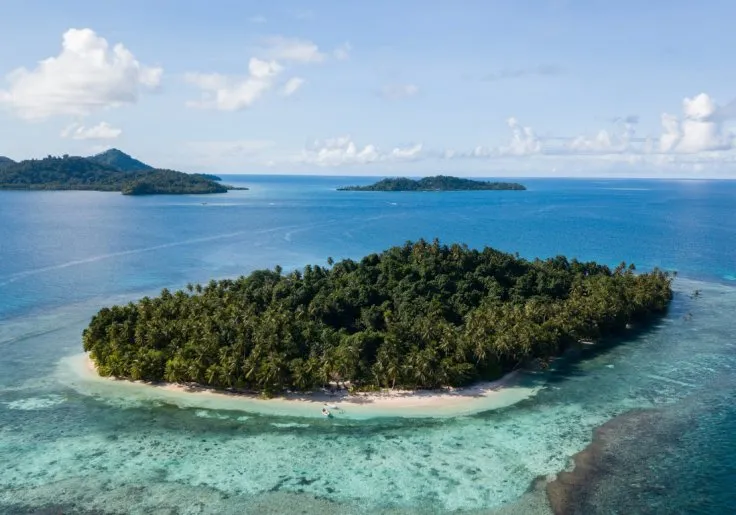
Geolocating a random island using geometry and CUDA programming
A geometry- and GPU-based geolocation process identified Oan resort on an islet in the Federated States of Micronesia as the location in Gralhix OSINT Exercise #004. The islet’s coordinates are 7.363444° N, 151.755750° E, and the camera was determined to face northwest, at a bearing of about 324.97°. The process found no useful EXIF or GPS data in the 736-by-515 WEBP image. It modeled three visible landmasses as a triangle, then searched OpenStreetMap’s 882 MB global land-polygon dataset for matching island configurations. Tropical-latitude, local-density, clustering, geometric, open-water, coral-cay-shape, vegetation, and elevation filters reduced more than 80.69 million candidate island triplets to 26. An NVIDIA GeForce RTX 3050 evaluated the initial 80.7 million triples in 204.1 milliseconds using one CUDA thread per triple, producing 158,784 initial matches. Further checks used Sentinel-2 imagery from Element84’s Earth Search catalog to require a normalized difference vegetation index above 0.6, and Copernicus GLO-30 elevation data to require a low resort islet and nearby terrain between 100 and 500 meters high. Manual satellite-map inspection of the final candidates selected the Micronesian location.
yassa9.github.io
10 min
8/19/2026
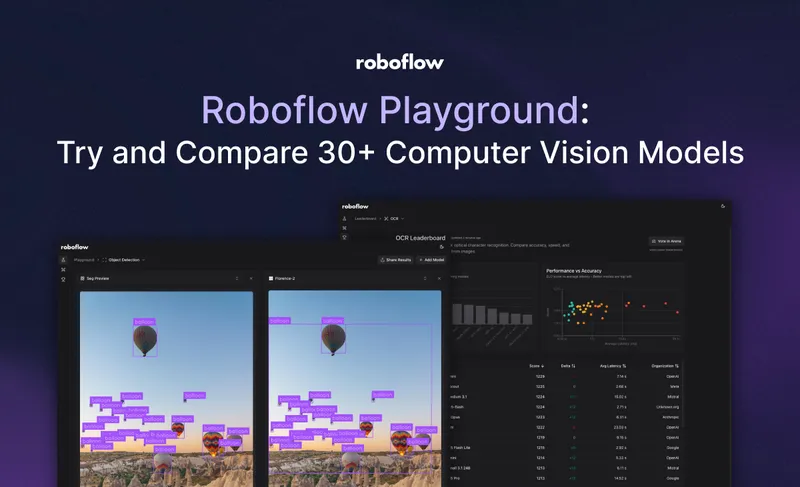
Roboflow Playground: Try and Compare 30 Computer Vision Models
Roboflow launched Roboflow Playground on September 30, 2025, a browser-based tool for testing and comparing more than 30 computer-vision models. Users can submit the same image and prompt to as many as five compatible zero-shot models simultaneously, including models from Anthropic, OpenAI, Meta, Google, Mistral, and open-weight providers such as Florence-2, Qwen3.8 27B, Muse Glimmer 30B, and Llama-series releases. Playground supports object detection, image classification, optical character recognition, captioning, and open-prompt visual question answering. Available models vary by task: Gemini 3.6 Flash and SAM 3 can be selected for object detection, while SAM 3 cannot be used for visual question answering. The service lets users upload images, enter prompts, and inspect output side by side without separately provisioning cloud APIs or infrastructure for open-weight models. For object detection, Playground draws bounding boxes returned by each model. In a Roboflow example using prompts for a book and coffee, Florence-2 and YOLO World identified both objects with accurate boxes, while Claude 3.5 Sonnet located them generally but did not produce precise boxes. In an open-prompt example, Claude 4 Sonnet and GPT-4.1 identified a coffee cup on a table and described the surrounding scene. Roboflow says Playground is available free to try and that it plans to add models as they become available.
blog.roboflow.com
4 min
8/17/2026

GPT 5.6 Sol is the best "vision" model OpenAI ever released
OpenAI's GPT-5.6 lineup includes the Sol, Terra, and Luna models, with a focus on enhanced computer use and the ability to navigate desktop applications. The models demonstrate improved visual understanding, which will be evaluated using an upcoming visual language model benchmark.
blog.roboflow.com
6 min
8/17/2026
&w=600&h=300&scale=both)
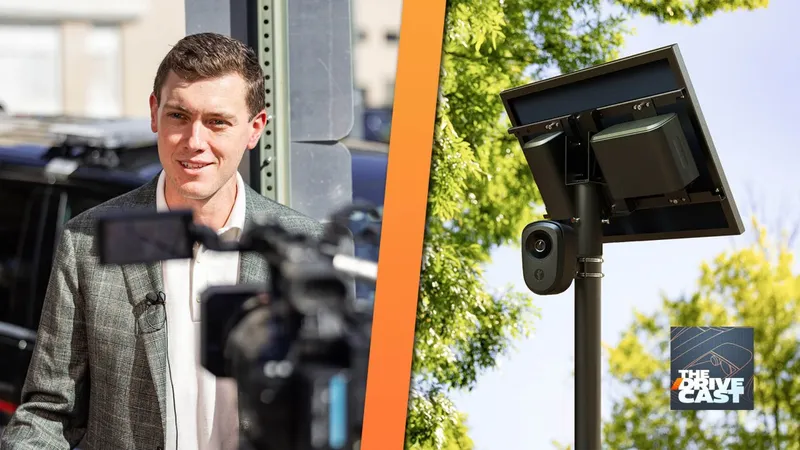
Flock's CEO Faced Me After Its Cameras Led to My Wrongful Stop
Flock cameras utilize AI technology to track vehicles, which can lead to wrongful stops due to human error. Flock Safety CEO Garrett Langley discussed the implications of these incidents and aims to eliminate wrongful stops in the future.
thedrive.com
34 min
8/3/2026
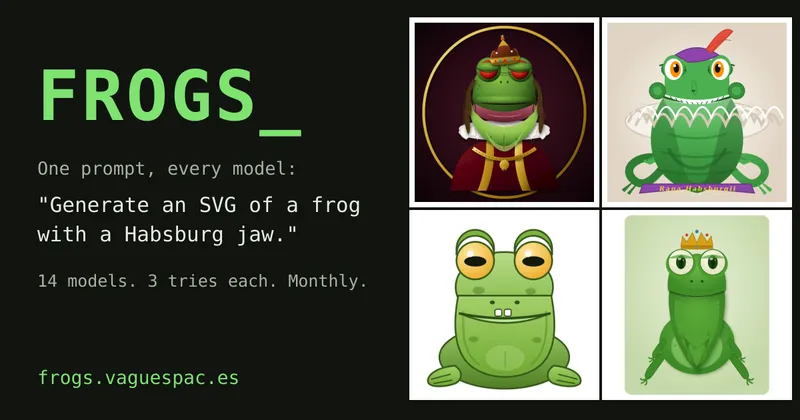
My personal AI benchmark: "Generate an SVG of a frog with a Habsburg jaw."
FROGS_ is a benchmark for SVG (Scalable Vector Graphics) focusing on the Habsburg jaw, featuring structural labels and editorial interpretations of anatomical features such as a "massive protruding mandible" and a "recessed" upper lip. The SVG includes a linear gradient definition for skin tones.
frogs.vaguespac.es
1 min
8/2/2026
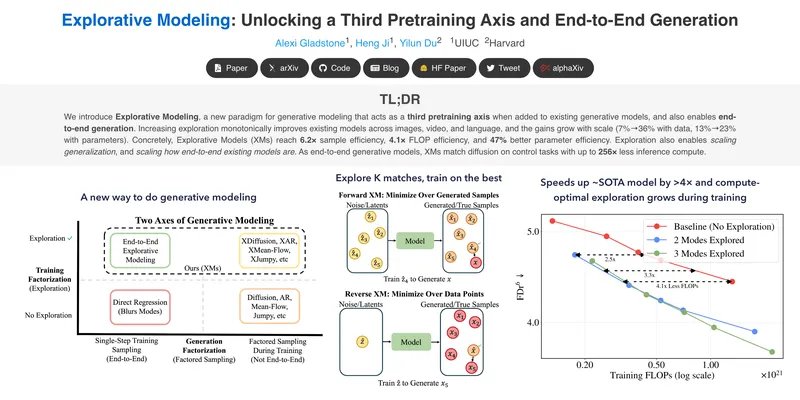
Explorative modeling: Train on the best of K guesses
Explorative Modeling introduces a third pretraining axis for generative models, enhancing end-to-end generation capabilities. Increased exploration leads to improved performance across images, video, and language, with benefits scaling alongside model size.
alexiglad.github.io
17 min
8/1/2026
DeepSeek-v4-flash-vision-exp
DeepSeek’s experimental deepseek-v4-flash-vision-exp model accepts image and text inputs for tasks including image description, screenshot text reading, and chart analysis. It supports JPEG, PNG, GIF, and WebP files, detecting formats from file contents rather than filenames or declared MIME types. Developers can provide images as inline base64 data URLs, public HTTP(S) URLs, or Files API uploads referenced by file_id. The model is available through OpenAI-compatible Chat Completions and Responses APIs, as well as DeepSeek’s Anthropic-compatible Messages endpoint. Inline image data counts toward a 48 MiB request-body limit. External image URLs may contain up to 8,192 characters, must download within 60 seconds, and are limited to 32 MiB per image. Files API references support images up to 64 MiB and allow uploaded images to be reused. Requests can contain up to 600 images, with total image limits of 64 MiB without file_id images and up to 200 MiB when file_id images are included. DeepSeek resizes images before inference and caps usage at 384 image tokens each. Images below about 384×384 pixels are enlarged, while larger images are reduced to roughly 800×800 pixels. A low-detail option downsizes image_url inputs to 512×512 for faster, cheaper processing. Images are accepted only in user messages for Chat Completions, and only the vision model supports them.
api-docs.deepseek.com
6 min
8/21/2026
Geolocating a random island using geometry and CUDA programming
A geometry- and GPU-based geolocation process identified Oan resort on an islet in the Federated States of Micronesia as the location in Gralhix OSINT Exercise #004. The islet’s coordinates are 7.363444° N, 151.755750° E, and the camera was determined to face northwest, at a bearing of about 324.97°. The process found no useful EXIF or GPS data in the 736-by-515 WEBP image. It modeled three visible landmasses as a triangle, then searched OpenStreetMap’s 882 MB global land-polygon dataset for matching island configurations. Tropical-latitude, local-density, clustering, geometric, open-water, coral-cay-shape, vegetation, and elevation filters reduced more than 80.69 million candidate island triplets to 26. An NVIDIA GeForce RTX 3050 evaluated the initial 80.7 million triples in 204.1 milliseconds using one CUDA thread per triple, producing 158,784 initial matches. Further checks used Sentinel-2 imagery from Element84’s Earth Search catalog to require a normalized difference vegetation index above 0.6, and Copernicus GLO-30 elevation data to require a low resort islet and nearby terrain between 100 and 500 meters high. Manual satellite-map inspection of the final candidates selected the Micronesian location.
yassa9.github.io
10 min
8/19/2026
GPT 5.6 Sol is the best "vision" model OpenAI ever released
OpenAI's GPT-5.6 lineup includes the Sol, Terra, and Luna models, with a focus on enhanced computer use and the ability to navigate desktop applications. The models demonstrate improved visual understanding, which will be evaluated using an upcoming visual language model benchmark.
blog.roboflow.com
6 min
8/17/2026
London Underground begins scanning passengers' faces
BTP has expanded its Live Facial Recognition (LFR) trial to include London Underground stations. The initiative aims to enhance public safety and assist in identifying suspects in real-time.
btp.police.uk
3 min
8/11/2026
My personal AI benchmark: "Generate an SVG of a frog with a Habsburg jaw."
FROGS_ is a benchmark for SVG (Scalable Vector Graphics) focusing on the Habsburg jaw, featuring structural labels and editorial interpretations of anatomical features such as a "massive protruding mandible" and a "recessed" upper lip. The SVG includes a linear gradient definition for skin tones.
frogs.vaguespac.es
1 min
8/2/2026
Seeing beyond BMI: Estimating cardiometabolic risk with smartphone imagery
Google Research introduced PhotoScan, an investigational deep-learning system that estimates body-fat percentage, Android-to-Gynoid fat ratio and Visceral-to-Subcutaneous fat ratio from standard 2D smartphone photos. The system was pre-trained on more than 35,000 UK Biobank participant records and fine-tuned using a cohort of 677 adults. It is intended to estimate body-composition markers associated with insulin resistance, which is commonly defined by a HOMA-IR score above 2.9 and can precede type 2 diabetes by years. In five-fold cross-validation on the PhotoBIA cohort, PhotoScan produced a mean absolute error of 2.15 for body-fat percentage, compared with 2.91 for smartwatch bioelectrical-impedance analysis. Independent validation in the MetabolicMosaic cohort produced errors of 2.13 for body-fat percentage, 0.085 for the Android-to-Gynoid ratio and 0.085 for the Visceral-to-Subcutaneous ratio. A gradient-boosting model using demographics plus PhotoScan metrics reached an AUROC of 0.760 for identifying insulin resistance, versus 0.692 for demographics alone and 0.773 for demographics plus DXA scan data. Adding smartwatch bioelectrical-impedance data did not improve insulin-resistance classification. Google describes PhotoScan as a research prototype rather than a clinical screening product.
research.google
6 min
8/20/2026
Roboflow Playground: Try and Compare 30 Computer Vision Models
Roboflow launched Roboflow Playground on September 30, 2025, a browser-based tool for testing and comparing more than 30 computer-vision models. Users can submit the same image and prompt to as many as five compatible zero-shot models simultaneously, including models from Anthropic, OpenAI, Meta, Google, Mistral, and open-weight providers such as Florence-2, Qwen3.8 27B, Muse Glimmer 30B, and Llama-series releases. Playground supports object detection, image classification, optical character recognition, captioning, and open-prompt visual question answering. Available models vary by task: Gemini 3.6 Flash and SAM 3 can be selected for object detection, while SAM 3 cannot be used for visual question answering. The service lets users upload images, enter prompts, and inspect output side by side without separately provisioning cloud APIs or infrastructure for open-weight models. For object detection, Playground draws bounding boxes returned by each model. In a Roboflow example using prompts for a book and coffee, Florence-2 and YOLO World identified both objects with accurate boxes, while Claude 3.5 Sonnet located them generally but did not produce precise boxes. In an open-prompt example, Claude 4 Sonnet and GPT-4.1 identified a coffee cup on a table and described the surrounding scene. Roboflow says Playground is available free to try and that it plans to add models as they become available.
blog.roboflow.com
4 min
8/17/2026
Mistral OCR 4.1
OCR 4.1 is a new OCR service from Mistral AI that includes native paragraph-level bounding box extraction, structural block labels, and block-level confidence scores. Pricing is set at €3.5 per 1000 pages and €4.38 per 1000 annotated pages.
docs.mistral.ai
1 min
8/13/2026
Flock's CEO Faced Me After Its Cameras Led to My Wrongful Stop
Flock cameras utilize AI technology to track vehicles, which can lead to wrongful stops due to human error. Flock Safety CEO Garrett Langley discussed the implications of these incidents and aims to eliminate wrongful stops in the future.
thedrive.com
34 min
8/3/2026
Explorative modeling: Train on the best of K guesses
Explorative Modeling introduces a third pretraining axis for generative models, enhancing end-to-end generation capabilities. Increased exploration leads to improved performance across images, video, and language, with benefits scaling alongside model size.
alexiglad.github.io
17 min
8/1/2026
DeepSeek-v4-flash-vision-exp
DeepSeek’s experimental deepseek-v4-flash-vision-exp model accepts image and text inputs for tasks including image description, screenshot text reading, and chart analysis. It supports JPEG, PNG, GIF, and WebP files, detecting formats from file contents rather than filenames or declared MIME types. Developers can provide images as inline base64 data URLs, public HTTP(S) URLs, or Files API uploads referenced by file_id. The model is available through OpenAI-compatible Chat Completions and Responses APIs, as well as DeepSeek’s Anthropic-compatible Messages endpoint. Inline image data counts toward a 48 MiB request-body limit. External image URLs may contain up to 8,192 characters, must download within 60 seconds, and are limited to 32 MiB per image. Files API references support images up to 64 MiB and allow uploaded images to be reused. Requests can contain up to 600 images, with total image limits of 64 MiB without file_id images and up to 200 MiB when file_id images are included. DeepSeek resizes images before inference and caps usage at 384 image tokens each. Images below about 384×384 pixels are enlarged, while larger images are reduced to roughly 800×800 pixels. A low-detail option downsizes image_url inputs to 512×512 for faster, cheaper processing. Images are accepted only in user messages for Chat Completions, and only the vision model supports them.
api-docs.deepseek.com
6 min
8/21/2026
Roboflow Playground: Try and Compare 30 Computer Vision Models
Roboflow launched Roboflow Playground on September 30, 2025, a browser-based tool for testing and comparing more than 30 computer-vision models. Users can submit the same image and prompt to as many as five compatible zero-shot models simultaneously, including models from Anthropic, OpenAI, Meta, Google, Mistral, and open-weight providers such as Florence-2, Qwen3.8 27B, Muse Glimmer 30B, and Llama-series releases. Playground supports object detection, image classification, optical character recognition, captioning, and open-prompt visual question answering. Available models vary by task: Gemini 3.6 Flash and SAM 3 can be selected for object detection, while SAM 3 cannot be used for visual question answering. The service lets users upload images, enter prompts, and inspect output side by side without separately provisioning cloud APIs or infrastructure for open-weight models. For object detection, Playground draws bounding boxes returned by each model. In a Roboflow example using prompts for a book and coffee, Florence-2 and YOLO World identified both objects with accurate boxes, while Claude 3.5 Sonnet located them generally but did not produce precise boxes. In an open-prompt example, Claude 4 Sonnet and GPT-4.1 identified a coffee cup on a table and described the surrounding scene. Roboflow says Playground is available free to try and that it plans to add models as they become available.
blog.roboflow.com
4 min
8/17/2026
London Underground begins scanning passengers' faces
BTP has expanded its Live Facial Recognition (LFR) trial to include London Underground stations. The initiative aims to enhance public safety and assist in identifying suspects in real-time.
btp.police.uk
3 min
8/11/2026
Explorative modeling: Train on the best of K guesses
Explorative Modeling introduces a third pretraining axis for generative models, enhancing end-to-end generation capabilities. Increased exploration leads to improved performance across images, video, and language, with benefits scaling alongside model size.
alexiglad.github.io
17 min
8/1/2026
Seeing beyond BMI: Estimating cardiometabolic risk with smartphone imagery
Google Research introduced PhotoScan, an investigational deep-learning system that estimates body-fat percentage, Android-to-Gynoid fat ratio and Visceral-to-Subcutaneous fat ratio from standard 2D smartphone photos. The system was pre-trained on more than 35,000 UK Biobank participant records and fine-tuned using a cohort of 677 adults. It is intended to estimate body-composition markers associated with insulin resistance, which is commonly defined by a HOMA-IR score above 2.9 and can precede type 2 diabetes by years. In five-fold cross-validation on the PhotoBIA cohort, PhotoScan produced a mean absolute error of 2.15 for body-fat percentage, compared with 2.91 for smartwatch bioelectrical-impedance analysis. Independent validation in the MetabolicMosaic cohort produced errors of 2.13 for body-fat percentage, 0.085 for the Android-to-Gynoid ratio and 0.085 for the Visceral-to-Subcutaneous ratio. A gradient-boosting model using demographics plus PhotoScan metrics reached an AUROC of 0.760 for identifying insulin resistance, versus 0.692 for demographics alone and 0.773 for demographics plus DXA scan data. Adding smartwatch bioelectrical-impedance data did not improve insulin-resistance classification. Google describes PhotoScan as a research prototype rather than a clinical screening product.
research.google
6 min
8/20/2026
GPT 5.6 Sol is the best "vision" model OpenAI ever released
OpenAI's GPT-5.6 lineup includes the Sol, Terra, and Luna models, with a focus on enhanced computer use and the ability to navigate desktop applications. The models demonstrate improved visual understanding, which will be evaluated using an upcoming visual language model benchmark.
blog.roboflow.com
6 min
8/17/2026
Flock's CEO Faced Me After Its Cameras Led to My Wrongful Stop
Flock cameras utilize AI technology to track vehicles, which can lead to wrongful stops due to human error. Flock Safety CEO Garrett Langley discussed the implications of these incidents and aims to eliminate wrongful stops in the future.
thedrive.com
34 min
8/3/2026
Geolocating a random island using geometry and CUDA programming
A geometry- and GPU-based geolocation process identified Oan resort on an islet in the Federated States of Micronesia as the location in Gralhix OSINT Exercise #004. The islet’s coordinates are 7.363444° N, 151.755750° E, and the camera was determined to face northwest, at a bearing of about 324.97°. The process found no useful EXIF or GPS data in the 736-by-515 WEBP image. It modeled three visible landmasses as a triangle, then searched OpenStreetMap’s 882 MB global land-polygon dataset for matching island configurations. Tropical-latitude, local-density, clustering, geometric, open-water, coral-cay-shape, vegetation, and elevation filters reduced more than 80.69 million candidate island triplets to 26. An NVIDIA GeForce RTX 3050 evaluated the initial 80.7 million triples in 204.1 milliseconds using one CUDA thread per triple, producing 158,784 initial matches. Further checks used Sentinel-2 imagery from Element84’s Earth Search catalog to require a normalized difference vegetation index above 0.6, and Copernicus GLO-30 elevation data to require a low resort islet and nearby terrain between 100 and 500 meters high. Manual satellite-map inspection of the final candidates selected the Micronesian location.
yassa9.github.io
10 min
8/19/2026
Mistral OCR 4.1
OCR 4.1 is a new OCR service from Mistral AI that includes native paragraph-level bounding box extraction, structural block labels, and block-level confidence scores. Pricing is set at €3.5 per 1000 pages and €4.38 per 1000 annotated pages.
docs.mistral.ai
1 min
8/13/2026
My personal AI benchmark: "Generate an SVG of a frog with a Habsburg jaw."
FROGS_ is a benchmark for SVG (Scalable Vector Graphics) focusing on the Habsburg jaw, featuring structural labels and editorial interpretations of anatomical features such as a "massive protruding mandible" and a "recessed" upper lip. The SVG includes a linear gradient definition for skin tones.
frogs.vaguespac.es
1 min
8/2/2026