How we made a text-to-speech model respond in sub-50 ms
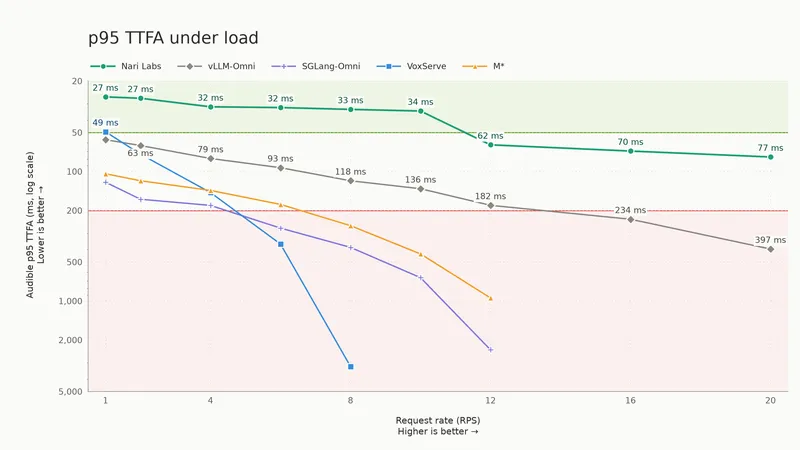
Nari Labs open-sourced a Qwen3-TTS CustomVoice 1.7B serving implementation that it says delivers 10 requests per second on one NVIDIA H100 SXM while keeping p95 time to first audible audio below 50 milliseconds and sustaining real-time playback. The system produces about 630 characters per second at 10 RPS; using a $4.29-per-hour H100 price, Nari estimates a compute cost of roughly $2 per million characters, excluding networking, idle capacity, and operational overhead. The benchmark used five-minute Poisson open-loop workloads, complete-text HTTP requests, streamed PCM audio, audible-onset detection, playback reconstruction, and Deepgram speech-to-text evaluation. Nari reports that its implementation maintains sub-50 ms p95 audible latency through 10 RPS and remains below 100 ms at 20 RPS. After tuning for silence trimming and audio-frame accumulation, VoxServe reached 49.3 ms p95 time to first audio at 1 RPS but rose to 363.2 ms at 6 RPS; vLLM-Omni measured 56.815 ms and 93.451 ms, respectively. The implementation schedules Qwen3-TTS’s Talker, Code Predictor, and Codec as separate jobs under one scheduler. It prioritizes first audio before playback begins, then schedules established streams around audio-buffer deadlines. Additional optimizations include CUDA graphs for the Code Predictor, specialized Triton attention, state-cached incremental Codec decoding, variable chunk sizes, and optional input streaming from an upstream language model.
nari-labs.com
8 min
8/21/2026
How we made a text-to-speech model respond in sub-50 ms
Nari Labs open-sourced a Qwen3-TTS CustomVoice 1.7B serving implementation that it says delivers 10 requests per second on one NVIDIA H100 SXM while keeping p95 time to first audible audio below 50 milliseconds and sustaining real-time playback. The system produces about 630 characters per second at 10 RPS; using a $4.29-per-hour H100 price, Nari estimates a compute cost of roughly $2 per million characters, excluding networking, idle capacity, and operational overhead. The benchmark used five-minute Poisson open-loop workloads, complete-text HTTP requests, streamed PCM audio, audible-onset detection, playback reconstruction, and Deepgram speech-to-text evaluation. Nari reports that its implementation maintains sub-50 ms p95 audible latency through 10 RPS and remains below 100 ms at 20 RPS. After tuning for silence trimming and audio-frame accumulation, VoxServe reached 49.3 ms p95 time to first audio at 1 RPS but rose to 363.2 ms at 6 RPS; vLLM-Omni measured 56.815 ms and 93.451 ms, respectively. The implementation schedules Qwen3-TTS’s Talker, Code Predictor, and Codec as separate jobs under one scheduler. It prioritizes first audio before playback begins, then schedules established streams around audio-buffer deadlines. Additional optimizations include CUDA graphs for the Code Predictor, specialized Triton attention, state-cached incremental Codec decoding, variable chunk sizes, and optional input streaming from an upstream language model.
nari-labs.com
8 min
8/21/2026
How we made a text-to-speech model respond in sub-50 ms
Nari Labs open-sourced a Qwen3-TTS CustomVoice 1.7B serving implementation that it says delivers 10 requests per second on one NVIDIA H100 SXM while keeping p95 time to first audible audio below 50 milliseconds and sustaining real-time playback. The system produces about 630 characters per second at 10 RPS; using a $4.29-per-hour H100 price, Nari estimates a compute cost of roughly $2 per million characters, excluding networking, idle capacity, and operational overhead. The benchmark used five-minute Poisson open-loop workloads, complete-text HTTP requests, streamed PCM audio, audible-onset detection, playback reconstruction, and Deepgram speech-to-text evaluation. Nari reports that its implementation maintains sub-50 ms p95 audible latency through 10 RPS and remains below 100 ms at 20 RPS. After tuning for silence trimming and audio-frame accumulation, VoxServe reached 49.3 ms p95 time to first audio at 1 RPS but rose to 363.2 ms at 6 RPS; vLLM-Omni measured 56.815 ms and 93.451 ms, respectively. The implementation schedules Qwen3-TTS’s Talker, Code Predictor, and Codec as separate jobs under one scheduler. It prioritizes first audio before playback begins, then schedules established streams around audio-buffer deadlines. Additional optimizations include CUDA graphs for the Code Predictor, specialized Triton attention, state-cached incremental Codec decoding, variable chunk sizes, and optional input streaming from an upstream language model.
nari-labs.com
8 min
8/21/2026
No more articles to load