Latest stories
Story · 1 report
A Working Nintendo in ~1GB of Qwen Weights
Nesformer compiles an NES 6502 CPU, 2 KB of work RAM and up to 32 KB of cartridge program ROM into the weights and Gated DeltaNet state of a Qwen3_5ForCausalLM checkpoint. Rather than training the model, a compiler calculates its weights so that greedy token generation produces the CPU execution trace one token at a time. A host program supplies controller input, renders graphics, handles vblank timing and injects NMI interrupts, while the model holds CPU registers, RAM and cartridge data. The 466.6 million-parameter bf16 checkpoint occupies 933 MB uncompressed but compresses to 3.3 MB because only 9.3 million parameters are nonzero. It uses seven Gated DeltaNet layers, with each head’s 128-by-128 state matrix serving as addressable memory. The same weights can run NROM, or iNES mapper 0, games including Super Mario Bros., Donkey Kong and Excitebike when users provide ROM files. Nesformer reports that its bundled test runs produced CPU traces and rendered frames matching a conventional 6502 emulator, including a 600-frame Thwaite run and a 420-frame Full Game run. Its numba-based engine runs at roughly 1,650 tokens per second on one CPU core, while an NES would require about 700,000 tokens per second; idle-loop skipping leaves reported frames and I/O writes unchanged. Limitations include no mapper support, unofficial opcodes, IRQs, PRG-RAM, sound or full PPU accuracy.
github.com
🔥🔥🔥🔥🔥2 min summary
10/30/2026
Story · 1 report
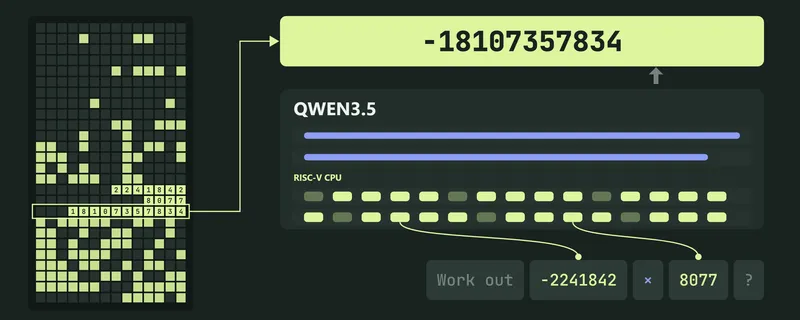
Qwenputer: A functioning, deterministic RISC-V CPU inside Qwen3.5
Qwenputer is an experimental version of Qwen 3.5 4B that embeds a deterministic 32-bit RISC-V CPU in added model weights. The CPU executes during model forward passes, using Qwen’s Gated DeltaNet recurrent-attention state as addressable RAM rather than calling an external tool, sandbox, or runtime. A compiler maps circuit operations onto attention heads, feed-forward units, and DeltaNet memory; generated ADDR, VAL, and STEP tokens form the execution trace. The added core implements RV32IM, the Zba extension, and a small big-number unit across 11 layers added ahead of Qwen’s original 32 layers. Creator Divyansh Agrawal reports that Qwenputer passes official riscv-tests, matches QEMU program results, and completed 18 million free-running instructions without an error. On reported arithmetic benchmarks, it scored 97.5% to 100%, versus 48.6% to 90% for base Qwen on most listed tests; replaying about 230,000 output positions against a reference machine found zero mismatches. An experimental in-model filesystem stores up to 512 files or roughly 53,000 text tokens in DeltaNet state. The 18.8 GB checkpoint can run on one 24 GB GPU, but requires the RvChat driver and runs calculations in seconds because each CPU instruction consumes several decoded tokens.
divagr.com
🔥🔥🔥🔥🔥1 min summary
10/29/2026
No more articles to load