Hot Chips 2026: CUDA Targets RISC-V – By Chester Lam
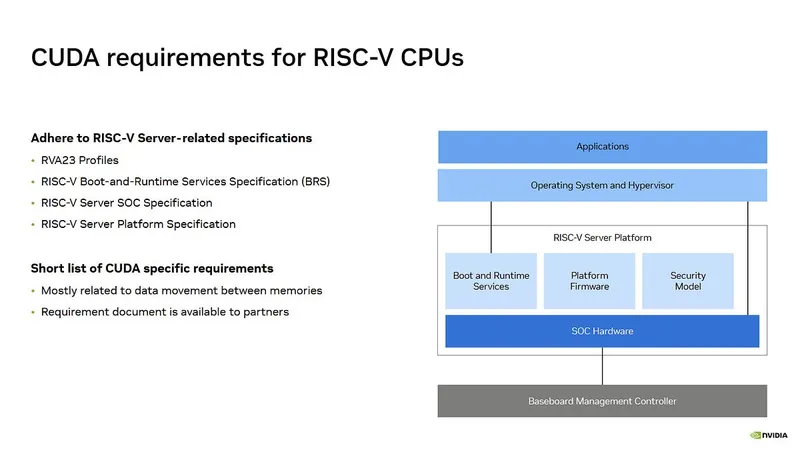
Nvidia is extending CUDA support toward RISC-V CPUs, potentially allowing server-class RISC-V systems to host Nvidia GPU compute workloads. CUDA currently supports x86-64 and AArch64 CPUs. Nvidia requires RISC-V systems to use the RVA23 profile and comply with RISC-V server SoC and platform specifications, which cover baseline reliability, availability, serviceability and security features. Nvidia also requires hardware features beyond those specifications, including vector extensions, PCIe cache coherency and peer-to-peer PCIe communication between devices. PCIe coherency prevents GPU DMA transfers from missing modified CPU-cache data or leaving CPUs with stale cached data after GPU writes. Without it, CUDA software would need explicit cache invalidation handling. Peer-to-peer PCIe support allows device-to-device buffer transfers without routing data through CPU memory. ACPI support was another initial obstacle, but the UEFI Forum added RISC-V ACPI support in 2025, and the ratified RISC-V Boot and Runtime Services specification includes ACPI. Nvidia said it is partnering with SiFive, which plans to demonstrate a CUDA-capable system at Hot Chips; the cited example specifications indicate a high-core-count server processor. Nvidia also described NVLink Fusion, which lets partners integrate Nvidia NVLink IP with custom CPUs or accelerators, including potential RISC-V designs, subject to CUDA requirements and support for frameworks such as DOCA and NCCL.
chipsandcheese.com
5 min
8/24/2026

Hot Chips 2026: CUDA Targets RISC-V – By Chester Lam
Nvidia is extending CUDA support toward RISC-V CPUs, potentially allowing server-class RISC-V systems to host Nvidia GPU compute workloads. CUDA currently supports x86-64 and AArch64 CPUs. Nvidia requires RISC-V systems to use the RVA23 profile and comply with RISC-V server SoC and platform specifications, which cover baseline reliability, availability, serviceability and security features. Nvidia also requires hardware features beyond those specifications, including vector extensions, PCIe cache coherency and peer-to-peer PCIe communication between devices. PCIe coherency prevents GPU DMA transfers from missing modified CPU-cache data or leaving CPUs with stale cached data after GPU writes. Without it, CUDA software would need explicit cache invalidation handling. Peer-to-peer PCIe support allows device-to-device buffer transfers without routing data through CPU memory. ACPI support was another initial obstacle, but the UEFI Forum added RISC-V ACPI support in 2025, and the ratified RISC-V Boot and Runtime Services specification includes ACPI. Nvidia said it is partnering with SiFive, which plans to demonstrate a CUDA-capable system at Hot Chips; the cited example specifications indicate a high-core-count server processor. Nvidia also described NVLink Fusion, which lets partners integrate Nvidia NVLink IP with custom CPUs or accelerators, including potential RISC-V designs, subject to CUDA requirements and support for frameworks such as DOCA and NCCL.
chipsandcheese.com
5 min
8/24/2026
Hot Chips 2026: CUDA Targets RISC-V – By Chester Lam
Nvidia is extending CUDA support toward RISC-V CPUs, potentially allowing server-class RISC-V systems to host Nvidia GPU compute workloads. CUDA currently supports x86-64 and AArch64 CPUs. Nvidia requires RISC-V systems to use the RVA23 profile and comply with RISC-V server SoC and platform specifications, which cover baseline reliability, availability, serviceability and security features. Nvidia also requires hardware features beyond those specifications, including vector extensions, PCIe cache coherency and peer-to-peer PCIe communication between devices. PCIe coherency prevents GPU DMA transfers from missing modified CPU-cache data or leaving CPUs with stale cached data after GPU writes. Without it, CUDA software would need explicit cache invalidation handling. Peer-to-peer PCIe support allows device-to-device buffer transfers without routing data through CPU memory. ACPI support was another initial obstacle, but the UEFI Forum added RISC-V ACPI support in 2025, and the ratified RISC-V Boot and Runtime Services specification includes ACPI. Nvidia said it is partnering with SiFive, which plans to demonstrate a CUDA-capable system at Hot Chips; the cited example specifications indicate a high-core-count server processor. Nvidia also described NVLink Fusion, which lets partners integrate Nvidia NVLink IP with custom CPUs or accelerators, including potential RISC-V designs, subject to CUDA requirements and support for frameworks such as DOCA and NCCL.
chipsandcheese.com
5 min
8/24/2026
No more articles to load