Decision trees – the unreasonable power of nested decision rules
mlu-explain.github.io
March 1, 2026
6 min read
Summary
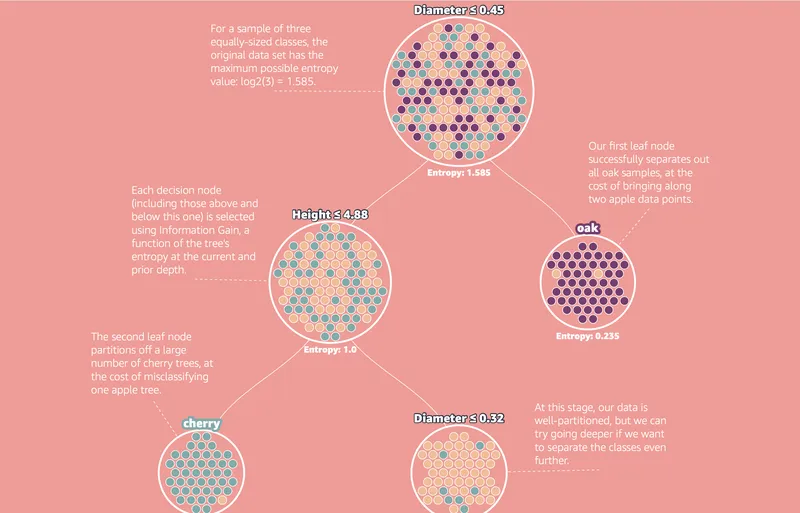
Decision Trees create sequential rules that split data into distinct regions for classification. Entropy is used to measure information and identify regions with significant data separation.
Key Takeaways
- Decision Trees classify data by creating a series of rules that partition the feature space into distinct regions based on conditional criteria.
- Entropy is used in Decision Trees to measure the purity of data samples, with pure samples having zero entropy and impure samples having higher entropy values.
- The ID3 algorithm utilizes entropy to determine the best rules for partitioning data, optimizing for information gain.
- Decision Trees are easy to interpret and fast to train but are unstable and sensitive to small changes in the training data.
Community Sentiment
MixedPositives
- The ability to model complex decision-making with simple decision trees highlights their effectiveness, challenging the notion that more complex methods are always superior.
- Decision trees are celebrated as a powerful classical machine learning algorithm, showcasing their versatility and effectiveness in various applications.
Concerns
- There is a lack of understanding regarding when to effectively compile neural networks into decision trees, indicating a gap in knowledge that could limit their application.
Source
mlu-explain.github.io
Published
March 1, 2026
Reading Time
6 minutes
Relevance Score
68/100
🔥🔥🔥🔥🔥
Why It Matters
This page is optimized for focused reading: quick context up top, a clean summary block, and a direct path to the original source when you want the full story.